Gobekli Tepe: Notes and Figures

March 13, 2012 – 9:36 am

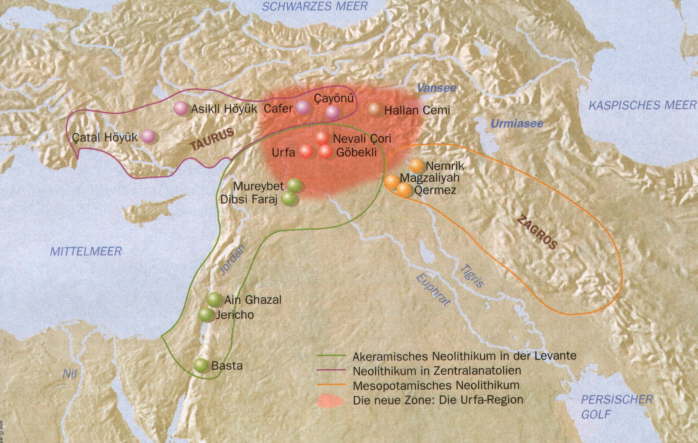
A temple site constructed, used, and reconstructed over a period of ~ 4ky from ~ 12.5 ky BP. Its material culture, location, and date make it part of the Pre-Pottery Neolithic A (PPNA.) The builders and users are assumed to be hunter-gatherers as no residential use structures have been discovered at the site. (The excavations are ongoing and no final evaluations of any sort can be made.) The nature of the temple structure including megaliths suggests that it is the product of a social organization that commands the resources of a larger population than can be assumed for any plausible hunter-gatherer band. The fact of sedentarism amongst hunter-gatherers is well-known from the neighbouring Natufian culture (14.5-11.5ky BP,) but that epipalaeolithic culture did not construct megalithic sites and their residential sites are well-known. A later development of the Gobekli Tepe culture or a closely related culture is found at Nevali Cori (now submerged) which has both residential structures indicating established sedentarism and clear modifications of Gobekli Tepe temple structures and furnitures. (See Hauptmann, H. 1991/1992 ‘Nevali Cori. Eine Siedlung des akeramischen Neolithikums am Mittlerer Euphrat.’ Nurnberger Blatter zur Archaologie 8: 15-33.)

The excavator of the site, K. Schmidt now of the German archaeological Institute theorizes (Schmidt, K. (2000) ‘Zuerst kam der Tempel, dann die Stadt.’ Vorlaufiger Bericht zu den Grabungen am Gobekli Tepe und am Gurcutepe 1995–1999. Istanbuler Mitteilungen 50: 5–41) that agriculture occurred in response to the stress placed on the wild resources by the population that accumulated about this temple. Since the standard theories of agricultural beginnings assume that agriculture preceded population growth which led to increased sedentarism and then urbanism together with surplus that supported ‘non-productive’ hierarchies and social organizations – such as religious institutions and, in particular, temples – this constitutes a revolutionary revision.

The site is located in south-west Anatolia. This map shows the site in relation to neighbouring and contemporary cultures:

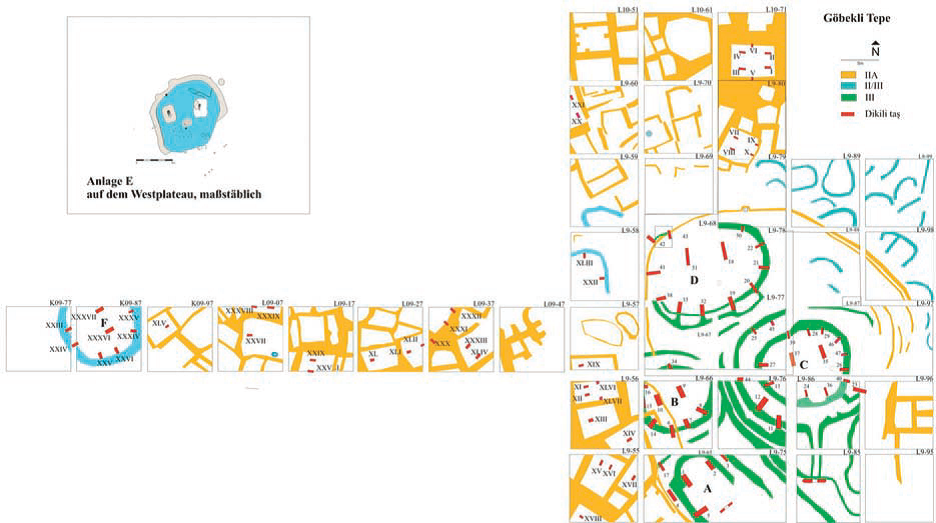
Schematic map of the main excavation area at the southern slope and the western hilltop. (K. Schmidt (2010) ‘Göbekli Tepe—the Stone Age Sanctuaries: New results of ongoing excavations with a special focus on sculptures and high reliefs,’ Documenta Praehistorica XXXVII: 239–256; p. 240:)

Reconstruction of the site

Aerial photograph of Enclosure C (for relative location see site schematic above:)

The most obvious feature of the temple structures are the T-pillars, megaliths standing up to 5.5m high (most are smaller.) Many of them are incorporated into the fabric of the walls (the gaps being filled with undressed stone) but some are free standing. One would suspect that they functioned as roof supports, but there is little evidence of that and being used in that way would make the decoration on the upper surfaces – cup sized row/random pockmarking – a bit pointless. They are described as anthropomorphic largely on the basis of low relief hands and arms. If so they represent a torso and head in profile. The bent posture of the arms is reflected in smaller statuary from the same site and period (for all of this see Klaus 2010 op. cit. supra) which does not however have the misshapen ‘head’ of the T-pillars. Further anthropomorphism is detected in the interpretation of a belt on some figures and perhaps loincloths. Similar structures/statuary are found at Nevali Cori and are equally ambiguous (Hauptmann, H., K. Schmidt (2007) ‘Die Skulpturen des Frühneolithikums’ in Badisches Landesmuseum Karlsruhe, or 12 000 Jahren in Anatolien. Die ältesten Monumente der Menschheit. Begleitband zur großen Landesausstellung Baden-Württemberg im Badischen Landesmuseum Theiss. Stuttgart: 67–82.) As anthropomorphisms these have to be quite unusual; they present only a profile although they are clearly intended to be seen either in the round (freestanding) or frontally (in the walls.) Moreover, I am not aware of any representations at this early period which do not emphasise the frontal aspect.

Schmidt proposes that theT-pillars are representations of ancestors, and looks forward to excavating at the lowest levels and discovering initial grave sites. This would then be the temple of a cult of the dead. But he also assumes shamanic practices. Such speculations are inevitable, but difficult to test. It is in fact my own main interest in this site. The T-pillars are also the locus of a great deal of art, especially the representation of animals and pictograms, which would be the natural place to test such theories. There are said to be certain things that one expects in art inspired by shamanic practices such as identified by Lewis-Williams (see for example Lewis-Williams, D.J. and J. Clottes (1998) The Shamans of prehistory: trance magic and the painted caves, Abrams:New York.) Without going into much detail at this point, I have to say I do not see the similarities here. In fact, the style of art and the arrangement of figures is more reminiscent of later art of the civilized period which is not at all connected with shamanism. However, we shall see.

Update: On this question, I also recommend Peters, J. and K. Schmidt (2004) ‘Animals in the symbolic world of Pre-Pottery Neolithic Gobleki Tepe, south-eastern Turkey: a preliminary assessmentAnthropozoologica 39(1):179-218

Tags:

The Name of Metatron

February 26, 2012 – 8:55 pm

It is said that Enoch ‘walked with God, and then was no more; for God took him’ (Gen. v, 24.) At some stage it became accepted that after his assumption Enoch was transformed into an angel called Metatron. And this angel was also the result of several other amalgamations and separations besides. P. Alexander notes (3 En. in Charlesworth, J. H. The O T Pseudepigrapha, London:Longman, 1983, v. 1, p. 244.) that there are many similarities between the characteristics of the archangel Michael and Metatron, and suggests that the latter was in fact a vox mystica for the former which subsequently became independent of him. Moreover, it may be that ‘Yaho’el’ the name of an independent the archangel at one time, then became attached to Metatron as a vox mystica of that being in turn (3En48D:1(1)).

There is considerable controversy over the origin and significance of the name ‘Metatron’ – which, it should be noted, occurs in two forms: mttrwn and myttrwn (Scholem, G., Major Trends in Jewish Mysticism, New York: Schocken, 1961 [1941], p. 70). Nine significant options are summarized in this extract from A. Orlov, The Enoch-Metatron Tradition (TSAJ, 107) Tuebingen: Mohr-Siebeck, 2005. Of these, I find the following possible derivations of interest.

NULL:

It may well be one of a seemingly inexhaustible supply of nonsense names invented to cover the true names of the celestial beings; it does have some of the form of other uninterpretable names in reduplicated consonants and the ron/on suffix the standard examples here are Adiriron and Dapdapiron.) Still, it seems unlikely that such a significant personage, whose name is not intended as a means of befuddlement, should be given such a title. This is especially the case when a good deal of significance is placed on the name itself, which is said to contain the name of God. (See below.)

MMTR:

There is a standard word mattara, meaning “keeper of the watch,” deriving from the verb MMTR, “to guard, to protect.” In Shimmusha Rabbah, Enoch was clothed with the splendor of light and made into a guardian of all the souls that ascend from earth, so there is a possible connection between that function and Enoch. Consequently, Odeberg (3 Enoch 1.125-6), Jellinek (Beiträge zur Geschichte der Kabbala, Leipzig: C.L. Fritzsche, 1852, 4) and Jastrow (A Dictionary of the Targumim, the Talmud Babli and Yerushalmi, and the Midrashic Literature, 767) propose that this may be the origin of ‘Metatron’.

Metathronios:

This is the ‘default’ derivation. It is accepted by Merkur (Gnosis, NY:SUNY, 1993, p. 169) (with reference to S. Lieberman, “Metatron, the Meaning of His Name and His Functions” in I. Gruenwald, Apocalyptic and Merkavah Mysticism, Leiden:Brill, 1980, pp. 235–241) and is noted by Scholem (MTJM:69). But Scholem’s objections to it are pretty strong: there is no such Greek word – no matter how attractive the meta + thronos (behind/with the throne) construction might seem; there isn’t a good reason for the use or invention of a Greek term here when it is not done elsewhere; there doesn’t seem to be a good way to derive the precise Hebrew form from the supposed Greek term. (Though just on this last point, it’s possible that numerological concerns could have been influential. See ‘metatrior’ below.)

Metatyrannos:

A Greek term meaning ‘with the ruler’. This proposal is often associated with the term synthronos which is ‘together on the throne.’ To be frank, I can’t see any reason for thinking the two terms are related or what one adds in plausibility to the other. It is even more mystifying to be told that there is the possibility of deriving Metatron from synthronos; how is that supposed to work?

Metator:

The name “Metatron,” which, as stated above, occurs only in Hebrew writings, is in itself striking. The derivation from the Latin “metator” (=”guide”) is doubtless correct, for Enoch also is represented as a guide in the apocryphal work which bears his name; and the Hebrew Book of Enoch, in which, however, reference to Me?a?ron is constantly implied, says: “He is the most excellent of all the heavenly host, and the guide [Me?a?ron] to all the treasuries of my [God]” (B. H. ii. 117) (Jewish Enc. s.v. Metatron)

This was first apparently proposed by Eleazar ben Judah (c. 1165 – c. 1230) and Moshe ben Nachman, and revived by H. Odeberg in his edition of 3 Enoch 1.125, 1.126; but Scholem is dismissive of this too since “there is nothing in the authentic sayings about Metatron that justified the derivation of the name from metator.” (G. Scholem, Jewish Gnosticism, p. 43) On the other hand Alexander (op. cit. 243, 228 n 11) notes that metator is known as a loan word in Hebrew and Jewish Aramaic, and claims that this gives added support to the idea that the word could be adapted by the inventors of Metatron. But this is misguided: there is no doubt that it is possible to get to metatron from metator, given enough flexibility in the manner of ‘derivation’, and that the word was there for the having; the question is whether there’s any of the evidence that that is what happened that we would expect to see – and there isn’t.

Metatrior + gematria:

Grunwald (in Jahrb. für Jüdische Gesch. und Literatur, 1901, pp. 127 ff.) has yet another solution for the problem of Metatron. The ancients had already noticed that the numerical value of the letters in the word “Metatron” corresponded with those of the word “Shaddai” (= 314), and “Metatron” is also said to mean “palace” (“metatrion”), and to be connected with the divine name, MQWM (“place”), etc. (Jewish Enc. s.v. Metatron)

Metron + Metator:

A new proposal that Orlov (op. cit.) describes thus:

Still another possible etymological source for the name “Metatron” is the Greek metron, “a measure.” Adolf Jellinek may well be the first scholar to suggest metron as an alternative explanation of Metatron, on the assumption that Metatron was identical with Horos.[20] In his recent article Gedaliahu Stroumsa provides some new convincing reasons for the acceptance of this etymology. These reasons focus on the fact that Metatron not only carried God’s name but also measured the Deity and was thus viewed as God’s Shi’ur Qomah (the measurement of the divine Body). [21] Stroumsa argues that “renewed attention should be given to metron and/or metator (a conflation of the two terms should not be excluded) as a possible etymology of Metatron.” [22]

[20] Odeberg, 3 Enoch, 1.134.
[21] Stroumsa, “Form(s) of God: Some Notes on Metatron and Christ,” 287.
[22] ibid. 287.

I particularly like the idea of a conflation of the terms, but surely this is a derivation that it would be very difficult to justify. One would like to see other examples of such conflations and whether they are as unremarked upon as this one. Otherwise this is an ad hoc solution to a straightforward problem.

Mitra:

The proposal that I’m most partial to is the one that makes Metatron a hidden form of the Zoroastrian Mitra. The possibility was raised by Kohut (Jüdische Angelologie und Dämonologie, pp. 36 et seq., Leipsic, 1866 – ref. in Jewish Enc. s.v. Metatron) on the grounds of some similarities of the functions of the two beings. The editors of the Jew. Enc. (sv. Merkaba) certainly seem to be convinced, and they point out that

Mithra, the heavenly charioteer, with his Quadriga, a chariot drawn by four horses, who was worshiped in ancient Persia as the god of light and regarded in early Roman times as the prime mover of the world, formed of the four elements (Dio Chrysostomus, “Oratio,” xxxvi.; see Cumont, “Die Mysterien des Mithra,” 1903, pp. 87-88; Windischmann, “Zoroastrische Studien,” 1863, pp. 309-312), was invoked under mysterious rites as the mediator between the inaccessible and unknowable Deity, in the ethereal regions of light, and man on earth (Cumont, l.c. pp. 95, 122).

Which would be an interesting enough parallel, but I think there is a little more to this too. It was mentioned above that the name ‘Yaho’el’ became attached to Metatron, and the suspicion on the part of some is that this is due to speculative explanation for the claim by God that the guardian angel of Ex 23:21 ‘has my name in him.’ Clearly if the angels name was to contain the tetragrammaton YHWH or some part of it then the name was not ‘Metatron’. Therefore, Metatron had to be associated with a more standard theophoric name. Thus, in the 2nd C we find then that Enoch was identified with the angel Yaho’el, and that name is also the first of the 70 names of Metatron listed in Gaonic period texts. Yaho’el is also referred to as the “lesser Yaho” by Jewish gnostics, and that term in the form “lesser YHWH” was daringly used by Merkabah mystics to refer to their guardian angel, who sits by (?) the throne of God.

However, if the angel’s name was actually Metatron and these speculations are merely ex post facto, then the mystery is unsolved. The proposal by Dan (The Ancient Jewish Mysticism, 109) that “it appears that the reference here is to the letters tetra, i.e., the number four in Greek, a four-letter word in the middle of the name Metatron” is even less convincing. But if ‘Metatron’ is actually a modification of ‘Mitra’, with the reduplication of consonants which is standard in these names as well as the suffix on/ron mentioned before, then the name is indeed theophoric.

Tags:

The Names and Order of the Seven Heavens

February 23, 2012 – 12:55 am

The theory of Seven Heavens is derived from astrological speculation on the 7 visible regularly moving celestial objects. In the 2nd C BCE the Greeks developed the “Chaldean” order for these objects: Moon, Mercury, Venus, Sun, Mars, Jupiter, and Saturn, which generally replaced the older Babylonian and Egyptian orderings. These objects were assumed to be each in its separate heaven. (D. Merkur, 1993, Gnosis (Albany:SUNY Press) p. 119.) The order and names of the Heavens (and their functions) do not however, seem to reflect this history very well.

In the Jewish tradition, the order and names of the Seven Heavens are given by Rabbi Shimon ben Laqish in Bavli Hagiga 12b (see also Ps. lxviii. 5.) (Refs: Jew. Enc. and R. Graves & R. Patai, 1963, Hebrew Myths, London:Arena, pp. 33ff.)

  1. Wilon [Latin, velum, “curtain”], which is rolled up and down to enable the sun to go in and out; according to Isa. xl. 22, ‘He stretched out the heavens as a curtain’;
  2. Raqi’a [firmament], the place where the sun, moon, and stars are fixed [Gen. i. 17];
  3. She?aqim [clouds/grindstones], in which are the millstones to grind [sha?aq] manna for the righteous (Ps. lxxviii. 23; comp. Midrash Tehillim to Ps. xix. 7
  4. Zebhul [dwelling], the upper Jerusalem, with its Temple, in which Michael offers the sacrifice at the altar [Isa. lxiii. 15; I Kings, viii. 13];
  5. Ma’on [residence], in which dwell the classes of ministering angels who sing by night and are silent by day, for the honor of Israel who serve the Lord in daytime [Deut. xxvi. 15, Ps. xlii. 9];
  6. Makhon [emplacement], in which are the treasuries of snow and hail, the chambers of dew, rain, and mist behind doors of fire [1 Kings, vii. 30; Deut. xxviii. 12];
  7. ‘Arabhoth [plains], where justice and righteousness, the treasures of life and of blessing, the souls of the righteous and the dew of resurrection are to be found. There are the ofanim, the seraphim, and the ?ayyot of holiness, the ministering angels and the throne of glory; and over them is enthroned the great King.

But the functions and contents of these heavens are very different even in different Jewish traditions. See, for example, 2 Enoch 3-9. In any case, it doesn’t seem very obvious how the planetary/cosmological origins are related to the developed functions of these heavens; in fact, the locating of the Sun and Moon in the same sphere (and the stars there too) indicate that the astrological origins were overwhelmed by later elaboration and semantic accretions. The example of 2 Enoch just mentioned suggests that amongst those accretions are the identifications of heavens with stages of ascension and the identification of those stages with degrees on the mystic path of enlightenment.

Update 24/02/20012

To this I can now add the following remarks from Adela Yarbro Collins (1995) ‘The Seven Heavens in Jewish and Christian Apocalypses’ in J.J.Collins & M.Fishbane, Death, Ecstasy, and Other Worldly Journeys, Albany:SUNY Press, p. 86

There is no clear indication that in the early Jewish and Christian apocalyptic writings that there is any connection between the seven heavens and the seven planets. Such a connection first becomes visible in Hermetic texts, Mithraic monuments, and Celsus’s discussion of Mithraic mysteries. The connection is clearly made under the influence of Greek astrology. The motif of seven heavens was probably borrowed from Babylonian tradition by Jewish apocalyptic writers. The reasons for adapting this motif probably included the magical properties of the number. The tradition of the Sabbath and the motif of the seven archangels may also have reinforced the choice of this motif.

So the received wisdom of the origin of the seven heavens is an error, presumably due to the history of scholarly studies in this area being founded instudies of the religions most important and accessible to early European scholars, and there is no mystery about the failure of some descriptions of the heavens to acknowledge their planetary relations. Oh well.

End Update

In the Shii’te Islamic tradition the names of the seven heavens are given in a hadith of Imam Ali (al-Burhan fi-Tafsir al-Qur’an. V. 5. pp. 415.)

  1. Rafi, the lowest heaven
  2. Qaydum
  3. Marum
  4. Arfalun
  5. Hay’oun
  6. Arous
  7. Ajma’

And are these heavens identical to the ‘worlds’ described in the entry on Tazkiyat an-Nafs? I have no idea, but again, they don’t look obviously astrological.

Tags:

Is Confucianism a Religion?

February 20, 2012 – 8:34 am

Peter Berger in The American Interest (February 15, 2012) asks: ‘Is Confucianism a Religion?’ It’s an old question and Berger himself goes through some of the issues involved – though he does not much consider the many ways that ‘Confucianism’ (ru jia) changed over time, some of which seemed to be much more ‘religious’ than others. His focus is on what we in the West would consider ‘classic’ Confucianism as we interpret it as having existed in the pre-Qin era (Spring-and-Autumn & Warring States). Nor does he properly define what he means by a religion, seeming to take it for granted that any supernatural element is ipso facto a religious element. I regard that as hardly satisfactory, since it would make Neo-Platonism – or even Platonism – a religious movement rather than a philosophical one; and I think that’s certainly debatable.

In any case, having made the obvious (and obviously true) points that Confucianism appears in large part to be a secular system:


Its teachings are almost exclusively concerned with behavior in the empirical world: ren “altruism or “human-mindedness”; li —ritual and etiquette; xiao —“filial piety”. These are moral principles that are applied to the so-called “five bonds”  —between ruler and subject, father and son, husband and wife; older and younger brother; friend and friend.

And that:


It is quite clear that these virtues (including the behaviors they promoted, as in ritual and etiquette) could be divorced from any specific religious beliefs.

And yet he concludes that it is a religion on the basis that


there is one classical and rather central Confucian belief that, I think, is unambiguously religious—that of tian, usually translated as “heaven”. It is not theistic, although gods are associated with it. Rather, it is a cosmic order, supernatural in that it transcends the empirical world, over which it presides and with which it interacts. It thus serves as the necessary, ipso facto religious foundation for all the secular virtues propagated by Confucian teachings.

And since the moral order that Confucianism promotes is justified by appeal to this supernatural entity tian, it follows that the ideology itself is a religious system.

It is certainly true that tian (?) plays a justificatory role in Confucianism, but only incidentally, and far from essentially. In fact, as far as I can tell, the concept is used almost always metaphorically in early Confucian texts. Thus it may be said that a ruler was entitled to rule only so long as he possessed the ‘mandate of Heaven’ (??, tianmìng), and this was a fairly standard opinion of the time, but the Confucianists do not depend on Heaven to make things turn out the way they ought: they seem always to have other justifications than appealing to the will of Heaven. In the case of the mandate of Heaven, for example, the Mencian version of Confucianism explained that a king could be a king only so long as he behaved as a king. If he failed to behave as a king – i.e. failed to follow the rules and rites and to have the appropriate ren as indicated by the sages of old – then he could not be called a king. The ‘rectification of names’ would name him as the criminal that he was, which would allow his oppressed subjects – who are accordingly not his subjects to rid themselves of this burden. Thus King Hsuan of Ch’i asked of Mencius (1B8):

“Is it permissible for a vassal to murder his lord?”


Mencius replied, “One who robs rén you call a ‘robber;’ one who wrecks yì you call a ‘wrecker;’ and one who robs and wrecks you call an ‘outlaw.’ I have heard that [Wu] punished the outlaw Zhou – I have not heard that he murdered his lord.

 But even if tian was, in fact, required to make the moral system of Confucianism work, that would not make Confucianism a religious system. To grasp this point we simply need to compare this with John Locke’s theory of rights and political legitimacy. Locke derives our claim to rights from his conception of Natural Law, which is really identical to Aquinas’s idea of Natural Law: it is a prescription of the way we ought to act, which reflects God’s authority over us, and is something that we can discover for ourselves just because we are human and rational. In these respects then, Locke’s rights’ are much more essentially tied to God than Confucius’s virtues are attached to tian, and nobody thinks to call Locke’s philosophy a religion.

Tags:

Accidental Features of Apocalypse

February 14, 2012 – 12:12 am

Lists of early apocalyptic writings may be found in DS Russell (1964) Method and Message of Jewish Apocalyptic, London: SCM, pp 37f; C Rowland (1982) The Open Heaven, London: SPCK, p 15. Examples of the genre may be found in J. Charlesworth (ed.) (1983) OTP:1, 2. Of the works typically listed, the Ascension is essentially involved (ie. more than just being noted as the method of revelation) only in:

1, 2, 3 Enoch; 3 Baruch, Testaments of the XII Patriarchs (Levi); Ascension of Isaiah; Apocalypse of Abraham; Testament of Abraham.

There are a number of recurrent features of these texts, apart from those which have been identified as the essential elements of the Ascension plotline.

  1. There is uncertainty about whether the ascent is physical or spiritual.[1]
  2. The heavens are entered by gates or doorways.
  3. There is water in the 1st heaven (sea, snow, clouds, dew).[2]
  4. Rebellious angels are constrained in 2nd heaven.[3]
  5. The protagonist finds ‘paradise’ (in the 3rd heaven.)[4]
  6. There is a great light in the 7th heaven.[5]
  7. Angels are opposed to the ascent of the protagonist.[6]
  8. There are visions of (flaming) thrones, and God sits on one.[7]
  9. The protagonist is transformed (before the theophany)[8]

[1] Cf. dispute over nature of Mohammed’s mi’raj, Paul’s uncertainty in 2 Corinthians, xii, 2-4, etc.

[2] Testament of Levi (from XII Patriarchs), 2 Enoch.

[3] Testament of Levi (from XII Patriarchs), 2 Enoch.

[4] 2 Enoch; Ap. Moses; 2 Corinthians, xii, 2-4.

[5] Ap. Abr., Asc. Isa..

[6] Cf. also Mi’raj of Abu Yazid al-Bistami (in MA Sells (ed.) (1996) Early Islamic Mysticism, NY: Paulist, 242-250.)

[7] This genre is related to merkabah speculation.

[8] Asc. Isa. 7:24-27, 2 Enoch 20-22.

Tags:

The Necessary Elements of the Ascension Story

February 13, 2012 – 7:12 pm

We can discover the necessary elements of the Ascension story.

  1. By comparison of the various particular texts in which the Ascension plotline occurs.

    1. Take the following to be the primary documents[1]:

      1. Dante, Commedia Divina: Paradiso;
      2. Ibn Ishaq, Sirat rasul Allah; (ibn al-‘Arabi[2], Kitab al-Isra‘; Miraj Nameh)
      3. Ezekiel, 1-11[3], 40 -48;
      4. R. Ishmael, The Apocalypse of Enoch[4];
      5. Anon. ‘The Legend of Etana and the Eagle.’[5]

    2. These supply the following primary plotline elements:

      1. Two principal characters
        1. The prophet
        2. The guide

      2. The guide meets the prophet in an isolated place
      3. The guide and the prophet ascend through heaven (by winged animal, chariot, or ladder)
      4. Heaven is envisaged as arranged in several levels
      5. As each level of heaven is closer to the Godhead than the last, each level represents a ‘higher’ state than the last.
      6. The souls of the dead are encountered.
      7. The prophet interacts with the inhabitants of each level and learns from them what is required to be of that level.
      8. The guide does not progress to the final level.
      9. At the final level the prophet encounters the Ultimate and comes to know the Truth of things.
      10. The prophet returns to the world

  2. By analysis of the ur-form of the Ascension plotline if that can be established.

    1. Shamanic ecstasy.[6]

      1. Shaman goes into a state approximating death (illness, sleep, coma, etc.)
      2. Encounters supernatural creatures
      3. Is teamed with a spirit-guide
      4. Shaman and guide ascend to heaven (he flies, climbs a pole or a tree, …)
      5. They enter heaven, which may be arranged in levels
      6. They tour heaven, possibly by moving through levels
      7. During the Tour (and possibly corresponding to heavenly levels):

        1. The souls of the dead are encountered
        2. The shaman learns important things from the inhabitants of heaven
        3. He faces dangers and initiations

      8. He returns to life

    2. The reported phenomena of mystical enlightenment.[7]

      1. Subject prepares for the meditative state – possibly through ascetic practices or techniques of mind-concentration.
      2. Enters meditative state – an altered state of consciousness.
      3. The states of consciousness are arranged hierarchically
      4. The subject progresses through each state of consciousness by effort resulting in further enlightenment
      5. The final state is one of mystical Union and complete enlightenment
      6. The subject recovers normal consciousness.


       [1] These form a pseudo-stemma of the Ascension plotline in a single broad cultural tradition. That is the Western Asian tradition. That is one of the traditions which lie at the root of the Modern Western European literary culture; therefore they are appropriate guides to a literary work that is a part of that culture. There are, of course, a vast number of secondary documents, which lack the cultural prominence of the primary documents, but which are not for that reason less reliable indicators of the fundamental plotline.

      [2] Dante’s direct debt to al Shaykh al Akhbar is argued for in M. Asin Palacios (1925) (tr. Sunderland) Islam and the Divine Comedy, New Delhi: Goodword.

      [3] Ma‘aseh Merkabah – ‘The Story of the Chariot’ (Mishnah Hagigah 2:1, ref. in Merkur, D. (1993) Gnosis: An Esoteric Tradition of Mystical Visions and Unions, Albany: SUNY, p. 155.)

      [4] Sefer Hekhalot – ‘The book of the Palace’. Source: P. Alexander (tr., ed.) in Charlesworth, J. H. (1983) The Old Testament Pseudepigrapha: Vol. 1, Apocalyptic Literature and Testaments, London: Darton, Longman & Todd. See also the other Enoch stories (1 & 2). (cf. also the tale of Enmeduranki [‘Prince of the me of the bond of Heaven and Earth’] who is often associated with Enoch.)

      [5] ANET p. 118. Assuming it is a related tale, it is by far the most primitive version. (Unfortunately we seem to lack evidence of a chain of transmission from it to the monotheist versions, unless the stories of Nimrod and Alexander (pseudo-Callisthenes) can play that role.)

      [6] The Ascension plotline is derived from the experiences of shamans in the older religion. Eliade, M. (1964) Shamanism: Archaic Techniques of Ecstasy, Harmondsworth: Arkana.

      Note that many proposed templates combine the two related but narratively separable traditions of ascent and descent. The consensus of our culture is that the tour of heaven and the harrowing of hell are best kept separated. I also choose to consider the theme of organ removal and replacement as separable from the ascension theme: it seems to be specifically initiatory.

      [7] Many sources are available. Chiefly refer to the studies of mystical experiences in the following traditions: Buddhist (Buddhaghosa, Vasubandhu); Jewish (Merkabah, Hekhalot); Islamic (Sufi); Christian.

      The shamanic experience is essentially the ancestor of the supposedly more sophisticated mystical experience. The apparent difference between the two arises from the conceptual background within which the psychological experience is interpreted. The relationship is complex: the shamanic experience gives rise to mythological expression, which affects the way that future experiences are conceptualised. Through mythology, too, the shamanic ecstatic experience becomes a cultural and therefore a psychological form, so that relevantly similar mystical experiences become assimilated to it. These experiences also give rise to further elaborations of literary expression, which in turn affect the way that mystical experiences can be felt.

Tags:

A Puzzle about Spirit Opposition in Later Ascension Plotlines

February 12, 2012 – 11:53 pm

In the ascension stories of the developed religions we very often find that the progress of the protagonist and his guide is impeded at each heaven by spirits determined to test his worthiness. For example, in Bistami’s mi’raj at the First Heaven:

[H]e continued to show me dominion that would wear out the tongue to describe and depict. I knew that he was testing me with it in that. I was saying: My goal is other than what you are showing me.

And by rejecting this temptation and passing the test he is allowed to pass on. Similar tests occur at each succeeding Heaven. (Al-Qasd ila Allah ch. 9. Extract in M. Sells (ed.) (1996) Early Islamic Mysticism, NY: Paulist Press) pp. 242 ff.)

In the Third (Hebrew) Book of Enoch (6:2) the challenges that Metatron recollects in his narrative to Rabbi Ishmael are more pointed still:

As soon as I reached the heavenly heights, the holy creatures, the ophanim, the seraphim, the cherubim, the wheels of the chariot and the ministers of consuming fire, smelled my odor 365,000 myriads of parasangs off; they said, “What is this smell of one born of a woman? Why does a white drop ascend on high and serve among those who cleave the flames?”

But he manages to make the passage here and elsewhere. (J. Charlesworth (ed.) (1983) The Old Testament Pseudepigrapha: Apocalyptic Literature and Testaments (London: Longmans) pp. 223 ff. (tr. P. Alexander))

Finally, let us note Dante’s rather gentler approach to this in his Paradiso, where the quality that is required for advancement is made plain to Dante by the mediation of Beatrice and in response to questions that he poses to the celestial population when their presence at that point challenges his beliefs or assumptions.

My problem with this is that, assuming that the ascension plotline is an adaptation of the shamanistic visionary trance – which seems to be widely accepted – where is the model for this spiritual opposition? It is standard that in the ascent the souls of the dead are encountered and the shaman learns important things from the inhabitants of Heaven, and he faces danger; but does the danger come in the form of opposition from the Heavenly inhabitants? I have not had time to read the entirety of the reports in Eliades’s Shamanism, but they do generally seem to lack a root for that theme. To pick one at random, here is part of the report of a Dolgan shamanic séance from U. Harva, (1935) Die religioesen Vorstellungen der altaische Voelker, Helsinki, p. 549 (Eliade, p. 233:)

For the Dolgan shamans likewise scale the nine heavens in performing a cure. According to them, before each new heaven there are guardians whose office is to watch over the shaman’s journey and at the same time to prevent the evil spirits from mounting.

So, my question is whether this nearly standard addition to the shamanic version of the ascension plotline is no more than a narrative device that has found favour. Or if it is more than that, what is its source. Is it perhaps a reflection of the difficulty of non-shamanic mystics in achieving the kind of naïve ecstasy that overcomes the barriers between this world and the various heavens?

Tags:

Ethical Consequences of the Gnostic Union

February 5, 2012 – 3:30 pm

There’s always the assumption that mystical gnosis will result in an elevated ethical state on the part of the gnostic. Given that there’s plenty of controversy over the ethical stance of someone who is concerned above all with their own salvation, I find this lazy acceptance a little puzzling. It’s easy enough, in fact, to see just how the unitive life can run the risk of moral detachment from humankind. Since at the moment I’m reading R. A. Nicholson 1914/1963) The Mystics of Islam, we can extract a few typical statements of the Sufi and see what they add up to.

First, here’s a passage from p. 109 recounting a story from the life of Fudayl ibn ‘Iyad

One day he had in his lap a child four years old, and chanced to give it a kiss, as is the way of fathers. The child said, ‘Father, do you love me?’ ‘Yes,’ said Fudayl. ‘Do you love God?’ ‘Yes.’ ‘How many hearts have you?’ ‘One.’ ‘Then,’ asked the child, ‘how can you love two with one heart?’ Fudayl perceived that the child’s words were a divine admonition. In his zeal for God he began to beat his head and repented of his love for the child, and gave his heart wholly to God.

This is introduced by the remark that “It would be touching if it were not so edifying.” I find it neither, but rather chilling. We then learn, amongst many claims that we should approach all in the spirit of ‘love’ and ‘charity,’ this corroborating quote from Jami:

Even from earthly love thy face avert not,
Since to the Real it may serve to raise thee.
Ere A, B, C are rightly apprehended,
How canst thou con the pages of thy Koran?
A sage (so heard I), unto whom a student
Came craving counsel on the course before him,
Said, ‘If thy steps be strangers to love’s pathways,
Depart, learn love, and then return before me!
For, shouldst thou fear to drink wine from Form’s flagon,
Thou canst not drain the draught of the Ideal.
But yet beware! Be not by Form belated:
Strive rather with all speed the bridge to traverse.
If to the bourne thou fain wouldst bear thy baggage,
Upon the bridge let not thy footsteps linger.’

But the only interpretation of this can be that love is to be valued not as respecting the worth of the thing being loved, but only as a path to the only real object of the Sufi’s esteem, which is God. This makes it a consequentialist approach only – but one which requires that you pretend to be unaware of the consequentialist justification for the love that you are determined to feel.

Nicholson then remarks, with words that must be true for anyone committed to the extreme unity thesis that the Sufis defended (or, rather, that they mouthed adherence to,) that

Inevitably such a man will love his fellow-men. Whatever cruelty they inflict upon him, he will perceive only the chastening hand of God, “whose bitters are very sweets to the soul.”

And the consequence of this would have to be that any evils that the Sufi does to another ought equally to be seen by that other as “the chastening hand of God,” and this will be especially the case when the Sufi presumes to have achieved the sought-after Union with God, and to be able to declare with al-Hallaj that “I am the Truth.” The man who takes these moral consequences seriously would be a monster of egotism, not a saint.

Tags:

Remnants of the Great Bear Cult in Punxsutawney

February 4, 2012 – 10:51 pm

I’ve just read a brief article about Punxsutawney Phil by Stephanie Pappas at the LiveScience site. She mentions that:

relying on rodents as forecasters may date back to the early days of Christianity in Europe, when clear skies on Candlemas Day (Feb. 2) were said to herald cold weather ahead. In Germany, the tradition morphed into a myth that if the sun came out on Candlemas, a hedgehog would cast its shadow, predicting snow all the way into May. When German immigrants settled in Pennsylvania, they transferred the tradition onto local fauna, replacing hedgehogs with groundhogs.

Actually, I have heard that the tradition goes back considerably further than indicated there. Rhys Carpenter in his (1958) book on ‘Folk Tale, Fiction and Saga in the Homeric Epics’ (pp. 152-5) traces the custom to the ancient Bear cult of Europe, via the myth of Salmoxis, which read great significance into the resurrection of that hibernating animal from his long Winter sleep. All trace of the human sacrifice that was originally involved has happily disappeared, and the shamanic pretensions of travel to the underworld with the bear spirit have gone with it, but some small remnants of the cult remain.

In Silesia, Hungary, and Carinthia the feast of Candlemas [Feb. 2 – six weeks from the Winter solstice] is still bear’s-day in popular observance; and on that precise day (it is maintained) the hibernating bear emerges to see whether or not he casts a shadow: if he sees his shadow he must retire again for six more weeks of winter.

[I]f we will think back all the way to the Arcadian bear cult on Mount Lykaion and remember that in that hallowed precinct the bear lost his shadow, because the shadow is the soul and the living being which descends into the underworld of death must leave its soul down there … we shall understand that the bear emerging from his deathlike winter sleep, having lain as one dead, must have left his shadow behind him. If he has not done so, if an accusing shadow moves besides him in the wan springtime sunlight, he has not truly been among the dead and he must go back and properly sleep his winter sleep of the full six weeks before he can finally emerge again to announce the rebirth of the world and the imminence of the springtide.

The adherents of the bear cult transferred their attention to other animals when bears became scarce. In Germany the humble badger took the honours, and when Germans moved to America they gave the part to the friendly little Groundhog – who inspires no awe or terror of the otherworld.

Tags:

Does Mars have Value?

February 4, 2012 – 7:17 pm


“Assuming that terraforming Mars would work, would doing so violate a moral obligation to leave Mars and other worlds alone?” The question is asked by Bailey (“Does Mars Have Rights” Reason, Feb. 2012) The question of moral rights for rocks can be addressed by reference to any appropriate ethical theory, but one version of this – which I recall hearing at a seminar once, and I’ve read repeatedly, is that (unspoiled) Mars has an intrinsic value that should weigh in our moral calculations when considering terraforming. It’s the sort of claim that is often made for the preservation of more mundane wilderness areas which are supposed to have some intrinsic value that trumps the value that their development would have. The proponents of such views rarely explain what kind of thing value is, how these objects get their value, whether these values are in fact morally weighty, or how weighty they are. It’s an open question in value theory whether all values are commensurable, whether they are all independent, and so on. Until these questions are answered we can’t even tell whether accepting the claim of intrinsic value for Mars would have the claimed consequences for action wrt Mars; I think, however, that the common sense view of values indicates that it would not.

Consider the most basic statements regarding values (easiest to understand, most likely to be accepted by competent language users, etc. ) It’s easy enough to grasp what is meant when we say that we value something, or that something has value for us. If I say that I value a beautiful object – say, Botticelli’s Venus – then I mean that I prefer that object to other comparable objects, say the painting of dogs playing poker or the green lady behind a tree. ‘Preference’ can be defined operationally in whatever way seems reasonable. In general, to say that something, X, has a value for some agent, A, is to say that there is a quality or property of X that features in A’s preference assignments in a certain way. If X has an appropriate property or quality, say Q, then X will be given a positive value by A; meaning that, other things being equal, A will prefer X with Q to something without Q. To say this is not to say that the quality or property possessed by X is a value, it is rather to say that there is a particular way A has of assigning preferences that references those properties and qualities rather than others. In the example given, our valuation might be affected by the colour balance of the painting, but ‘colour balance’ doesn’t have to be a value, it only has to be valued or to contribute to a valuation in certain circumstances. (Nevertheless, the common way of speaking often will make these properties and qualities ‘values.’)

In other circumstances we can also say that something, X, has a value, tout court. But this lacks the relativisation to any valuer and thus is divorced from the process of preference assignment that is fundamental to the explanation of something having value for an agent.  We can restore the relativisation if we take such a statement to mean that for any A that we take to be a relevant agent, X has a value for A. So I can say that the beautiful object – say, Botticelli’s Venus – has (positive) aesthetic value: but by this I mean that this painting is valuable for everyone whom I regard as being a relevant valuer of the painting. (It might be that I would exclude philistines or imbeciles or other categories of presumptively ‘defective’ valuer; or I might take the attitude that my class of relevant agents is restricted to a small list of those who know. Those are details that needn’t detain us.)

Understanding ‘X has value’ in that way has at least two other advantages: first, it is plausibly the natural way that we would come to express the idea that something has a value for any relevant A; and second, any alternative would seem to involve connecting two different meanings under the single verb ‘value.’ At the very least, the onus would be on those rejecting the proposed interpretation to show the advantages of their alternative.  

Assuming that this is the right way to think of valuing things, or of things having value, it is equally reasonable to suppose that there are different kinds of value. Nothing in the nature of preference requires that there is only one source of preference rankings, however much the prudentialists and moralists and rational actors might wish it to be otherwise. We value things for their beauty, or for their sentimental value, or for their utility, or for their contribution to the advance of projects that we love, or for any of a vast number of other reasons – and there is nothing, prima facie, to indicate that they are all versions of the same value. Now some of these ‘valued’ qualities are pretty straightforward, and the way that they feature is no great mystery – for example, things which contribute to my own well-being are going to have value insofar as I have a preference for pursuing my own self-interest. Other things, like beauty, are a little more puzzling. But the source of the value – the reason why and the manner in which it features in those preference assignments – doesn’t affect the fact of the thing having value.

Thus, on our story, there are as many values – aesthetic values, moral values, social values, alethic value, etc.  – as there are different ways of assigning preferences to things in the world, and that these different ways reference different sets of properties and qualities. In fact, more than just arguing that this should be the default position, I would argue that if we take preference assignment to be anything but a purely rational function, then we make it a part of our sentimental nature, and thus a part of nature subject to contingent evolutionary, cultural, historical, and biological forces, and therefore almost certainly pluralistic in nature.

In any case, the naïve story of value, the story which is the interpretation of least resistance, indicates that unless a thing, like Mars, has a moral value – yet to be established – it cannot be claimed that there are moral claims inherent in the thing itself; and it cannot be said that just because one valuer finds value in a thing that all must find the same value; and it can’t be claimed that just because it is accepted that a thing has value, that that necessarily has moral consequences. (In all of this I’m ignoring the question of respect for the things that others value for whatever reason.)

Tags: