Gobekli Tepe: Notes and Figures
March 13, 2012 – 9:36 amA temple site constructed, used, and reconstructed over a period of ~ 4ky from ~ 12.5 ky BP. Its material culture, location, and date make it part of the Pre-Pottery Neolithic A (PPNA.) The builders and users are assumed to be hunter-gatherers as no residential use structures have been discovered at the site. (The excavations are ongoing and no final evaluations of any sort can be made.) The nature of the temple structure including megaliths suggests that it is the product of a social organization that commands the resources of a larger population than can be assumed for any plausible hunter-gatherer band. The fact of sedentarism amongst hunter-gatherers is well-known from the neighbouring Natufian culture (14.5-11.5ky BP,) but that epipalaeolithic culture did not construct megalithic sites and their residential sites are well-known. A later development of the Gobekli Tepe culture or a closely related culture is found at Nevali Cori (now submerged) which has both residential structures indicating established sedentarism and clear modifications of Gobekli Tepe temple structures and furnitures. (See Hauptmann, H. 1991/1992 ‘Nevali Cori. Eine Siedlung des akeramischen Neolithikums am Mittlerer Euphrat.’ Nurnberger Blatter zur Archaologie 8: 15-33.)
The excavator of the site, K. Schmidt now of the German archaeological Institute theorizes (Schmidt, K. (2000) ‘Zuerst kam der Tempel, dann die Stadt.’ Vorlaufiger Bericht zu den Grabungen am Gobekli Tepe und am Gurcutepe 1995–1999. Istanbuler Mitteilungen 50: 5–41) that agriculture occurred in response to the stress placed on the wild resources by the population that accumulated about this temple. Since the standard theories of agricultural beginnings assume that agriculture preceded population growth which led to increased sedentarism and then urbanism together with surplus that supported ‘non-productive’ hierarchies and social organizations – such as religious institutions and, in particular, temples – this constitutes a revolutionary revision.
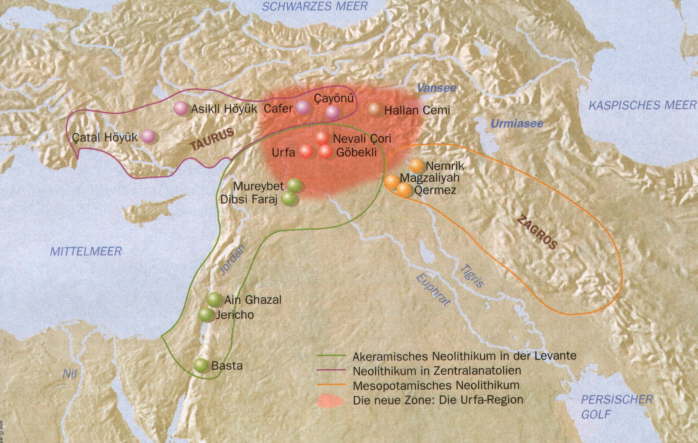
The site is located in south-west Anatolia. This map shows the site in relation to neighbouring and contemporary cultures:
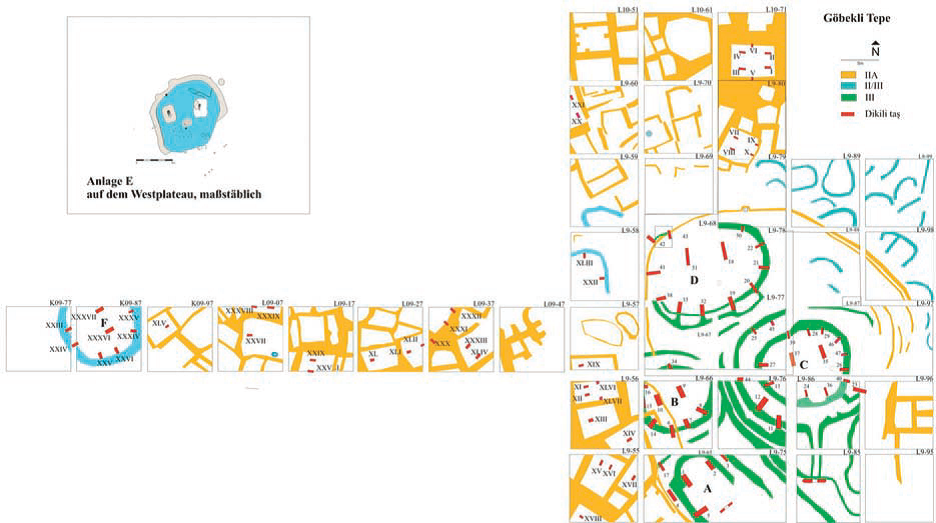
Schematic map of the main excavation area at the southern slope and the western hilltop. (K. Schmidt (2010) ‘Göbekli Tepe—the Stone Age Sanctuaries: New results of ongoing excavations with a special focus on sculptures and high reliefs,’ Documenta Praehistorica XXXVII: 239–256; p. 240:)
Reconstruction of the site

Aerial photograph of Enclosure C (for relative location see site schematic above:)
The most obvious feature of the temple structures are the T-pillars, megaliths standing up to 5.5m high (most are smaller.) Many of them are incorporated into the fabric of the walls (the gaps being filled with undressed stone) but some are free standing. One would suspect that they functioned as roof supports, but there is little evidence of that and being used in that way would make the decoration on the upper surfaces – cup sized row/random pockmarking – a bit pointless. They are described as anthropomorphic largely on the basis of low relief hands and arms. If so they represent a torso and head in profile. The bent posture of the arms is reflected in smaller statuary from the same site and period (for all of this see Klaus 2010 op. cit. supra) which does not however have the misshapen ‘head’ of the T-pillars. Further anthropomorphism is detected in the interpretation of a belt on some figures and perhaps loincloths. Similar structures/statuary are found at Nevali Cori and are equally ambiguous (Hauptmann, H., K. Schmidt (2007) ‘Die Skulpturen des Frühneolithikums’ in Badisches Landesmuseum Karlsruhe, or 12 000 Jahren in Anatolien. Die ältesten Monumente der Menschheit. Begleitband zur großen Landesausstellung Baden-Württemberg im Badischen Landesmuseum Theiss. Stuttgart: 67–82.) As anthropomorphisms these have to be quite unusual; they present only a profile although they are clearly intended to be seen either in the round (freestanding) or frontally (in the walls.) Moreover, I am not aware of any representations at this early period which do not emphasise the frontal aspect.

Schmidt proposes that theT-pillars are representations of ancestors, and looks forward to excavating at the lowest levels and discovering initial grave sites. This would then be the temple of a cult of the dead. But he also assumes shamanic practices. Such speculations are inevitable, but difficult to test. It is in fact my own main interest in this site. The T-pillars are also the locus of a great deal of art, especially the representation of animals and pictograms, which would be the natural place to test such theories. There are said to be certain things that one expects in art inspired by shamanic practices such as identified by Lewis-Williams (see for example Lewis-Williams, D.J. and J. Clottes (1998) The Shamans of prehistory: trance magic and the painted caves, Abrams:New York.) Without going into much detail at this point, I have to say I do not see the similarities here. In fact, the style of art and the arrangement of figures is more reminiscent of later art of the civilized period which is not at all connected with shamanism. However, we shall see.

Update: On this question, I also recommend Peters, J. and K. Schmidt (2004) ‘Animals in the symbolic world of Pre-Pottery Neolithic Gobleki Tepe, south-eastern Turkey: a preliminary assessment‘ Anthropozoologica 39(1):179-218
Tags: Neolithic