The Nephilim
July 3, 2026 – 12:07 pmGenesis 6:4 in the KJV says
There were giants in the earth in those days, and also after that, when the sons of God came in unto the daughters of men, and they bare children to them, the same became mighty men which were of old, men of renown.
Here ‘giants’ translates the Hebrew nephilim. The same choice was made by early Latin and Greek translators, who used gigantes/γίγαντες at that place. The choice requires explanation, because the word nephilim doesn’t mean ‘giant,’ but seems rather to derive from the root naphal and to mean something like ‘the fallen ones.’ That term has given rise to a lot of speculation in later interpretations and expansions of the meagre and ambiguous source material to the effect that the nephilim were fallen angels, and that they were the sons of God who came down to Earth to lie with the daughters of men and that their children were the men of renown.
None of that speculation and invention is justified. Terms derived from naphal are used elsewhere in the OT to describe those who have fallen in battle – as, for example, in 2 Samuel 1:19 that talks of “how the warriors have fallen” – and it is nowhere used to talk of those who have come down from Heaven. The natural interpretation is therefore that the nephilim are those qui ante illos fuerunt. They were those who were the mighty men of old, men of renown; and they were the offspring of the sons of God and daughters of men, and they have passed away and are no more.
This interpretation is reinforced by the fact that the nephilim are mentioned also at Numbers 13:32-3
And they brought up an evil report of the land which they had searched unto the children of Israel, saying, The land, through which we have gone to search it, is a land that eateth up the inhabitants thereof; and all the people that we saw in it are men of a great stature.
And there we saw the giants, the sons of Anak, which come of the giants: and we were in our own sight as grasshoppers, and so were we in their sight.
Here too the word ‘giants’ translates nephilim, and here we can see one reason why the translators chose the word ‘giants’ to translate it – since there were no people otherwise known by the demonym Nephilim and the nephilim are here explicitly said to be characterized by gigantic stature. In this case, however, the nephilim are not the children of the sons of God and the daughters of men, but the sons of Anak. Nor are they, of course, fallen angels. Nor, again, are they apparently the men of renown of the past, but a tribe of people actually present at that time. They seem, in fact, to be quite unrelated to the nephilim of Gen 6:4, and we get no particular help in this regard from their new family: the Anakim were said to be a Rephaite tribe (Deuteronomy 2:11) that lived in the land before they were expelled by Joshua (Joshua 11:22,) and like all of the Rephaites, were known for their great size, but apart from this we have little else to identify them.[4]
The nephilim may be mentioned once more in Ezekiel, particularly 32:27, though this is not certainly talking about the same people. There it is said that
… they do not lie with the fallen warriors of long ago who went down to Sheol with their weapons of war, whose swords were laid under their heads, and whose shields are upon their bones; for the terror of the warriors was in the land of the living.
This would seem to identify the nephilim again with warriors of days gone by, but there is no hint here that they are of any special lineage or stature. They are remarkable only by comparisons with the hordes of the uncircumcised who lie in shame in Sheol, for they do not appear to share in their shame.
The significance of this passage is principally that the translators of the Classical period may have taken it into account when determining a proper translation for the term nephilim. That term, they would have seen, names a people with some divine ancestry or a semi-divine status, a notably great stature, and a place in the underworld a little elevated above the common ruck of the enemies of God. In the context of late Hellenic culture in which the translators worked, this would naturally suggest an association with the Earth-born Giants of Classical mythology, who were then often conflated with the Titans, a predecessor race of gods banished by the Olympians to Tartarus[1].
The question remains, however, why the fallen of Gen 6:4 should be associated with great stature in the first place. A fairly obvious theory[2] is that the fallen, or the ones who went before in the land of Canaan, were supposed to be those who were responsible for the impressive cyclopean masonry of the abandoned fortresses that the Israelites found in the Land to which they had come. It’s a reaction that we’ve seen in other places. The term cyclopean itself refers to the supposed builders of Mycenaean walls that the Classical Greeks could not believe were man-made,[3] and in the famous Anglo-Saxon poem The Ruin the poet huddled in the wreck of Rome speculates that those walls were the work of giants ‘whom Wierd took.’
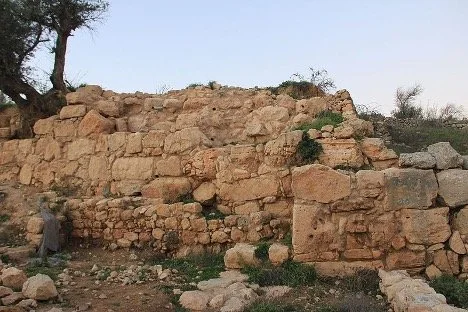
The Middle Bronze Age walls of Tell er-Rumede/Tel Hevron, Hebron, home of the Anakim.
The use of the term nephilim in Numbers could then be explained by assuming that the term had become associated with giants living in the land quite independently of whether they were the prior inhabitants, and the author of Numbers had no intention of associating the two concepts.
[1] See W Smith (ed.) A Dictionary of Greek and Roman biography and mythology, s.v. ‘Gigantes’
[2] GE Wright (1938) ‘Troglodytes and giants in Palestine’ Journal of Biblical Literature. 57 (3): 305–309
[3] Pliny, Hist. Nat.vii.57.195
[4] In ‘Hebrew Myths’ p. 113, Robert Graves suggests that the Anakim [SW: like the tribe of Dan, perhaps] might be Mycenaean Greeks of the Sea Peoples’ confederation that troubled the area in the 12th-13th centuries BC. The name Anak could be a form of (w)anax – the Mycenaean term for a king – plural anakes; and note that that term was widely used as an epithet for the Greek gods. Greek myths also speak of a giant Anax ruling Anactoria (Miletus) which thus associates that term with the reputed stature of the Anakites.
Tags: