Text Hoard: Dead Sea Scrolls
October 3, 2026 – 12:48 amNature of the Hoard
- 972 manuscripts
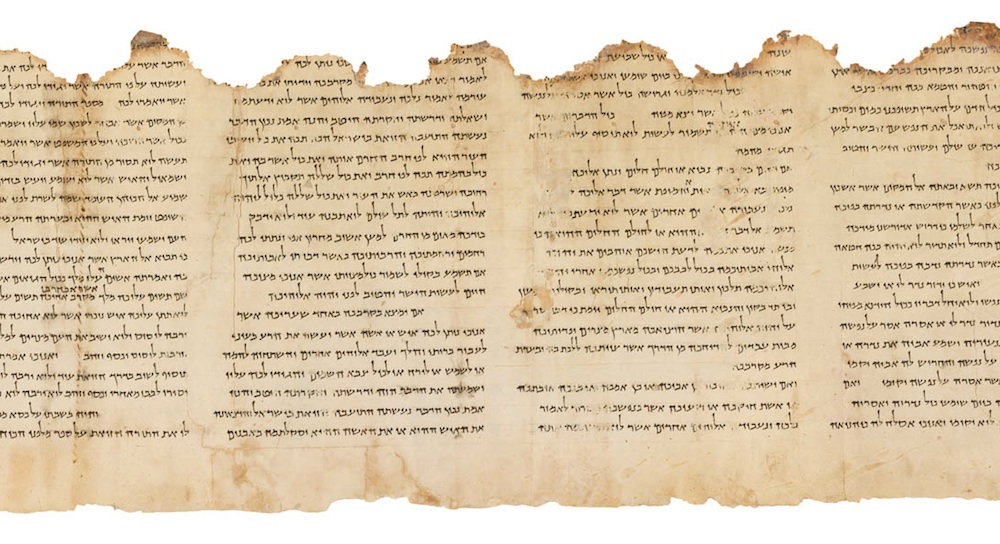
- In the form of scrolls or fragments of scrolls
- The fragments in Cave 4 are in >15,000 pieces
- Mostly parchment, some papyrus, and one of copper
- In the form of scrolls or fragments of scrolls
- Written mostly in Hebrew, about 15% in Aramaic, and a few in Greek
- Dated 3rd C BC – 1st C AD (i.e. before the destruction of the second temple in 70AD.)
- Consisting of ~230 ‘biblical’ scrolls bearing texts that are found in the modern Tanakh the rest being ‘non-biblical’ religious texts from the Second Temple period – about ¼ of which are described as ‘sectarian’ as they appear to be specific to a particular religious subcommunity.
- Widely assumed (following Sukenik and DeVaux) to be the concealed property of a supposed Essene community settled at Qumran, though this is now disputed by some.
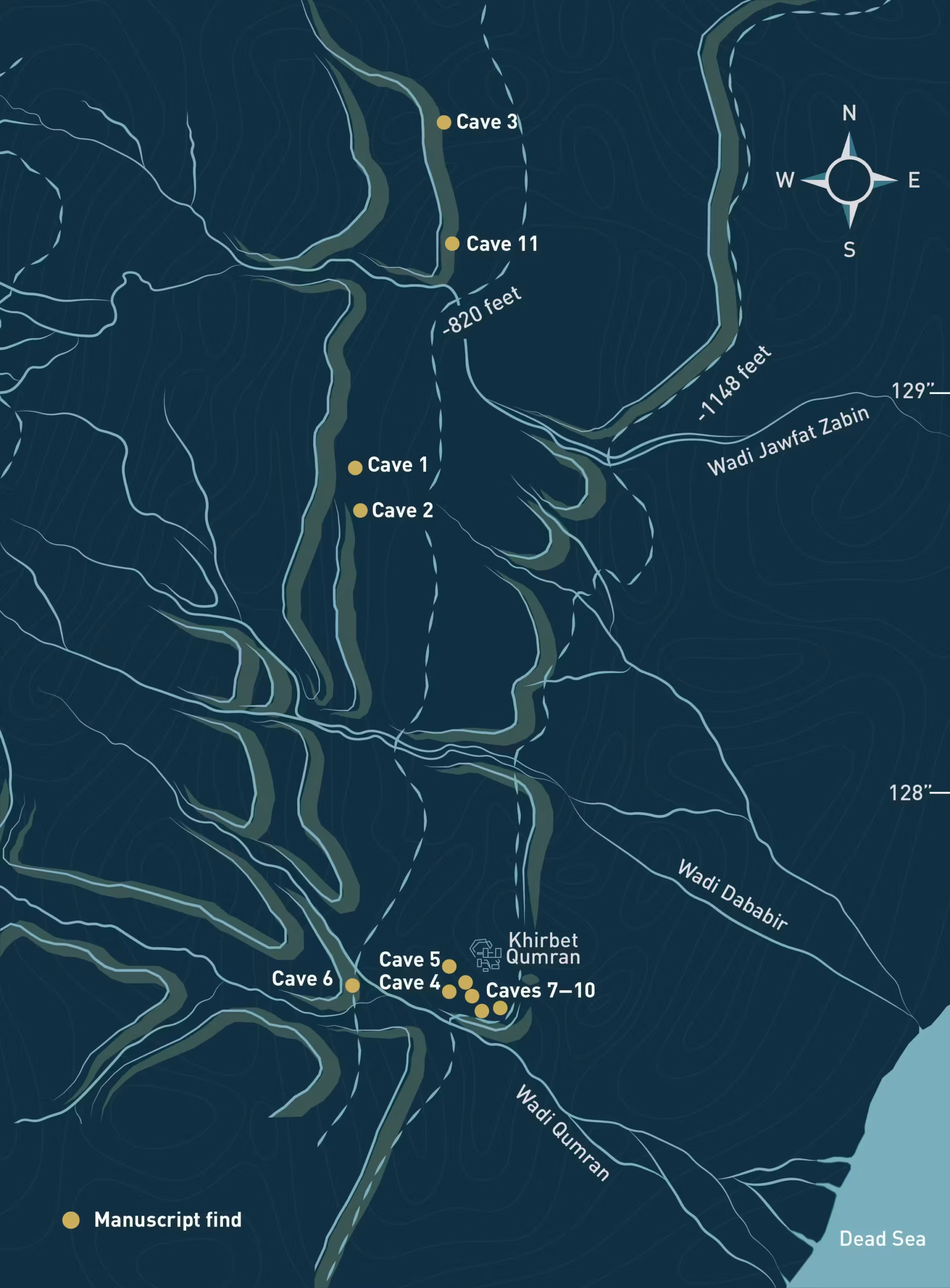
Location
Discovery
The term ‘Dead Sea Scrolls’ originally referred only to manuscripts found in the caves in the cliffs along and nearby the Wadi Qumran and with every indication (by the presence of identical associated pottery types) of originating from the same community (and thus constituting a ‘hoard.’) Its use is now often expanded to include manuscripts discovered elsewhere in the Dead Sea Western coastal area and with different origins, but that expanded sense is not accepted here.
Sometime between late 1946 and early 1947, Bedouin shepherd Muhammad edh Dhib of the Ta’amireh tribe entered Cave 1 where he found 7 scrolls stored in jars. He and the two others with him took these back to their camp. The Bedouins made several attempts to sell them, and some passed through several hands in the process, eventually attracting the attention of John C Trever of the American School of Oriental Research (ASOR) who recognised their antiquity and probable value. He interviewed the Bedouins to learn the circumstances of the discovery. The discovery was announced to the public on 11 Apr. 1948 by Millar Burrows, head of the ASOR.
War and unrest made a search for the original cave impossible until the Jordanian government allowed the Arab Legion to do so. The cave was rediscovered on 28 Jan. 1948 by UN Observer Capt. Phillipe Lippens and Arab Legion Capt. Akkash el Zebn. Gerald Lankester Harding (British Director of the Department of Antiquities of Jordan (DAJ)) and Roland Guérin de Vaux (Director of the Dominican École Biblique et Archéologique Française de Jérusalem) excavated the site from 15 Feb. to 5 Mar. 1949 for the DAJ, yielding additional fragments. From 1951 to 1956 R de Vaux led 5 further expeditions for the ASOR, searching for more caves in competition/collaboration with the Ta’amireh Bedouin and excavating various related sites.
All but one of the other caves were discovered between 1952 and 1956.
- Cave 2 in Feb. 1952 by the Bedouin.
- Cave 3 on 14 Mar. 1952 by the ASOR.
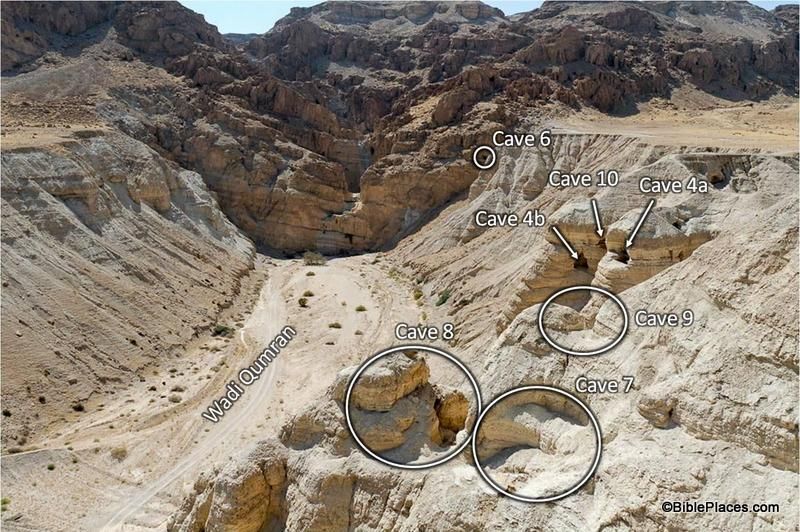
- Cave 4 in Aug. 1952 by the Bedouin. This cave is the most productive site, containing 575 manuscripts, most of them in many small pieces. It is actually two caves, denoted 4a and 4b, but the contents looted by the Bedouin are hopelessly mixed, so they are considered as a single source.
- Cave 5 and 6 in Sep. 1952, by the Bedouin
- Caves 7-10 between Feb. and Apr. 1955 by the ASOR.
- Cave 11 in Feb. 1956 by the Bedouin
- Cave 12 in Feb. 2017 by Dr. Oren Gutfeld and Ahiad Ovadia from the Hebrew University of Jerusalem’s Institute of Archaeology, with the collaboration of Dr. Randall Price and students from Liberty University in Virginia, USA. It had been looted, presumably by Bedouin, in the 1950s, and is therefore designated Q12 (The Q preceding the cave number indicates it contained no scrolls.)
Acquisition
- In 1947, the Bedouin who discovered Cave 1 sold four of the seven scrolls to ‘Kando’ (Khalil Eskander Shahin,) a Bethlehem antiquities dealer (for $20,) and three to a second antiquities dealer named Faidi Salahi.
- Salahi entrusted his three scrolls to an Armenian antiquities dealer named Ohan and arranged that they should be shown to Professor Eleazer Lipa Sukenik of Hebrew University. On 29 Nov. 1947 this occurred and the scrolls were informally given to Sukenik to be inspected at Hebrew University. The next day, however, the UN passed resolution 181 partitioning Mandatory Palestine and the scrolls were never returned.
- Kando resold his four scrolls to Metropolitan Mar Athanasius Yeshue Samuel, an Archbishop of the Syrian Church and head of the Syrian Orthodox Monastery of St Mark in Jerusalem (for $97.) In 1948, alarmed by the political situation, he smuggled them out of the country to Beirut and in 1949 to a Syrian Church in New Jersey. In 1954 he sold them for $250,000 to Yigael Yadin, son of Sukenik, who was acting on behalf of the State of Israel, and in 1955 they were given to the Hebrew University.
- In 1965 the Cave 1 scrolls of Hebrew University were moved to the Shrine of the Book, a specially designed building on the grounds of the Israel Museum, in West Jerusalem.
- The initial holding institution for the recovered texts was the Palestine Archaeological Museum (PAM) (after 1967, the Rockefeller Archaeological Museum (RAM))
- Manuscripts recovered by the ASOR excavations or sold to the ASOR team by the Bedouin who competed with them (often through the intermediation of Kando) became the property of the DAJ and went to the PAM.
- It is known that the Bedouin sold some recovered manuscripts to dealers from the caves that they had discovered. A concerted effort to recover these by purchase has led to very many being recovered and also sent to the PAM.
- In 1956, the Bedouin sold Kando 7 scrolls from Cave 11. He sold 6 of them to the PAM which in turn auctioned them to European & American institutions.
- The Copper Scroll (3Q15) and some fragments from Cave 1 were initially sent to the Jordan Archaeological Museum on Amman’s Citadel Hill.
- In 1967, following the Israeli capture of East Jerusalem,
- The scrolls of the PAM went to the Shrine of the Book.
- Yadin searched Kando’s property in Bethlehem and found the Temple Scroll (11Q19, below) in a shoe box. It was sent to the Shrine of the Book.
| Collection holding DSS Fragments | Acquired | Number |
| Israel Museum | 1967 | > 15,000 |
| Schøyen Collection | 1980, 1994, 1995 | 115 |
| The Jordan Museum | 1947–1956 | > 25 |
| Southwestern Baptist Theological Seminary | 2009, 2010, 2012 | 8 |
| Azusa Pacific University | 2009 | 5 |
| Ashland Theological Seminary | 1 | |
| Museum of the Institute for the Study of Ancient Cultures | 1956 | 1 |
| Lanier Theological Library | 1 | |
| Pasadena private collection | 1 | |
| Syrian Orthodox Church’s eastern U.S. archdiocese | 1 |
Publication
On 21 Feb. 1948, John C. Trever, a resident for the ASOR, photographed 3 texts from the scrolls held by St Mark’s Monastery (a complete manuscript of the book of Isaiah, the Community Rule, and a commentary on the book of Habakkuk.) In the same year Sukenik published selections from the three scrolls he had obtained from Salahi: The War Scroll, the Thanksgiving Scroll (Hodayot), and a second copy of Isaiah. In 1950 Trever published his photos of the Isaiah scroll and the Habakkuk Commentary (1QpHab.)
In 1951 Millar Burrows and ASOR colleague William Brownlee publish the text of 1QS as the Manual of Discipline.
In 1956, the Genesis Apocryphon was unrolled at Hebrew University and published by Yadin.
In 1957, Theodore H. Gaster (Columbia U) published English translations of 13 texts from cave 1.
Between 1952 and 1967 the PAM, which housed the scrolls controlled by the DAJ, had the scrolls photographed by local photographer Najib Albina using broadband fluorescence infrared photography and producing over 1750 plates.
In 1953, all the scrolls controlled by the DAJ were put in the control of a small committee of scholars appointed by Harding and de Vaux to constitute the Dead Sea Scrolls Publication Project (DSSPP,) which would be led by de Vaux as Project Director, and whose results would be published in the series Discoveries in the Judaean Desert (DJD.) They were, from the US, Frank Moore Cross (McCormick) and Patrick Skehan (Catholic U;) from the UK, John M Allegro (Manchester) and John Strugnell (Oxford;) from France, Dominique Barthélemy and Jean Starcky; from Germany, Claus-Hunno Hunzinger (Göttingen;) and from Poland, Josef T. Milik. Access to the scrolls was almost completely restricted to this small group working in East Jerusalem, and this continued after 1967 when those scrolls became the responsibility of what is now the Israel Antiquities Authority. Publication of the texts was, however, extremely slow, leading to great international scholarly dissatisfaction.
In 1955, Barthélemy and Milik published the fragments of Cave 1 in Discoveries in the Judaean Desert, volume 1: Qumran Cave 1 (DJD1.) In that year also, Allegro took the Copper Scroll to Manchester University to have it opened and sent a preliminary transcription of its contents to de Vaux. At the request of the director of DAJ, he published the text in 1960. (Milik, to whom the text had actually been assigned for the project, had published a translation in 1959 but his official edition did not appear until 1962 in DJD3.)
In 1965 the Psalms Scroll (11QPsa) was published in DJD4 edited by James A. Sanders.
Further editions of the DJD dealt with the contents of Cave 4 (as well as other non-Qumran material.)
- DJD5 in 1968, edited by Allegro and A.A. Anderson, presented minimalist editions of many manuscripts
- DJD6 in 1977, ed. Milik, presented 4Q128–4Q157
- DJD7 in 1982, ed. Maurice Baillet (who had replaced Hunzinger on the Project team in 1958) presented 4Q482–4Q520
- DJD9 in 1992, eds Skehan, E. Ulrich, and J. E. Sanderson dealt with “Palaeo-Hebrew and Greek Biblical Manuscripts.”
Note that publication of texts by the DSSPP was blocked for a time because of the refusal of de Vaux, Skehan, Starcky, and Milik to cooperate with the Israelis, but this resistance ended with the appointment in 1972 of Fr Pierre Benoit, also of the École Biblique, as Project Director following the death of de Vaux in 1971.
In 1983, Yadin published the Temple Scroll that he had recovered in 1967 for the Shrine of the Book.
In 1989, following a public dispute with John Strugnell, editor-in-chief of the DSSPP from 1984 to 1990, over the latter’s refusal to share access to photos of the Cave 4 Damascus Document with Robert H. Eisenman, many Israelis with access to the scrolls began to send Eisenman unauthorized photographs of the scrolls. The next year he showed 1700 of these to Michael Wise of Chicago, who began to transcribe them. On 20 Nov. 1991, Hershel Shanks published Eisenman’s photos in A Facsimile Edition of the Dead Sea Scrolls co-edited by Eisenman and James M. Robinson for the Biblical Archaeology Society.
In 1989, the Royal Dutch Academy granted Ben Zion Wacholder, a researcher at Hebrew Union College in Cincinnati, OH, permission to publish its fragment of a 2nd copy of the Temple scroll. Strugnell sent Wacholder scroll photos and a concordance of unpublished scrolls to assist him in this. In Sep. 1991 Wacholder and his colleague Martin G. Abegg, announced that they had developed a computer program that reconstructed fragmented sections of the scrolls from that concordance, thereby making the full content of the scrolls accessible.
In Sep. 1991 officials at the Huntington Library in San Marino, CA, announced that they would allow researchers unrestricted access to the library’s complete set of photographs of the scrolls.
In the early 1990s, responding to developments, the Israel Antiquities Authority (IAA) took major steps to advance the publication of the Dead Sea Scrolls. On 30 Dec. 1990, Hebrew University Professor Emanuel Tov was nominated as editor-in-chief of the DSSPP, and the work was soon divided among about 100 international scholars. In Nov. 1991, Tov lifted all publication restrictions and allowed all scholars access to the official scroll photographs.
By 2009, with the appearance of DJD40, the official editions had all been published and were located in academic libraries.
Contents
- Standard Identifiers
The Dead Sea Scrolls are identified by a manuscript number, which is the Cave number followed by a Q for ‘Qumran’ (recall that scrolls from other sites around the Dead Sea are also called Dead Sea Scrolls officially – but not by me – and they will have other letter designators) and a sequential number indicating the position in the catalogue. For example, 3 copies of the Temple Scroll were found in Qumran Cave 11 and were items 19, 20, and 21 catalogued from that site. These copies can be referenced as 11Q19, 11Q20, and 11Q21. If a text contains a composition that can be easily and conveniently named or described, like the Temple Scroll, this name or description is also commonly used as its title. Recognising this, many texts also have a manuscript name in which the catalogue index is replaced by an abbreviation of the name or description. If there are several copies of that text, the manuscript name includes a superscript indicating which copy it is. In the case of the Temple Scroll, the title ‘Temple’ is abbreviated to give 11QTa, 11QTb, and 11QTc.
- Contents by Caves
Cave 1
| Manuscript name | Document | Manuscript number |
| 1QIsaa | Great Isaiah Scroll | |
| 1QIsab | Isaiah | cf. 1Q8 |
| 1QS | Serekh ha-Yahad or “Community Rule” | |
| 1QpHab | Pesher on Habakkuk | |
| 1QM | Milhamah or War Scroll | |
| 1QHa | Hodayot or Thanksgiving Hymns | |
| 1QapGen | Genesis Apocryphon | |
| CTLevi | Cairo Geniza or Testament of Levi | |
| 1QGen | Genesis | 1Q1 |
| 1QExod | Exodus | 1Q2 |
| 1QpaleoLev | Leviticus – Numbers | 1Q3 |
| 1QDeuta | Deuteronomy | 1Q4 |
| 1QDeutb | 1Q5 | |
| 1QJudg | Judges | 1Q6 |
| 1QSam | Samuel | 1Q7 |
| 1QIsab | Isaiah | Parts of 1QIsab as 1Q8 |
| 1QEzek | Ezekiel | Parts of 1QIsab as 1Q9 |
| 1QPsa | Psalms | 1Q10 |
| 1QPsb | 1Q11 | |
| 1QPsc | 1Q12 | |
| 1QPhyl | Phylactery | 1Q13 |
| 1QpMic | Pesher on Micah | 1Q14 |
| 1QpZeph | Pesher on Zephaniah | 1Q15 |
| 1QpPs | Pesher on Psalms | 1Q16 |
| 1QJuba | Jubilees | 1Q17 |
| 1QJubb | 1Q18 | |
| 1QNoah | Book of Noah | 1Q19 |
| 1QapGen | Fragments of the “Genesis Apocryphon” | 1Q20 |
| 1QTLevi / 1QALD | Testament of Levi | 1Q21 |
| 1QDM | “Dibrê Moshe” or “Words of Moses” | 1Q22 |
| 1QEnGiantsa | Book of Giants | 1Q23 |
| 1QEnGiantsb | 1Q24 | |
| 1Q Apocr.Prophecy | “Apocryphal Prophecy” | 1Q25 |
| 1Q Instruction | “Instruction” | 1Q26 |
| 1QMyst | “The Book of Mysteries” | 1Q27 |
| 1QS or 1QSa | “Rule of the Congregation” | 1Q28 (1Q28a) |
| 1QSb | “Rule of the Blessing” or “Rule of the Benedictions” | 1Q28b |
| 1QapocrMoses B | Apocryphon of Moses | 1Q29 |
| 1Q Liturgical Text(?) A | “Liturgical Text 1” | 1Q30 |
| 1Q Liturgical Text(?) B | “Liturgical Text 2” | 1Q31 |
| 1QNJ(?) | “New Jerusalem” | 1Q32 |
| 1QM | Fragment of the 1QM or “War Scroll” or “Milhamah” | 1Q33 |
| 1QPrFetes / 1QLitPr | “Liturgical Prayers” or “Festival Prayers” | 1Q34 |
| 1QHb | “Hodayot” or “Thanksgiving Hymns” | 1Q35 |
| 1Q Hymns | “Hymns” | 1Q36 |
| 1Q Hymnic Composition(?) | “Hymnic Composition” | 1Q37 |
| 1Q Hymnic Composition(?) | “Hymnic Composition” | 1Q38 |
| 1Q Hymnic Composition(?) | “Hymnic Composition” | 1Q39 |
| 1Q Hymnic Composition(?) | “Hymnic Composition” | 1Q40 |
| 1Q41–70 | 1Q41–70 | |
| 1QDana | Daniel | 1Q71 |
| 1QDanb | 1Q72 |
Cave 2
| 2QGen | Genesis | 2Q1 |
| 2QExoda | Exodus | 2Q2 |
| 2QExodb | 2Q3 | |
| 2QExodc | 2Q4 | |
| 2QpaleoLev | Leviticus | 2Q5 |
| 2QNuma | Numbers | 2Q6 |
| 2QNumb | 2Q7 | |
| 2QNumc | 2Q8 | |
| 2QNumd? | 2Q9 | |
| 2QDeuta | Deuteronomy | 2Q10 |
| 2QDeutb | 2Q11 | |
| 2QDeutc | 2Q12 | |
| 2QJer | Jeremiah | 2Q13 |
| 2QPs | Psalms | 2Q14 |
| 2QJob | Job | 2Q15 |
| 2QRutha | Ruth | 2Q16 |
| 2QRuthb | 2Q17 | |
| 2QSir | “Wisdom of Sirach” or “Ecclesiasticus” | 2Q18 |
| 2QJuba | Book of Jubilees | 2Q19 |
| 2QJubb | 2Q20 | |
| 2QapMoses /2QapocrMoses(?) | “Apocryphon of Moses” | 2Q21 |
| 2QapDavid /2QapocrDavid | “Apocryphon of David” | 2Q22 |
| 2QapProph /2Qapocr.Prophecy | “Apocryphal Prophecy” | 2Q23 |
| 2QNJ | “New Jerusalem” | 2Q24 |
| 2Q Juridical Text | “Juridical Text” | 2Q25 |
| 2QEnGiants | “Book of Giants” from “Enoch” | 2Q26 |
| 2Q27
2Q28 2Q29 2Q30 2Q31 2Q32 2Q33 |
||
| 2QX1 | 2QX1 |
Cave 3
| 3QEzek | Ezekiel | 3Q1 |
| 3QPs | Psalms | 3Q2 |
| 3QLam | Lamentations | 3Q3 |
| 3QpIsa | Pesher on Isaiah | 3Q4 |
| 3QJub | Jubilees | 3Q5 |
| 3QHymn | Unidentified Hymn | 3Q6 |
| 3QTJud(?) | Testament of Judah(?) | 3Q7 |
| 3Q Text Mentioning Angel of Peace | 3Q8 | |
| 3QSectarian text | 3Q9 | |
| 3QUnc | Unidentified | 3Q10
3Q11 |
| 3QUncA-B | Unclassified fragments | 3Q12
3Q13 |
| 3QUncC | Unidentified | 3Q14 |
| 3QCopScr | The Copper Scroll | 3Q15 |
Cave 4
| 4QGen-Exoda | Genesis–Exodus | 4Q1 |
| 4QGenb | Genesis | 4Q2 |
| 4QGenc | 4Q3 | |
| 4QGend | 4Q4 | |
| 4QGene | 4Q5 | |
| 4QGenf | 4Q6 | |
| 4QGeng | 4Q7 | |
| 4QGenh/4QGenh1 | 4Q8 | |
| 4QGenh2 | 4Q8a | |
| 4QGenh-para | 4Q8b | |
| 4QGenh-title | 4Q8c | |
| 4QGenj | 4Q9 | |
| 4QGenk | 4Q10 | |
| 4QpaleoGen-Exodl | Paleo-Genesis/Exodus | 4Q11 |
| 4QpaleoGenm | Paleo-Genesis | 4Q12 |
| 4QExodb | Exodus | 4Q13 |
| 4QExodc | 4Q14 | |
| 4QExodd | 4Q15 | |
| 4QExode | 4Q16 | |
| 4QExod-Levf | Exodus–Leviticus | 4Q17 |
| 4QExodg | Exodus | 4Q18 |
| 4QExodh | 4Q19 | |
| 4QExodj | 4Q20 | |
| 4QExodk | 4Q21 | |
| 4QpaleoExodm (olim 4QExα) | Paleo-Exodus | 4Q22 |
| 4QLev-Numa | Leviticus–Numbers | 4Q23 |
| 4QLevb | Leviticus | 4Q24 |
| 4QLevc | 4Q25 | |
| 4QLevd | 4Q26 | |
| 4QLeve | 4Q26a | |
| 4QLevg | 4Q26b | |
| 4QNumb | Numbers | 4Q27 |
| 4QDeuta | Deuteronomy | 4Q28 |
| 4QDeutb | 4Q29 | |
| 4QDeutc | 4Q30 | |
| 4QDeutd | 4Q31 | |
| 4QDeute | 4Q32 | |
| 4QDeutf | 4Q33 | |
| 4QDeutg | 4Q34 | |
| 4QDeuth | 4Q35 | |
| 4QDeuti | 4Q36 | |
| 4QDeutj | 4Q37 | |
| 4QDeutk1 | 4Q38 | |
| 4QDeutk2 | 4Q38a | |
| 4QDeutk3 | 4Q38b | |
| 4QDeutl | 4Q39 | |
| 4QDeutm | 4Q40 | |
| 4QDeutn | All Souls Deuteronomy | 4Q41 |
| 4QDeuto | Deuteronomy | 4Q42 |
| 4QDeutp | 4Q43 | |
| 4QDeutq | 4Q44 | |
| 4QpaleoDeutr | Paleo-Deuteronomy | 4Q45 |
| 4QpaleoDeuts | 4Q46 | |
| 4QJosha | Joshua | 4Q47 |
| 4QJoshb | 4Q48 | |
| 4QJudga | Judges | 4Q49 |
| 4QJudgb | 4Q50 | |
| 4QSama | Samuel | 4Q51 |
| 4QSamb | 4Q52 | |
| 4QSamc | 4Q53 | |
| 4QKgs | Kings | 4Q54 |
| 4QIsaa | Isaiah | 4Q55 |
| 4QIsab | 4Q56 | |
| 4QIsac | 4Q57 | |
| 4QIsad | 4Q58 | |
| 4QIsae | 4Q59 | |
| 4QIsaf | 4Q60 | |
| 4QIsag | 4Q61 | |
| 4QIsah | 4Q61 | |
| 4QIsai | 4Q62 | |
| 4QIsaj | 4Q63 | |
| 4QIsak | 4Q64 | |
| 4QIsal | 4Q65 | |
| 4QIsam | 4Q66 | |
| 4QIsan | 4Q67 | |
| 4QIsao | 4Q68 | |
| 4QIsap | 4Q69 | |
| 4QIsaq | 4Q69a | |
| 4QIsar | 4Q69b | |
| 4QJera | Jeremiah | 4Q70 |
| 4QJerb | 4Q71 | |
| 4QJerc | 4Q72 | |
| 4QJerd (olim 4QJerb) | 4Q72a | |
| 4QJere (olim 4QJerb) | 4Q72b | |
| 4QEzea | Ezekiel | 4Q73 |
| 4QEzeb | 4Q74 | |
| 4QEzec | 4Q75 | |
| 4QXIIa | The Twelve Minor Prophets | 4Q76 |
| 4QXIIb | 4Q77 | |
| 4QXIIc | 4Q78 | |
| 4QXIId | 4Q79 | |
| 4QXIIe | 4Q80 | |
| 4QXIIf | 4Q81 | |
| 4QXIIg | 4Q82 | |
| 4QPsa | Psalms | 4Q83 |
| 4QPsb | 4Q84 | |
| 4QPsc & 4QPst[n 1] | 4Q85 / 4Q98c | |
| 4QPsd | 4Q86 | |
| 4QPse | 4Q87 | |
| 4QPsf | 4Q88 | |
| 4QPsg | 4Q89 | |
| 4QPsh | 4Q90 | |
| 4QPsj | 4Q91 | |
| 4QPsk | 4Q92 | |
| 4QPsl | 4Q93 | |
| 4QPsm | 4Q94 | |
| 4QPsn | 4Q95 | |
| 4QPso | 4Q96 | |
| 4QPsp (olim 4Q237) | 4Q97 | |
| 4QPsq | 4Q98 | |
| 4QPsr | 4Q98a | |
| 4QPss | 4Q98b | |
| *4QPst (see 4QPsc) | *4Q98c | |
| 4QPsu | 4Q98d | |
| 4QPsv (olim 4QPsu frg. 2) | 4Q98e | |
| 4QPsw | 4Q98f | |
| 4QPsx (olim 4Q236) | 4Q98g | |
| 4QJoba | Job | 4Q99 |
| 4QJobb | 4Q100 | |
| 4QpaleoJobc | Paleo-Job | 4Q101 |
| 4QProva | Proverbs | 4Q102 |
| 4QProvb | 4Q103 | |
| 4QRutha | Ruth | 4Q104 |
| 4QRuthb | 4Q105 | |
| 4QCanta | Canticles (Song of Songs) | 4Q106 |
| 4QCantb | 4Q107 | |
| 4QCantc | 4Q108 | |
| 4QQoha | Ecclesiastes | 4Q109 |
| 4QQohb | 4Q110 | |
| 4QLam | Lamentations | 4Q111 |
| 4QDana | Daniel | 4Q112 |
| 4QDanb | 4Q113 | |
| 4QDanc | 4Q114 | |
| 4QDand | 4Q115 | |
| 4QDane | 4Q116 | |
| 4QEzra | Ezra | 4Q117 |
| 4QChr/4QChron | Chronicles | 4Q118 |
| 4QLXXLeva gr | Septuagint Leviticus | 4Q119 |
| 4QpapLXXLevb/ pap4QLXXLevb gr | 4Q120 | |
| 4QLXXNumb gr | Septuagint Numbers | 4Q121 |
| 4QLXXDeut gr | Septuagint Deuteronomy | 4Q122 |
| 4QpaleoparaJosh | Paraphrase on Joshua | 4Q123 |
| 4QUnid gr | Unidentified text | 4Q126 |
| 4Qpap paraExod / pap4QParaExod gr | Paraphrase on Exodus | 4Q127 |
| 4Qphyla | Phylactery Scrolls | 4Q128 |
| 4Qphylb | 4Q129 | |
| 4Qphylc | 4Q130 | |
| 4Qphyld | 4Q131 | |
| 4Qphyle | 4Q132 | |
| 4Qphylf | 4Q133 | |
| 4Qphylg | 4Q134 | |
| 4Qphylh | 4Q135 | |
| 4Qphyli | 4Q136 | |
| 4Qphylj (olim 4Qphyla) | 4Q137 | |
| 4Qphylk | 4Q138 | |
| 4Qphyll | 4Q139 | |
| 4Qphylm | 4Q140 | |
| 4Qphyln | 4Q141 | |
| 4Qphylo | 4Q142 | |
| 4Qphylp | 4Q143 | |
| 4Qphylq | 4Q144 | |
| 4Qphylr | 4Q145 | |
| 4QPhyls | 4Q146 | |
| 4Qphylt | 4Q147 | |
| 4Qphylu | 4Q148 | |
| 4QMeza | Mezuzah Scrolls | 4Q149 |
| 4QMezb | 4Q150 | |
| 4QMezc | 4Q151 | |
| 4QMezd | 4Q152 | |
| 4QMeze | 4Q153 | |
| 4QMezf | 4Q154 | |
| 4QMezg | 4Q155 | |
| 4QtgLev | Targum of Leviticus | 4Q156 |
| 4QtgJob | Targum of Job | 4Q157 |
| 4QRPa | Reworked Pentateuch A | 4Q158 |
| 4QOrdinancesa | Ordinances A | 4Q159 |
| 4QVisSam | Vision of Samuel | 4Q160 |
| 4QpIsaiaha | Pesher on Isaiah | 4Q161 |
| 4QpIsaiahb | 4Q162 | |
| 4QpHosA | Pesher on Hosea A | 4Q166 |
| 4QpHosB | Pesher on Hosea B | 4Q167 |
| 4QpMic(?) | Pesher on Micah? | 4Q168 |
| 4QpNah | Pesher on Nahum | 4Q169 |
| 4Q Eschatological Commentary A | Florilegium or Midrash on the Last Days | 4Q174 |
| 4QTest | Testimonia | 4Q175 |
| 4QapocrLamA | Apocryphal Lamentations A | 4Q179 |
| 4Q Horoscope | Physiognomies/Horoscopes | 4Q186 |
| 4QpapTobita | Tobit | 4Q196 |
| 4QTobitb | 4Q197 | |
| 4QTobitc | 4Q198 | |
| 4QTobitd | 4Q199 | |
| 4QTobite | 4Q200 | |
| 4QEna | The Enoch Scroll | 4Q201a |
| 4QALD / 4QLevia-f ar | The Aramaic Levi Document (ALD) | 4Q213 4Q213a 4Q213b 4Q214 4Q214a 4Q214b |
| 4QTNaph | Testament of Naphtali | 4Q215 |
| 4QCanta(?) | Pesher on Canticles/Song of Songs | 4Q240 |
| 4QapocrDan | Aramaic Apocalypse or The Son of God Text | 4Q246 |
| 4QCommentary on Gen A /4QCommGenA | Commentary/Pesher on Genesis | 4Q252 |
| 4QCommentary on Gen B /4QCommGenB | 4Q253 | |
| 4QCommentary on Gen C /4QCommGenC | 4Q254 | |
| 4QCommentary on Gen D (olim 4QpGenc) | 4Q254a–820 | |
| 4QSd | Serekh ha-Yahad or Community Rule | 4Q258 |
| 4QD | The Damascus Document | 4Q265–273 |
| 4Q Sefer ha-Milhamah | Rule of War | 4Q285 |
| 4QMysta | The Book of Mysteries / The Book of Secrets |
4Q299 |
| 4QMystb | 4Q300 | |
| 4QMystc | 4Q301 | |
| 4QRPb | Reworked Pentateuch | 4Q364 |
| 4QRPc | 4Q365 | |
| 4QRPd | 4Q366 | |
| 4QRPe | 4Q367 | |
| 4QapocrJosha | Apocryphon of Joshua | 4Q378 |
| 4QapocrJoshb | 4Q379 | |
| 4QpsEzek | Pseudo-Ezekiel | 4Q385 4Q385b 4Q385c 4Q386 4Q388 4Q391 |
| 4QMMT /4Q Cal.Doc.D | Miqsat Ma’ase Ha-Torah or Some Precepts of the Law or the Halakhic Letter | 4Q394–399 |
| 4Q Non-Canonical Psalms A | Songs of Sabbath Sacrifice or the Angelic Liturgy | 4Q400–407 |
| 4QInstruction | Sapiential Work A | 4Q415–418 |
| 4QParaphrase | Paraphrase of Genesis and Exodus | |
| 4Q Barkhi Nafshia | Barkhi Nafshi – Apocryphal Psalms | 4Q434 |
| 4Q Apocr. Psalm and Prayer | Hymn to King Jonathan or The Prayer For King Jonathan Scroll | 4Q448 |
| 4QpapGen or papJub | pap-Genesis or pap-Jubilees | 4Q483 |
| 4QShira-b | Songs of the Sage or Songs of the Maskil |
4Q510–511 |
| 4Q Messianic Apocalypse | Messianic Apocalypse | 4Q521 |
| 4Q Jonathan | 4Q523 | |
| 4QTempleScrollb | Temple Scroll | 4Q524 |
| 4QBeatitudes | 4Q525 | |
| 4Q TJoseph | Testament of Joseph | 4Q539 |
| 4QapocrLevi(?)b | Testament of Levid | 4Q541 |
| 4QTKohath (4QTQahat) | Testament of Qahat | 4Q542 |
| 4QNJc | New Jerusalem | 4Q555 |
| 4QGenn | Genesis | 4Q576 |
| Unnumbered |
Cave 5
| 5QDeut | Deuteronomy | 5Q1 |
| 5QKgs | Kings | 5Q2 |
| 5QIsa | Isaiah | 5Q3 |
| 5QAmos | Amos | 5Q4 |
| 5QPs | Psalms | 5Q5 |
| 5QLama | Lamentations | 5Q6 |
| 5QLamb | 5Q7 | |
| 5QPhyl | Phylactery | 5Q8 |
| 5QapocrJosh or 5QToponyms | Toponyms | 5Q9 |
| 5QapocrMal | Apocryphon of Malachi | 5Q10 |
| 5QS | Rule of Community (Serek ha-Yahad) | 5Q11 |
| 5QD | Damascus Document | 5Q12 |
| 5QRule or 5QRégle | Rule of Community | 5Q13 |
| 5QCurses | Curses | 5Q14 |
| 5QNJ | New Jerusalem Scroll | 5Q15 |
| 5QUnid | Unidentified | 5Q16–5Q24 |
| 5QUnc | Unclassified | 5Q25 |
Cave 6
| 6QpaleoGen | Genesis | 6Q1 |
| 6QpaleoLev | Leviticus | 6Q2 |
| pap6QDeut or 6QpapDeut(?) | Deuteronomy | 6Q3 |
| 6QpapKgs | Kings | 6Q4 |
| pap6QPs or 6QpapPs(?) | Psalms | 6Q5 |
| 6QCant | Song of Songs | 6Q6 |
| 6QpapDan | Daniel | 6Q7 |
| 6QpapGiants or pap6QEnGiants | Book of Giants from Enoch | 6Q8 |
| 6Qpap apocrSam-Kgs or pap6QapocrSam/Kgs | Apocryphon on Samuel–Kings | 6Q9 |
| 6QpapaProph or pap6QProph | Unidentified prophetic fragment | 6Q10 |
| 6QAllegory | Allegory of the Vine | 6Q11 |
| 6QapProph | An apocryphal prophecy | 6Q12 |
| 6QPriestProph | Priestly Prophecy | 6Q13 |
| 6Q Apocalypse | Apocalyptic text | 6Q14 |
| 6QD | Damascus Document | 6Q15 |
| 6QpapBened or pap6QBen | papBenediction | 6Q16 |
| 6QCalDoc | Calendrical Document | 6Q17 |
| pap6QHymn | Hymn | 6Q18 |
| 6Q Text Related to Genesis | Genesis | 6Q19 |
| 6QDeut(?) | Deuteronomy | 6Q20 |
| 6QfrgProph or 6Q Prophetic Text | Possibly prophetic text | 6Q21 |
| pap6QUnidA | Unclassified fragments | 6Q22 |
| pap6QUnidA ar | Unclassified fragments | 6Q23 |
| 6QUnidB | Unclassified fragments | 6Q24 |
| 6QUnidB | Unclassified fragments | 6Q25 |
| 6QUnidB or 6QpapAccount or Contract | Accounts or contracts | 6Q26 |
| 6QUnidB | Unclassified fragments | 6Q27–6Q28 |
| 6QpapProv | Proverbs | 6Q30 |
| 6QUnidB | Unclassified fragments | 6Q31 |
Cave 7
| 7QpapLXXExod | Exodus | 7Q1 |
| 7QpapEpJer | Letter of Jeremiah | 7Q2 |
| 7Q3 | Unidentified | 7Q3 |
| 7Q4 | Unidentified | 7Q4 |
| 7Q5 | Unidentified | 7Q5 |
| 7Q6–18 | Unidentified | 7Q6–18 |
| 7Q papImprint | Unidentified | 7Q19 |
Cave 8
| 8QGen | Genesis | 8Q1 |
| 8QPs | Psalms | 8Q2 |
| 8QPhyl | Phylacteries | 8Q3 |
| 8QMez | Mezuzah | 8Q4 |
| 8QHymn | Unidentified hymn | 8Q5 |
Cave 9
| 9Qpap | Unidentified | 9Q1 |
Cave 10
| 10QOstracon | Ostracon | 10Q1 |
Cave 11
| 11QpaleoLeva | Paleo-Leviticusa | 11Q1 |
| 11QLevb | Leviticusb | 11Q2 |
| 11QDeut | Deuteronomy | 11Q3 |
| 11QEzek | Ezekiel | 11Q4 |
| 11QPs | The Great Psalms Scroll | 11Q5 |
| 11QPsa | Psalms | 11Q5 |
| 11QPsb | 11Q6 | |
| 11QPsc | 11Q7 | |
| 11QPsd | 11Q8 | |
| 11QPse | 11Q9 | |
| 11QtgJob | Targum Job | 11Q10 |
| 11QapocrPs | Apocryphal Psalms | 11Q11 |
| 11QJub | Jubilees | 11Q12 |
| 11QMelch | Melchizedek | 11Q13 |
| 11Q Sefer ha-Milhamah | Sefer ha-Milhamah (“The Book of War”) | 11Q14 |
| 11QHymnsa | Hymns | 11Q15 |
| 11QHymnsb | 11Q16 | |
| 11QShirShabb | Songs of the Sabbath Sacrifice | 11Q17 |
| 11QNJ | New Jerusalem | 11Q18 |
| 11QTa | Temple Scroll | 11Q19 |
| 11QTb | 11Q20 | |
| 11QTc | 11Q21 | |
| 11Q Unidentified | Unidentified | 11Q22 |
| 11Q23 | ||
| 11Q24 | ||
| 11Q25 | ||
| 11Q26 | ||
| 11Q27 | ||
| 11Q28 | ||
| 11Q29 | ||
| 11Q30 | ||
| 11Q31 | ||
| 11Q9999 | Unidentified |
Tags: