Incompetence and the Institutions
October 15, 2026 – 1:09 pmAs noted previously
[I]n sociological theories institutions are generally reckoned to be significant features of a society, and there seems to be some primitive notion that underlies the use of the term, but as is often the case the precise definitions offered cover a range of related possibilities. The Stanford Encyclopedia of Philosophy (Miller, S. 2011, s.v. ‘Social Institutions’, ¶1) provides a reasonable overview of the issues and begins by referring to a pair of representative definitions. The first by J. Turner (1997, The Institutional Order, New York: Longman, p. 6): “a complex of positions, roles, norms and values lodged in particular types of social structures and organising relatively stable patterns of human activity with respect to fundamental problems in producing life-sustaining resources, in reproducing individuals, and in sustaining viable societal structures within a given environment.” And the second by Rom Harré (1979, Social Being, Oxford: Blackwell, p. 98): “An institution was defined as an interlocking double-structure of persons-as-role-holders or office-bearers and the like, and of social practices involving both expressive and practical aims and outcomes.” From such evidence, the consensus seems to be that an institution is a set of norms, rules of behaviour, etc. (i.e. a norm formation) that creates a structure of interacting roles into which participants in the institution fit, and which is seen to have the function of achieving some end (whether or not it also has other functions.)
I claim that in so far as institutions are constituted by their characterizing normset, they are vulnerable to certain incompetencies on the part of their participating populations. In particular, an institution which has both implicit and explicit functions supported by its normset as it was instituted by and for a population that possessed competences favourable to the operation of that institution will fail to operate in the appropriate fashion if that originating population is displaced by a population that does not have the appropriate competences.
- Cultural Incompetence.
Cultures in which the norms that constitute an institution are in conflict with norms that constitute that culture are highly inimical to that institution. The family-centric culture that produces nepotism, the shame-honour culture that resists feedback or admission of error or etc, and the low-trust culture/society that subordinates all norms to simple calculations of actor’s advantage, are all cultures that find it hard to make most institutions work efficiently. The relationship of culture to material success was noted in general terms by Adam Smith (Theory of Moral Sentiments) and JS Mill (Principles of Political Economy) and famously by M Weber (The Protestant Ethic and the Rise of Capitalism) who pointed to the cultural values encouraged by Protestantism – hard work, honesty, thrift, rationality, future orientation, delayed gratification (not his terms) – as the preconditions for European success. ‘Modernisation Theory,’ as proposed by researchers such as WW Rostow (Stages of Economic Growth) responding to the difficulties experienced in the post-colonial world and reflecting on the empirical data available, hypothesized that development in currently underdeveloped countries will similarly require that the culture of those countries should adopt these norms (or something like them.) The failure of many societies to throw off their traditional cultural norms in favour of these ‘modern’ norms is equivalently taken to be at the root of continuing underdevelopment. Although modernization theory does not concentrate on the particular effect of traditional social norms on institutional functioning, it is quite clear that the traditional norms in question would have their retarding effects largely through their effects on the functions of imposed or inherited or innovated institutions. The topic of cultural effects on institutions has itself been the subject of considerable research in recent times, with wide acceptance that the functioning of institutions that are identically constituted normatively can be very different depending on the normative constitution of the participating populations. (See, for example, Alesina & Giuliano (2015) ‘Culture and Institutions’ in the Journal of Economic Literature, 53:4, 898-944, Persson & Gabelli (2021) ‘Culture, Institutions, and Policy’ for Bisin & Federico, The Handbook of Historical Economics c. 16, or Acemoglu & Robinson (2021) ‘Culture, Institutions, and Social Equilibria: A Framework.’ (I endorse none of their theoretical assumptions.))
The fundamental nature of institutional corruption by incompetent cultures can be illustrated by the failure of the essentially British institution of ‘queuing’ to survive the multicultural experiment. A simple thing made worse, as they say.
Queuing means the old, small and weak are treated fairly. Not all cultures queue. I saw this living abroad. https://t.co/XAXOY5n5uq
— Larry Lemon (@larrylemonmaths) May 13, 2024
- Psychological Incompetence.
The female resistance to impersonality, objectivity, discriminatory, etc. norms has been noted recently, together with the deleterious effects upon all institutions in which female participation beyond a certain threshold has led to norms of that sort being subordinated to female psychological preferences for accommodation, compassion, subjective judgements, etc. Thus Universities, the Justice system, Medicine, Journalism, Politics, etc are crippled or at least perverted. The general phenomenon has been very effectively described by Helen Andrews in her essay The Great Feminization for Compact 16/10/2025.
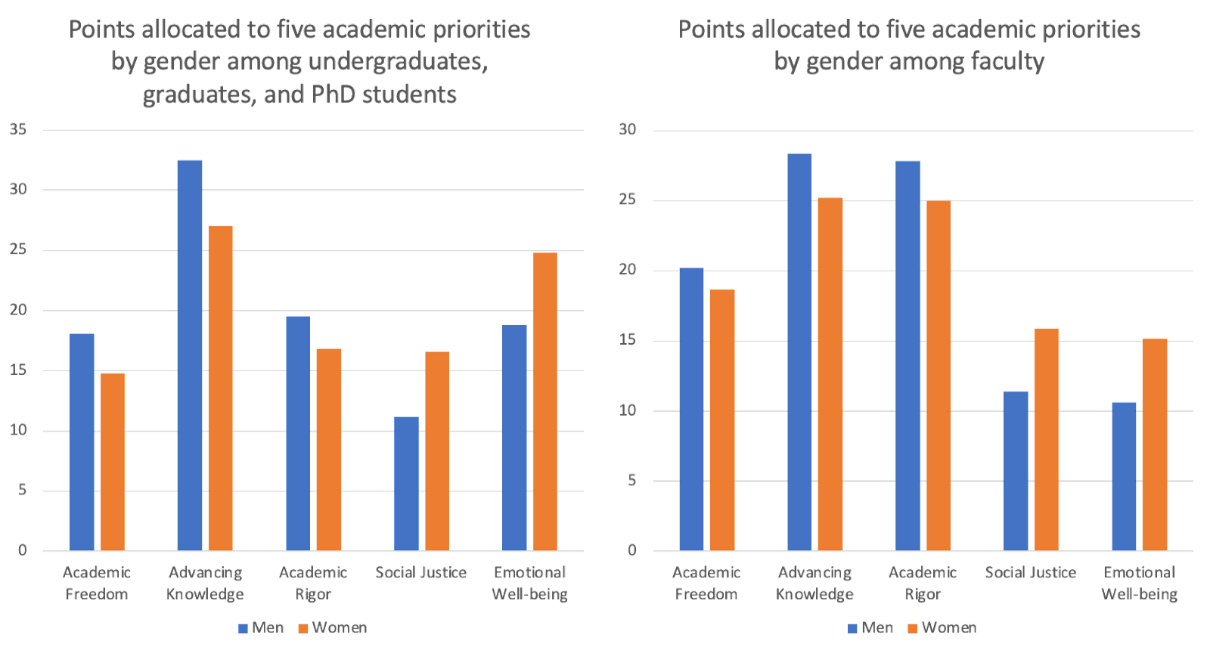
The particular instance of the university has most often featured in commentary. A representative instance would be Understanding the Feminization of Academic Institutions by Cory Clark & Bo Winegard in Quillette 8 Oct 2022. There we find several attitude surveys of faculty and staff and students at Western Universities which show how female attitudes towards the function of the university are at odds with the designed function which is supported by men’s attitudes. This extract gives some idea of the problem:
A 2020 paper by Geher and colleagues, in which 140 academic faculty at colleges or universities in the United States completed the same point-allocation task described above, found that:
- Women allocated more points to social justice and emotional wellbeing than men, and consequently had fewer points to allocate to advancing knowledge, academic rigor, and academic freedom, although these latter three differences did not reach statistical significance.
- Intellectual Incompetence.
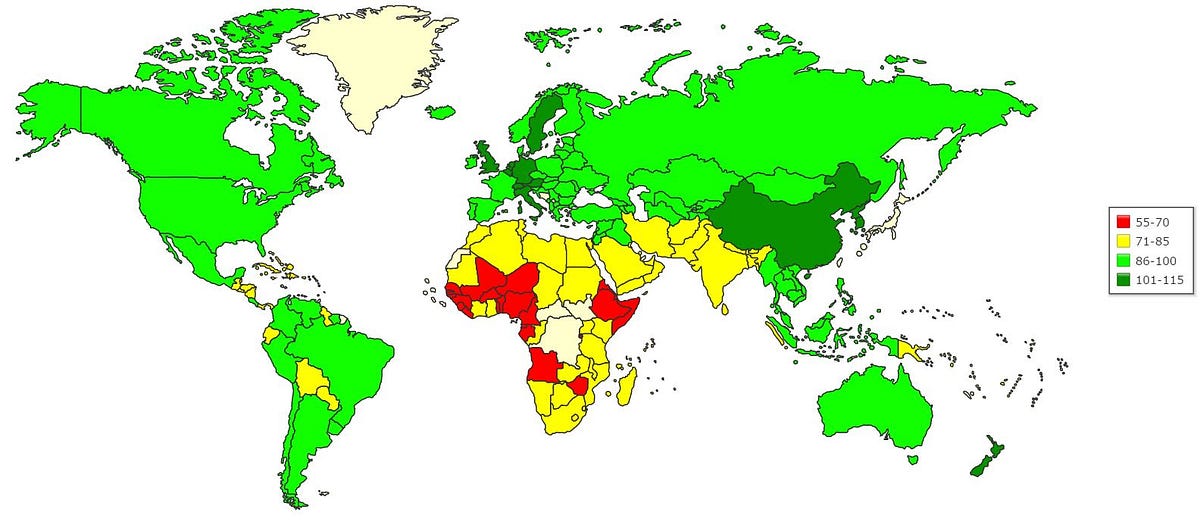
The operation of an institution requires that the implications of the constitutive norms can be derived and that the actions required in response to those norms can be similarly derived according to ‘practical reason.’ Where a population does not possess in adequate numbers actors with the intellectual capacity to perform those derivations reliably (and to act upon them?) the institution will fail. Jordan Petersen has remarked that the US Army will not accept anyone with a measured IQ below about 85, because they have determined that such people – no matter what IQ is taken to be measuring – just cannot be made to contribute to the functioning of that institution in any way that counts. A glance at a world map of average IQs indicates that many countries may lack sufficient populations of sufficiently high IQ to populate and operate their institutions. It will come as no surprise that this is an aspect of development or immigration policy that gets very little attention.