Botticelli – The Birth of Venus

March 31, 2019 – 12:20 pm

One of several criticisms of the Actual Intentionalist theory of interpretation – even in its weakened or modified forms – is that it requires that each artwork have just one correct interpretation. According to Davies (ed. 2015, The Philosophy of Art, p. 118) for example, such a critic

rejects the idea that artworks have only one meaning, this being the one intended by the author. In Art, we expect great works to invite multiple, even contradictory, interpretations

Unfortunately, the reply offered to this is rather odd.

In reply, the moderate actual intentionalist can allow … that the work has meanings additional to those that are intended. And a more important point is that artists deliberately make their works to be complex, richly layered, and tantalizingly ambiguous or vague, precisely because they intend to produce art allowing for a variety of plausible interpretations. The multiple interpretability of artworks is consistent with the claims of moderate actual intentionalism, so the proposed objection misses its mark.

A more reasonable response is to once again point to the analogy between Art and common speech (an analogy that is appropriate for discussions of the communicative purposes of Art, but not necessarily for much else) and to note the entirely uncontroversial fact that any utterance may have several meanings that are all intended by the utterer. Those different meanings and messages conveyed are conveyed by different aspects of the utterance, and the same may undoubtedly be true of an Artwork. In support of this, let us consider a work where it is acknowledged that there are probably multiple interpretations: the Birth of Venus by Botticelli.

Thought to have been painted 1484-6, the history of the painting is disputed. Sometime before 1550 Vasari saw it and the Primavera in the Villa di Castello outside Florence, which had been bought in 1477 by Lorenzo di Pierfrancesco and his brother Giovanni di Pierfrancesco de’ Medici, cousins to Lorenzo ‘Il Magnifico.’ It has usually been assumed that the Primavera and Birth of Venus are companion pieces, and were commissioned soon after the Castello had been bought. (On the other hand, a catalogue of 1499 lists the former but not the latter as belonging to Lorenzo’s descendants, which has led to some doubt on the matter.) It is also a common assumption – because it makes sense of some of the iconography and would add to the sense of some of the interpretations – that the paintings were commissioned as wedding presents.
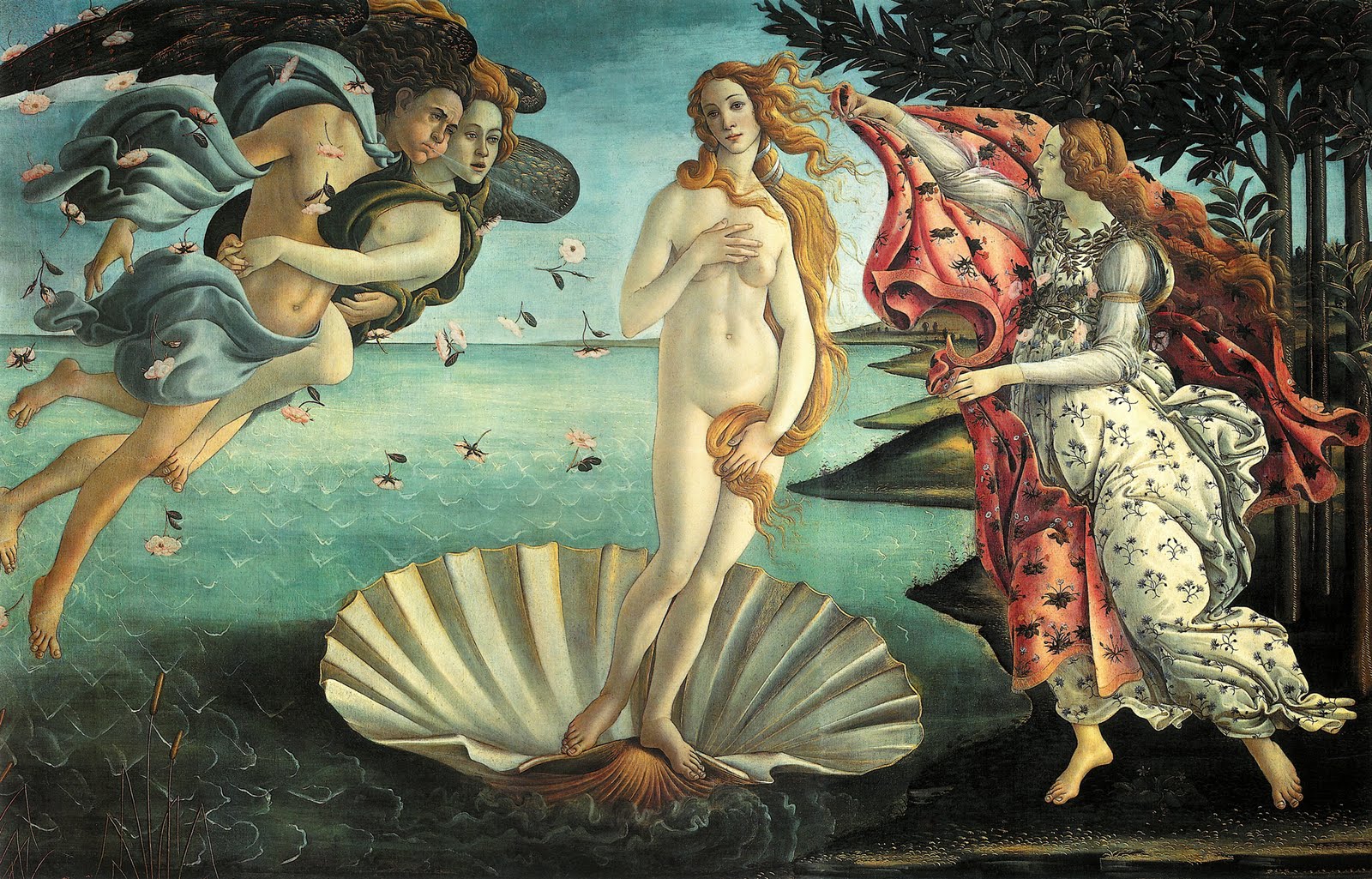
The subject of the painting, however, has never been in dispute: it is the arrival of Venus to shore on Cyprus after her birth full grown in the sea. (The painting’s original name is not known, but it was said to depict the birth of Venus by Vasari, who made a trivial error there. The current name which continues that error is known to have been applied to it in the XIXth C.) The episode is a common one in the minor classical arts, and Pliny reports (HN 35) that Apelles once painted it for Alexander, but the scene that this painting shows is inspired rather by late literary sources than by any of those early works. Two poems are commonly identified in this context: the first being Angelo Poliziano’s Stanze di messer Angelo Politiano cominciate per la giostra del magnifico Giuliano di Pietro de’ Medici, in which a representation in relief of the episode is described (verses 99-102;) and the second is a translation by Demetrios Chalkokondyles of the second hymn to Aphrodite from the Homeric Hymns.

The elements of the painting are more interesting: the image of Venus herself in particular. Her posture is closely modelled on the Medici Venus which is a Venus pudica. That is not according to the classical tradition, in which this mythological episode is illustrated with a Venus anadyomene. In style, it has long been noted that the image is more reminiscent of the gothic treatment of nudes with their rounded bellies, broad hips, lack of musculature, sloping shoulders, and generally exaggerated length. In the gothic imagination, however, nakedness was typically associated with shame or some sort of moral failure – harlots in Hell, Eve being expelled, fallen women generally. There is no such suggestion here. In fact, her head is just the same as the heads of his Madonnas – the expression is ‘wistful’ (Clark, K. (1956) The Nude Harmondsworth: Pelican, pp. 97 f.) Moreover, though she is shown classically contrapposto, Botticelli’s Venus fails to meet the classical standard of aplomb, for she could not possibly stand at that angle. We are presumably to read her as floating, like the two winds Zephyr and Aura at left, and also, possibly, like the Hora of Spring at right.

A number of interpretations have been proposed.

  1. A now standard interpretation of the painting (see Panofsky, E. (1965) Renaissance and Renascences in Western Art, London: Paladin pp. 198 f) begins from the observation that the Venus pudica type derives from Praxiteles’ famed Aphrodite of Knidos whose nude form came to be associated with the Venus coelestis representing pure, intellectual love. (This being contrasted with the Venus vulgaris deriving from Praxiteles’ clothed Aphrodite of Kos and representing love of a more worldly and natural kind.) The painting is therefore supposed to reference and recommend this more elevated aspect of the goddess. This interpretation would be especially plausible if the painting had been intended as wedding gift: for it could then be seen as an appropriate moral reminder for the young couple.                                                                                                                                                                                                                 
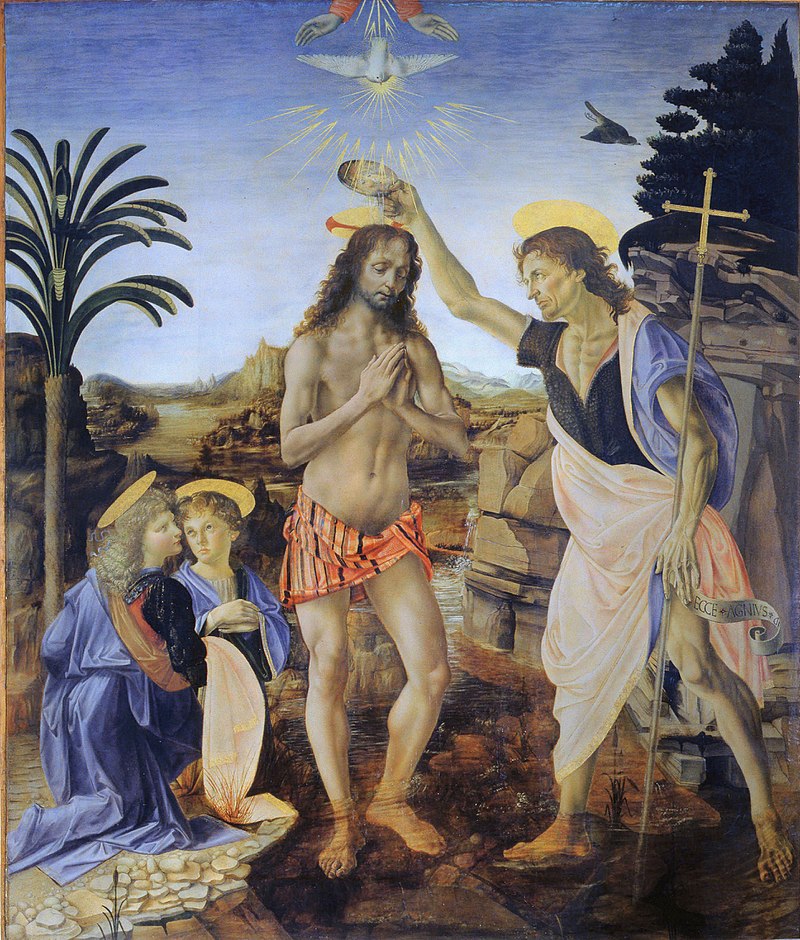
  2. It is possible to enlarge upon this interpretation if it is also accepted (as it usually is) that Botticelli or his patron was familiar with the Neo-platonism that was then popular amongst the Florentine humanists. In that system, Venus coelistis is said to bring forth divine love (Amor divinus) “ad divinam cogitandam pulchritudinem,” i.e. so that we may come to understand divine Beauty (Ficino in Commentary on the Symposium II, 7.) The painting thus celebrates that event and the possibility of this knowledge. Some (e.g. Gombrich, E. (1945) “Botticelli’s Mythologies” Journal of the Warburg and Courtauld Institute, 8:7-60, p. 55) have seen further support for this interpretation in the way that the attitude of the Hora who bestows the mantle upon Venus echoes John’s attitude in scenes of the baptism of Christ (compare, for example, Verrocchio’s Battesimo di Cristo.) The implication is that the arrival of Venus in the world in this form is an event that brings the possibility of divine love and the knowledge of Beauty, in much the same way that the entrance of Christ into his mission brings the possibility of divine love and the knowledge of God.
  1. It may further be noted (as by Wind, E. (1967) Pagan Mysteries in the Renaissance, Harmondsworth:Peregrine, pp. 131 ff.) that from the left it is a wind of passion that issues from the two entwined and amorous spirits (and especially da’ Zefiri lascivi as Poliziano describes him in Giostra 99) to move Venus. And on the right it is chaste Hora who approaches to wrap her in a decent cloak. The Venus pudica itself is an image of not exactly chaste but elevated love, but here she manages to unify the two forms to one wholesome whole. Again, this is a recommendation appropriate for a wedding present.
  1. As a wedding present however, it may have a more than simply admonitory intention. It has been argued that the peculiar flatness of the painting and the space-filling pattern of flowers give it an appearance that would well suit it to the environment of a private chamber, where tapestries and heavy patterns were common. Supposing it then to be intended to be enjoyed privately, we can identify a number of erotic elements that are proper only in that context. The principal element of course is the image of the naked Venus herself; and here it is surely significant that it is amongst the first full length nudes after the classical period. The faces of the two spirits at the left plausibly belong to a couple in coitus. The shell that Venus stands on has since classical times been taken as a symbol of the goddess of love and as representing the female sexual organs. And the loop of hair directly above her pudendum and the fold of fabric into which her hair blows are also clearly depicting the female sex. (In no other place in Botticelli’s works do we see such loops or folds.) In so far as we think that this is intended to have an ‘interpretation,’ it may that sexual desire is not alien to the pure goddess, and this claim presumably implies a recommendation to indulge it in the marriage. However, that is probably not the principal intended function for those elements.
  1. Some have also tried to argue that the painting was intended as a piece of flattery to Lorenzo ‘Il Magnifico’ de’ Medici, head of the Medici family. It is claimed that the model for the Venus is Simonetta Catanneo Vespucci, who was a noted beauty of the time and reputed to be the mistress of both Lorenzo and his brother Giuliano. Lorenzo’s allowing the use of Simonetta’s likeness (though she had by then been dead for about 10 years) is compared to Alexander offering his mistress Campaspe to Apelles as a model for the original Aphrodite anadyomene (Pliny, HN 35.) Lorenzo is thus to be compared to Alexander. Unfortunately, there is no evidence that Simonetta was taken as the model, nor that she was the mistress of Lorenzo. Indeed, it was Giuliano who took her as the object of his courtly love gestures (which are celebrated in Poliziano’s Giostra) but there is no evidence for her being his mistress either. Consequently, we can dismiss this as a possible interpretation.

All of those interpretations are consistent with each other, and the evidence actually offered for them (or against them) is exactly the evidence that the Actual Intentionalist would admit. Where there is proposed to be conflict between these interpretations – as between the 2nd and 3rd listed above – it is reasonable to think that those who are proposing the conflict would say that one of those is correct and the other is incorrect; just as it is possible to interpret a statement in two ways according to the rules of the language and the conventions of the conversation, but for only one of those interpretations to be the intended (correct) one. Does anyone actually claim that the intention of an artist is to assert two contradictory claims?

Tags:
Poussin – Et in Arcadia Ego

March 23, 2019 – 9:19 pm

According to Actual Intentionalism, an artwork should be considered as a type of communication by the artist, and the ‘meaning’ of the artwork – which is what is to be understood by an interpretation of the artwork – is just what its author intended when creating it. There is supposedly an analogy to be made to more straightforward communications like common speech; according to which, to understand what someone has said is to interpret it in such a way as to retrieve its meaning, and the meaning of what a person says is just what they wanted to get across to their audience when they spoke. Analogies to the understanding of common speech will prove to be very useful and we shall recur to them often.

In fact, the principal objection to AI can be motivated by observing that the supposed analogy assumes that the speaker has succeeded in their intention, whereas we know from our own experience that sometimes a speaker may fail to say just what they mean. Similarly, where the actual intentionalist makes the same assumption with respect to an artist’s intentions and their artworks, we recognise the possibility that an artist may fail to make good on their intentions in creating an artwork.

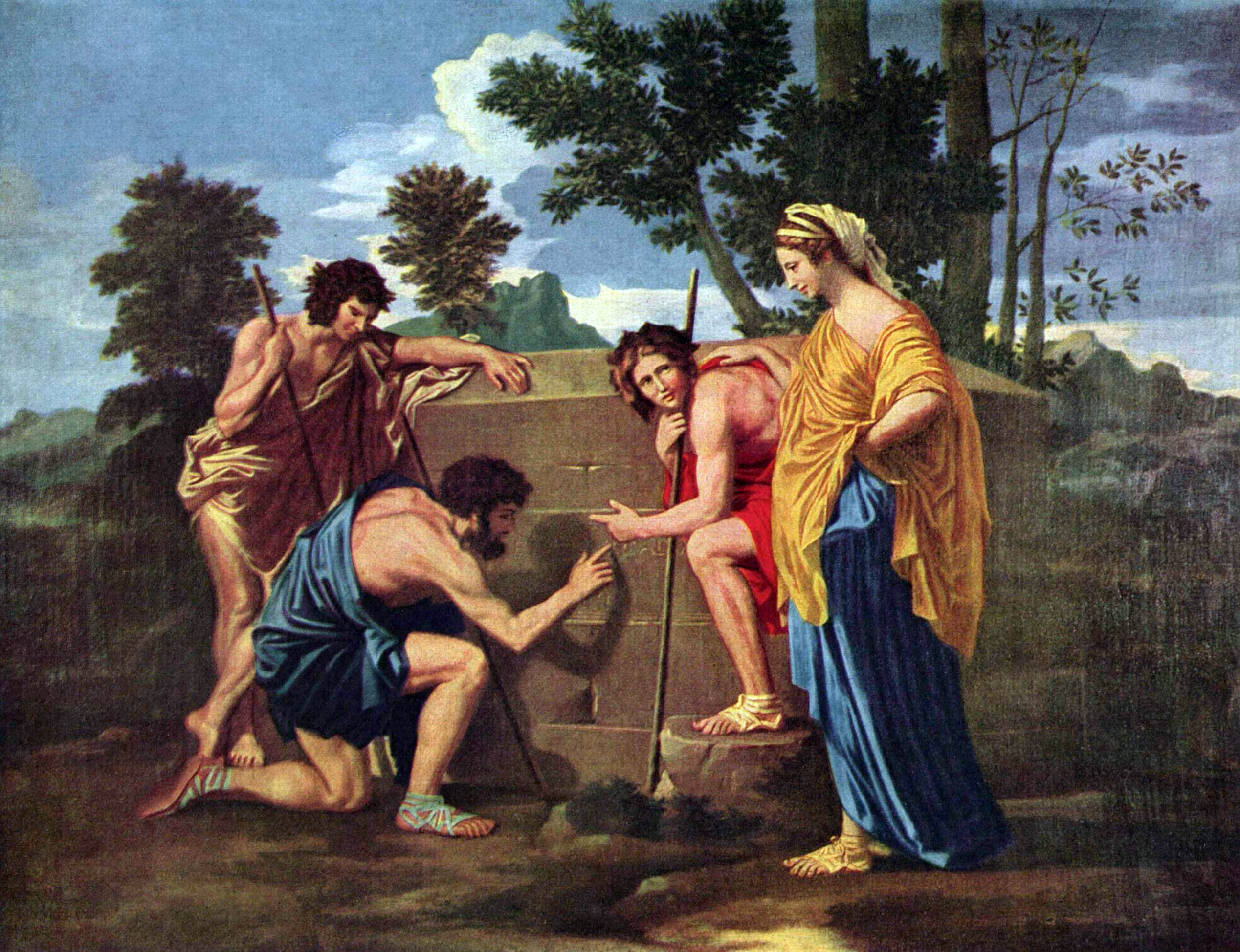
We can see that this has happened, for example, in Poussin’s Et in Arcadia Ego.

In this painting (also known as the Bergers d’Arcadie) three shepherds and a woman gather about a sarcophagus to remark upon the inscription they can see on it, which reads as in the title. It is now generally agreed that the painting is a kind of memento mori (“reminder you will die!”) and the inscription should be understood as “Even in Arcadia, there am I” meaning that even in an Earthly paradise, there is Death. This interpretation, however, was not always obvious to all, because the inscription is written upon the sarcophagus and the usual interpretation of such things is that they are being said by the person entombed therein. Thus, the Latin was tortured a little to give the meaning “I too lived in Arcadia” and signified only that others had preceded them in enjoying these delights. Eventually it came to signify no more than a kind of nostalgia for happiness now past. (Panofsky, E. & G. (1968) ‘The “Tomb in Arcady” at the “Fin-de-Siècle”’ Wallraf-Richartz-Jahrbuch, 30, pp. 287–304.) Goethe used a German form of it, for example, as the motto for his book of fond recollections of his Italian Journey.

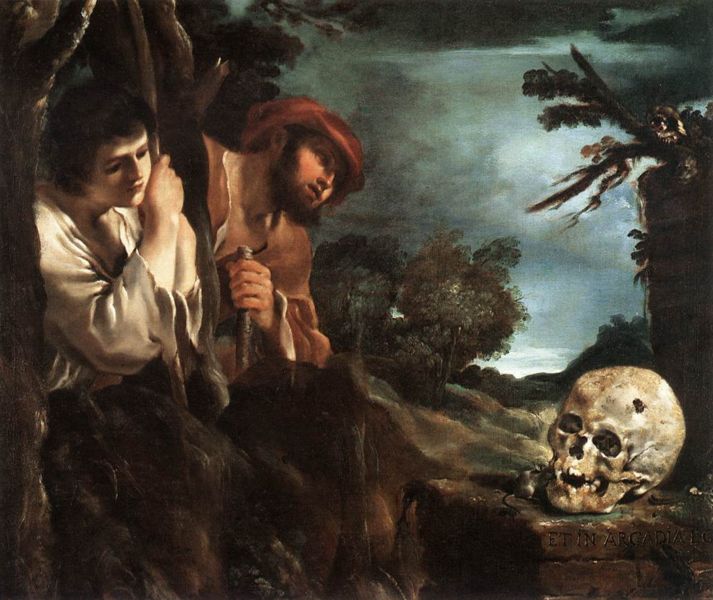
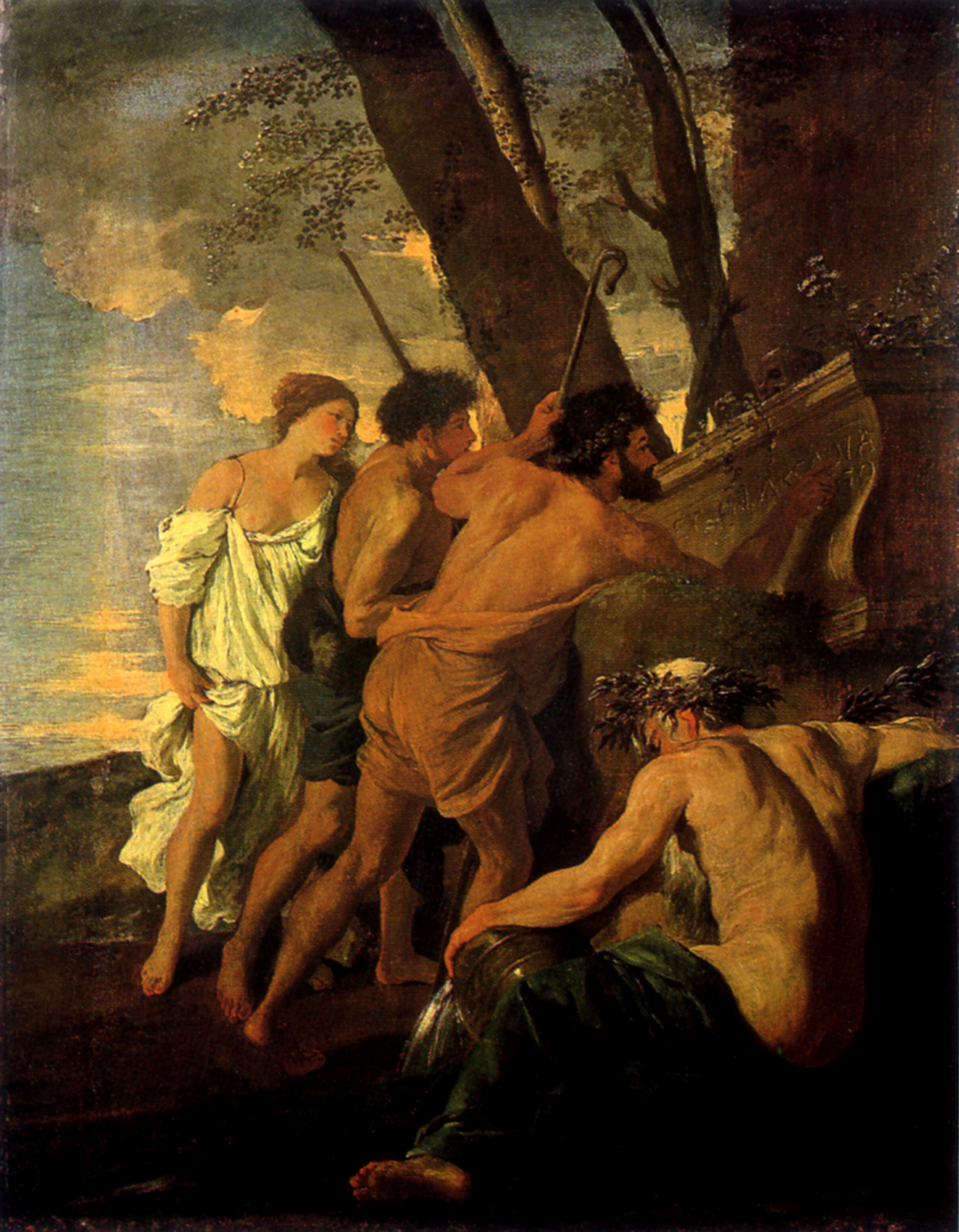
In order to arrive at the now-accepted interpretation it was necessary to trace the history of the painting’s theme through earlier versions. The famous version by Poussin was painted in 1637/8, but he also did a slightly different one in 1627 in which the sarcophagus bearing the inscription also has a barely visible skull on its top.

This painting in turn seems to have been inspired by a much more obvious painting by Guercino dated to somewhere about 1618-22 in which two shepherds ponder a skull atop an ancient masonry pedestal on which is inscribed the famous phrase.

In this context it is clear that the phrase is to be understood as spoken on behalf of the skull, which is the iconographic symbol of Death (it is still called a ‘death’s head,’) and thus makes sense of the more natural reading of the Latin. Poussin, in altering the pedestal to a sarcophagus and then removing the skull altogether, so violated the then-current norms of iconography that the original intention was no longer unambiguously derivable from the image itself.

The critic of AI will now say that the meaning of the painting cannot be the ‘remember death’ that Poussin intended, but, if anything, the ‘nostalgic for Arcadia’ that the painting’s earlier public understood. If the critic nevertheless continues to accept that in cases where the artist is successful in his efforts his intentions should determine the meaning of his artwork, then we might say that the critic is a Moderate Intentionalist.

Returning to our analogy, however, we should note that the moderate intentionalist approach doesn’t actually agree very well with our general attitudes to interpreting common speech. In the case of speech, if someone misspeaks or otherwise fails to say just what they mean, we do not simply write off their intentions as no longer relevant, instead we try to discover what they did mean despite what they said. This is an essential principle of charitable interpretation. It will then be a matter of dispute whether you wish to say that their utterance really had the meaning they intended or had none or had some other meaning that could be discovered using the usual (non-intention-seeking) rules for understanding speech. It’s worth noting, however, that in the case of the Poussin painting, the artist’s intention as newly established has pretty much displaced the earlier alternative interpretation as giving the painting’s meaning, so that the verdict of the art public here seems to favour the stricter AI claim.

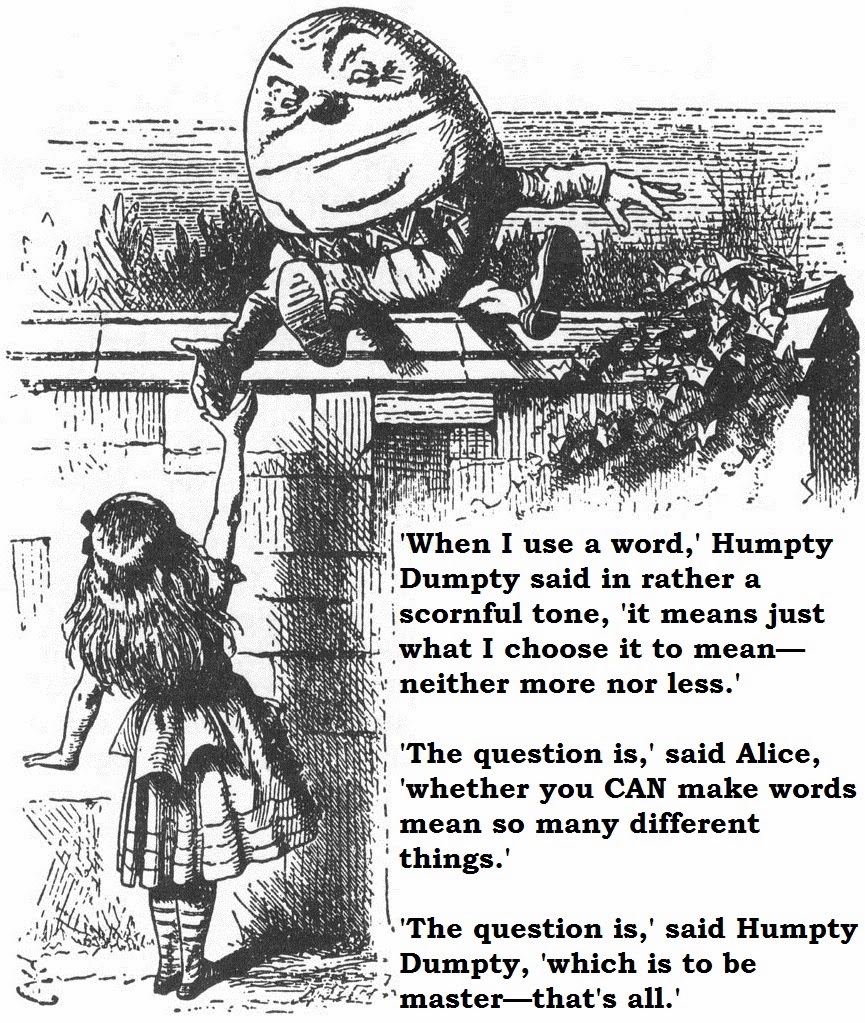
At this point we might also note the exchange between Humpty Dumpty and Alice Through the Looking Glass


Tags:

Titian – Sacred and Profane Love

March 23, 2019 – 8:38 pm

The appreciation of art is usually taken to involve an aesthetic judgement, and this judgement is most often said to be essentially non-cognitive. According to the Hume/Kant model of artistic appreciation, however, an aesthetic judgement of that kind is very often dependent upon a previous cognitive act of ‘understanding’ the artwork. Hume, for example, pointed out ((1751) Enquiry Concerning the Principles of Morals, §1) that

[I]n order to pave the way for [an aesthetic judgement,] and give a proper discernment of its object, it is often necessary, we find, that much reasoning should precede, that nice distinctions be made, just conclusions drawn, distant comparisons formed, complicated relations examined, and general facts fixed and ascertained. Some species of beauty, especially the natural kinds, on their first appearance, command our affection and approbation; and where they fail of this effect, it is impossible for any reasoning to redress their influence, or adapt them better to our taste and sentiment. But in many orders of beauty, particularly those of the finer arts, it is requisite to employ much reasoning, in order to feel the proper sentiment;

An act of understanding is thus supposed to be required in order to be able to present all the relevant features (whatever they might be) of the artwork to the faculty (whatever it might be) responsible for the aesthetic judgement. But whether or not we think that there is some special faculty or special judgement or special aesthetic quality, it is almost universally believed that a proper appreciation of an artwork can only be gained once the artwork is properly understood. For this reason the critical engagement with artworks has tended (very strongly) to be directed at increasing our understanding of them.

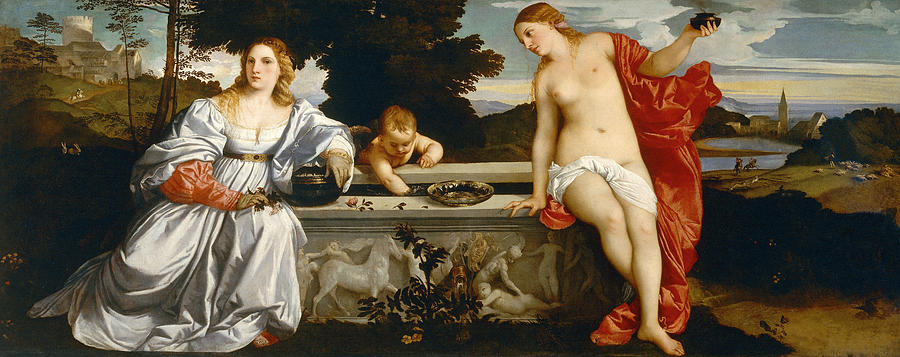
Consider, for example, the painting by Titian now known as Sacred and Profane Love

Certainly, this is a beautiful thing and it can be appreciated at that level alone in admiring the colours, the organization of forms, the images of two pretty girls, and so on; but no one really thinks that leaving the appreciation at that level would be doing justice to the art work, and therefore much scholarly effort has gone into understanding why the artist has disposed the details of the painting in the way that he has. Such enquiries, though they may not all reach the same conclusions, seem to be in general agreement about the sorts of things that would count as contributing to the understanding of the artwork.

Many begin by noticing, for example, that the painting is divided neatly into two with the details on one side being in some sort of correspondence with details on the other, and from that reasonably supposing that the painting has a ‘dialectical’ structure, so that the one half is a commentary upon the other. This was not an unusual way of proceeding at the time. Beyond that it has been proposed (by E. Panofsky in (1962) ‘The Neoplatonic Movement in Florence and North Italy’ pp. 150-4 in Studies in Iconology, New York: Harper & Row, pp. 129-169) that the two figures are two images of Venus – one, the Venere Vulgare at left standing for the generative, fertile, earthly form of love; and the other, the Venere Celeste standing for the pure, intelligible, intellectual and universal form of love. The identification does not come out of nowhere: there are arguments from the nature of Titian’s earlier works, his prior and later use of imagery, the iconography and thematic concerns then current, and references to the contemporary philosophical movements and literature. In any case, it does make some sense of the background details, as on the left there are rabbits (a pretty obvious symbol of fertility) and the turret of a town (where worldly interests are pursued;) while on the right we see the campanile of a church, sheep, and a hunt in progress. In this interpretation, inspired by the Neoplatonism of Marsilio Ficino – as perhaps transmitted to Titian in discussions with his friend and leading humanist Pietro Bembo – the two figures in harmony indicate that an emergent harmony between Earthly and Heavenly Love is possible, that the idealised form of each is compatible with the other. This, it is felt, is an appropriate signification for a painting that was intended as a wedding present to celebrate the marriage of Nicolò Aurelio (whose coat-of-arms is seen on the frieze beside the spigot) and Laura Bagarotto. (The woman on the left is dressed as a bride with myrtle flowers which are symbols of Venus and also signify married fidelity.)

According to that interpretation, then, we should understand the painting as a meditation on the proper form of married love, and an exhortation to its realisation. So, if we were correct above to say that an understanding of the artwork is essential to its proper appreciation, and if the methods of producing the appropriate understanding are such as produced the interpretation at which we have arrived, then it is this sort of understanding that we seem to believe is essential to a just appreciation of Titian’s painting.

But what sort of understanding does this kind of interpretation give us? Well, pretty clearly, it takes the artwork to be the deliberate creation of an artist who had some intention in mind in creating it; and it is assumed that a proper interpretation will depend upon identifying the intentions of the artist. For that reason, we note that the painting is of a genre with which the artist was familiar, that he would therefore be aware of the purposes of that genre and how it was meant to be interpreted. We propose the sort of interpretation that we could imagine the artist feeling was appropriate in the circumstances of the painting’s commission as a wedding present. We present evidence that the artist might well have had the intellectual resources to intend that interpretation by looking at the intellectual milieu in which he existed, and even at the popular ideas of his time. We look at his other works to see whether the use of iconography required for that interpretation is consistent with his other uses of similar elements. And so on.

All of this points toward a theory of interpretation that is called Actual Intentionalism

Tags:

Confucians can torture

May 8, 2017 – 11:02 am

I asked Sam Crane at Useless Tree:

Are there, in fact, any arguments against torture in Chinese philosophy that aren’t basically utilitarian? If there aren’t, then could there have been? In Western philosophy our arguments are usually from appeal to various notions of ‘human rights’, but that wouldn’t be possible for the Chinese sages. Other arguments are from the harm done to the character of the torturers: i.e. you don’t want to be the sort of person who does that, so it’s morally impermissible for you to do so. Is it possible to run such an argument in the Chinese context? Has it ever been done?

His reply was to the effect that a Mencian interpretation would require that “The noble-minded, who conscientiously cultivate their appetite for Duty and Humanity, are obviously most repelled at the thought of the suffering of others.  Thus, the noble-minded would not take up torture…” I found this doubtful and sent the following reply, which I think might be interesting.

I think the arguments that you give are likely to be the sort that a Confucian sage would give on this topic if he wanted to argue against torture, and I think you’re right that he would have a preference for not torturing, but I doubt that that preference could be extended to a blanket prohibition against torture – at least, not on the grounds you give. Your proposed argument appeals to the limits placed on a man’s possible behaviours by his ren, and no-one doubts that there are such limits, but I think that even fully-developed ren cannot play the role that you want it to play of erecting impassable barriers against some forms of behaviour.

It’s reasonable enough to suppose that on the Mencian understanding of human nature, torture would offend against the compassionate element of human nature that allows us to feel empathy (for the child in the well, for example.) Also, it is right and proper to nurture this aspect of our human nature, for it is the seed that grows into ren (“The heart of compassion is the germ of benevolence” (2A.6)) and ren is one of the virtues. Now, Mencius wants us to develop this ren as far as we can, to make us noble, from which it follows that the truly noble man is one who is truly compassionate; but your claim would then be that no truly compassionate person could bring themselves to cause pain to another, and that therefore torture would be effectively absolutely prohibited. This, I think, does not follow.

Ren cannot be just free-floating compassion. To be a virtue it has to be expressed according to the li. If there are cases where, according to the li, the appropriate way to show ren involves causing some pain or even killing, then it couldn’t be the Mencian position that causing pain was never the right thing to do; and that opens the door to a possible justification for torture *in some cases*. So the question now is, do the li ever call for such a thing? I think that, given the widespread acceptance of punishment in Chinese society, we’d have to say that the traditions did encompass the inflicting of pain as part of the pattern of behaviours that contributes to a harmonious society. Those traditions are the li.

So I don’t think that “Don’t do what should not be done, and don’t desire what should not be desired” is going to give us the blanket prohibition that you suggest, because it leaves it up to an interpretation of the li what it actually is that should or should not be done, and the li may well allow us (or demand of us) that we inflict pain.

One way (the only way that I can think of offhand) to deny that this mediation of ren through li has the consequence I am suggesting, would be to claim that the only cases in which inflicting pain was according to the li involved it being inflicted by a superior upon an inferior, and that Mencius thought that the noble character aspired to treat all men as social equals. All relations then would be relations like friendship – and in no circumstances is it proper for a friend to cause pain to a friend. But could such a claim be supported? I doubt it; because it would mean that Mencius had taken up the position of the Mohists, and he was pretty clear elsewhere (e.g. 3B.9) that Mohism was wrong on just this point.

There’s one other thing that might be relevant. This conversation started with a consideration of the proper treatment of prisoners of war; but what is their place in the Confucian division of society? Which one of the five fundamental relationships covers the captive enemy soldier and his captor. I would guess that it would be the sovereign-subject relationship, but I don’t know. If the relationship was not covered at all, or not recognised in the li, then the Confucian would have no guidelines at all as to the proper behaviour.

Tags:

The Confucian Canon

May 8, 2017 – 10:29 am

Confucian_canon

Tags:

Limits to Reason

May 8, 2017 – 10:25 am
Colin McGinn had a comment on the human tendency to irrationality, partly wondering why people are so irrational given that “human irrationality can seem the oddest and least adaptive trait of the species,” and accepting that “we need to know what causes irrationality and what we can do to fix it.” I replied, and I thought I might as well save that reply here:

There is a general assumption that rationality is adaptive – and your claim that irrationality looks maladaptive would be a version of that – but Stephen Stich in his book The Fragmentation of Reason went through a selection of the arguments that he could reconstruct for that position and found them all pretty badly wanting. Even without reviewing his counterarguments, it must be pretty clear that if rationality really was so advantageous it wouldn’t have taken 3 billion years to arise in the current evolutionary process; so the mere fact that we are as rational as we are (or can be) is something that we should marvel at.

There are, in fact, very good reasons why a restricted irrationalism might be an optimal evolutionary strategy, and why we should therefore expect people to be irrational at least to some degree. (Cherniak’s Minimal Rationality has more thoughts on this topic.) The principal reason follows from the fact that we cannot expect any natural system to be a perfect reasoner. For one thing, there are physical limits to deductive capacities in any finite device. Since we can’t be perfect reasoners, and there are time constraints on the reasoning that we can indulge in, it makes sense that we would be designed to take shortcuts (as Breako mentioned.) These shortcuts get us answers that are good enough and tend to err on the side of safety. That is an evolutionarily superior strategy to one which involves just reasoning – even reasoning according to the most reliable rules of induction or deduction. There’s a lot of work on this sort of thing following on from Kahneman and Tversky’s experiments. (It’s not even the case that ‘knowing the truth’ or ‘disbelieving falsehoods’ has an adaptive value in itself. One very annoying finding is that people who are religious believers are relatively more successful and happier than others – and it doesn’t seem to matter what they believe in, just that they believe.)

In this respect then, we are really in the same position as many other animals on this planet, having a certain degree of rationality, far from perfect, and trying our best to get along with what we’ve got. One way to see how our limits affect us, and why we should be cautious and humble in applying our reasoning powers to complex questions, is to look further down the Great Chain of Being and see how the situation looks for those ‘lower’ creatures. Take dogs for example. Do we think dogs would be better off if they were stripped of their instincts and the traditional social structures of the pack, and were left to attempt to reason out their life choices? Would such animals be able to set appropriate goals for themselves? And for any choices they made, would they be competent to reason out the proper means to achieving them, or would they fail because they are just not smart enough and don’t have a proper understanding of the way the world is? And if we can accept that those animals have that problem, and that we are essentially just as far as they are from perfect rationality, then does it not follow that we will have that problem too?

I guess the upshot of this reasoning, if it can be trusted, is that we don’t really know when deliberate reasoning is the appropriate way to get to a practical conclusion. At least, we shouldn’t be so sure that more ‘rationality’ is going to be a good thing, and that people who are acting irrationally, if that means acting against the reasoned opinions of others, are necessarily doing the wrong thing.

Tags:

Thoughts on Torture

May 8, 2017 – 10:22 am

Christopher Hitchens has followed in the footsteps of Steve Harrigan and subjected himself to the process known as ‘waterboarding’ in order to be able to report more insightfully on just what it is that is the focus of so much controversy. He reports that it is clearly torture and that therefore it ought not to be practised. On the other hand the Americans say that they don’t torture, but that 3 persons were waterboarded in the early days after 9/11; from which we might conclude that they don’t consider it to be torture. In both cases, however, there is a fundamental agreement: torture is inadmissible under any circumstances.

One way that the argument might now go is to start disputing what is and is not torture. According to the UN it is “any act by which severe pain or suffering, whether physical or mental, is intentionally inflicted on a person for such purposes as obtaining from him or a third person information or a confession.” (Plus some other conditions.) But according to the US memo… Any definition is going to have to distinguish between treatments that are merely unwelcome to the subject and things which are somehow more serious. And legal definitions need to be precise. There will then be borderline cases. Torture is as vague a concept as any.

Another obvious area of dispute is to whether we can mean what we say when we make torture inadmissible under any circumstances – and here we would start talking about ticking time bomb scenarios, Dostoevsky’s Grand Inquisitor, etc. 

But all that can be put to one side. What I want to know is why torture is impermissible. How do we go from  whatever definition of torture we adopt to a ban on its use?

Information is unreliable. That’s just not a very plausible position. Nazis used torture quite effectively to roll up resistance operations. The Americans say that a huge amount of usable (and used) information was obtained through waterboarding KSM and the two others. Witches under torture gave up the names of their friends and family – can one doubt that they would have given up the names of their fellow witches if there had been any? In any case that is not really why people would oppose it. Just ask yourself – if it could be shown that torture was reliable in 99% of cases in establishing the truth (and if we applied it to everything from parking tickets to murders I wouldn’t be surprised if it was that effective,) would that change our opposition to its use in (almost) any circumstances. I don’t think so. 

This is especially difficult for someone like myself who doesn’t any longer believe that there are such things as fundamental, inalienable, human rights.

Tags:

What’s the Point of This?

May 8, 2017 – 10:20 am


A: Imagine this B: Look at this
Something big wrapped in plastic Christo Javacheff (2000) Wrapped Reichstag Project for Berlin
A pickled cow Damien Hirst (1995) Mother and Child, Divided
Some bricks William Anastasi (1964) En Route (Stack of Bricks) Originally untitled
A toilet Marcel Duchamp (1917) Fountain
A bike seat with handlebars arranged like a bull Pablo Picasso (1943) Head of a Bull
Dirty sheets Tracy Emin (1999) I Think It Must Have Been Fear
A light turning on/off Martin Creed (2007) Work No. 227: The Lights Going On and Off
A picture of a soup can Andy Warhol (1968) Soup Can
A really big comic book Roy Lichtenstein (1962) Blam
repeat ad nauseam

.

.

.


.

.

.

.


What do you get from column B that you don’t get from column A? Whatever you get has little to do with Art – if Art is anything more specific than ‘an experience.’ As Art therefore, the elements of column B are purely pointless.


Tags:

Art vs. Pornography

May 7, 2017 – 11:06 pm

Many defenders of Bill Henson’s pictures of naked sexualised children claim that the public (Philistines) are wrong to condemn Henson’s work as pornography because they are art. (But note that some in the Art world’s ‘in crowd’ were prepared to admit Henson’s offensiveness before the public noticed.) In making this claim they appear to be confusing two applicable dichotomies: that which divides images that are pornographic from those that are not; and that which divides images that are Art from those that are not. They ignore the perfectly valid possibility that an image may be both Art and pornography. Without getting into the weeds of definitions, it’s clear enough that, whatever Art might be, Pornography is understood and sanctioned as something belonging to a category of items that if allowed currency would be damaging to public morality. The following grid shows the possible combinations and some representatives.

 Pornography  Not Pornography
 Art  Bill Henson  Sandro Botticelli
 Not Art  Kayleigh Pearson  C. M. Coolidge

The situation is slightly confused by the possibility that the current Australian law that regulates these things (and I will not pretend any familiarity with it) does make some allowance for artistic license. In a previous version of the law, I believe, a disputed piece might be given a pass on the basis of  ‘expert opinion’ as to its ‘artistic merit’. In that case, legally speaking, the category of pornographic art is effectively empty. (Also, if that were the case, the public would be right to conclude that the law is a ass.) Let us suppose, however, that the Henson defenders intend more than a purely legal claim. How then could we charitably interpret their claims that Art should not be restricted by pornography laws; and could such claims be reasonably defended?

If Artists want the public to accept that a picture is de facto rather than de jure not pornography just because it is Art, they will need to defend that claim. Given that they accept that the very same picture that counted as pornography when found on some dirty old man’s hard drive would not be pornography if it were hung in a gallery and accepted by them as Art, they will have to argue that Art is defined as Art by something external to the artwork itself. What could this possibly be, and could whatever it is really provide a guarantee that Art is not Pornography? Several possibilities seem most likely to be argued here:

  1. Perhaps it is the intention of the artist that is relevant. A thing is or is not pornography depending on whether or not the artist willed it to be so. This seems to be a promising line: it’s obviously true that the intention of the pornographer and the intention of the artist are supposed to be quite different – the pornographer intends to pander to our basest preferences, and the Artist (one is certain) has some other purpose in mind.

But this will not do. The arguments of Beardsley and Wimsatt against the ‘Intentional Fallacy‘ apply here more effectively even than in the cases that those authors intended. Recall that Pornography is understood and sanctioned according to its feared effects on public morality, and the intentions of the artist in the case will almost always be irrelevant to the effects of the artwork. (In general, indeed, we have no access to the artists intentions, so interpretation that relies on this access is impossible.) A thing is or is not pornography without regard to what the intention of the artist might have been in creating it.

  1. Is it then the intention of the set of experiencers, the audience let’s say, that makes the difference; so that whether something is pornography or not depends upon the attitudes that the audience members take to the experience of the artwork? That is what seems to be suggested by the objection to the previous proposal. If the audience can be relied on not to be badly affected by the art, not to be titillated, not to have base motives excited, etc., then surely the Artwork is not to be considered to be pornographic. So an Artwork that appears in an Art gallery and is seen by the Art crowd can have no evil tendencies. Therefore it cannot be pornography.

It is certainly possible that some specialised audiences might be more resistant to the corrupting influence of some works than others, but even if that were true that wouldn’t support the claim being made. In that argument the audience of the Artwork has now been restricted to a  non-random subset of the possible audience, whereas the understanding of pornography that we have is that it is defined in reference to the effects of the work if it is available to be experienced by the entire possible audience (or, equivalently, to random subsets of it.) The claim that could be made here is that the Artwork is not harmful if the audience is an Art crowd, but that’s not the same as saying that the Artwork is not pornography. Child pornography appreciated by the Art crowd would still be pornography.

If it is claimed that Art should have a special dispensation from this moral judgement – and artists have recently been keen to claim that they are above the moral laws that apply to the rest of benighted mankind (especially since the mid XIXth C, see Grana Modernity and its Discontents) – then they will need to make the case for that privilege. I can’t see any prospect of a successful argument along those lines, but suppose that we accepted this proposal; what then? Well, since the argument does not deny that the State may have an interest in restricting some forms of symbolic production on the grounds of public good, we will need to know when to apply this privilege.

  1. Perhaps we may be supplied with an uncontroversial, non-trivialising, and impartially applicable definition of Art that will operate as a filter: each piece may be tested against this definition and a decision reached as to whether the thing is Art or not and the Art privilege is to operate or not.

Unfortunately, given the controversy that has surrounded all previous proposed definitions of Art, I think we have good reason to believe that no such objective and applicable characterization of Art is to be had. There is a further irony in this case that in previous attacks on ‘Modern Art,’ where it has been claimed that this or that piece is “not Art,” the response of the Art crowd had been to mockingly and rhetorically demand a definition of Art from their attackers. Failing to be able to say what is or is not Art has for some reason been seen as giving the Artist the ability to claim that whatever he wants to do is Art. (It should have made Artists wonder what on earth the point of their occupation was, and it should have made Art funding bodies wonder about what their (usually tax-derived) money was funding. But that’s another topic.)

  1. Perhaps we can can take the Art crowd at their word then, and define Art as what Artists do. Then, anything that looks like Pornography but is done by an artist would invoke the Art privilege. All that remains is to find a definition of an Artist that is not equivalent to ‘someone who makes Art.’ Since Artist’s are to be the beneficiaries of a privilege extended by the State, the State will have to agree on the method of discrimination – rather like the priesthood or the medical profession. Perhaps he is to be a member of an official body of state-recognised artists – a sort of Arts Academy with legal teeth. How will membership be determined? How will Artists enjoy being organized by the State? (It wouldn’t exactly be consistent with their revolutionary posturing would it? In fact, wasn’t Modern Art largely a rejection of the Academy Art of earlier times?) And will their audiences be similarly organized in order to benefit from the Art privilege? A State-run connoisseur’s club? All this hardly seems to be in the spirit of the defences of Bill Henson; and a solution on these grounds might seem to be worse than the problem it is intended to solve.
  1. Perhaps it will be claimed that Art is what happens in Art venues; but I think it’s pretty obvious that all the same problems that attached to Art-as-what-Artists-do will also apply here m.

No, I am afraid it will not do. There can be no Art privilege in these matters. Artists will just have to accept that they must obey the same rules as the rest of the citizenry – and Bill Henson should stop taking pictures of naked children.


Andrew Bolt has an amusing debunking of particularly bad arguments given in support of Bill Henson and the Art Privilege in Prejudices stripped bare (Herald Sun, 28/05/2008)

Tags:

A Modest Proposal for Middle-East Peace

May 7, 2017 – 10:52 pm

Context

UN resolution 242 calls for a withdrawal to secure and recognised borders.

Israel may have to accept that no conceivable borders can satisfy both criteria. The Arabs maintain a maximalist (or very nearly) interpretation which insists on Israeli withdrawal to the 1948 borders, but these are impossible for Israel , given the hostility of the surrounding states – and especially if the state that arises in the vacated territory is hostile. The evidence of the withdrawal from Gaza and from South Lebanon is that such a state would indeed be hostile.

Desiderata

Israel cannot

1.      maintain a military occupation of conquered territory and a conquered population indefinitely,

2.      annex all the disputed territories and make the Arab population citizens of Israel ,

3.      withdraw to the 1948 borders leaving a hostile entity in the disputed evacuated territories,

Israel must

a.     control the Jordan valley

b.     have guaranteed access to East Jerusalem religious sites – and in the view of the Israeli population, probably must retain sovereignty over those sites

c.     be able to neutralise the danger of Arab irredentism/revanchism/etc.

d.     rid itself of the burden of controlling a hostile and essentially irreconcilable population

e.     resolve the issue of the settlements in the disputed territories humanely (evacuation? extraterritoriality? retained control? Population transfers? etc.)

Israel would prefer

         i.     a ‘Palestinian’ polity (PP) to control and be responsible for the Palestinian Arab population

       ii.      a stable cooperative regime in any Palestinian polity

      iii.      not to be required to concern itself with the internal affairs of the PP (even if it became hostile or unstable)

     iv.       an internationally recognised solution (but can probably be satisfied with one which is merely acceptable to America

Arabs require

A.   an independent polity

B.    a viable polity

C.    access to East Jerusalem religious sites – and have always maintained that the sanctuary must be their sovereign territory (but see Israeli b)

D.    a polity free of Jewish settlers – though they might be permitted to remain as dhimmi

Opportunity

The time is right for an Israeli unilateral solution to the problem of the Disputed Territories

1.     PA is thoroughly discredited internationally because of its involvement in terror, corruption

2.     PA leadership is recognised as not being capable of making peace ( Camp David , intifada Hamas elections, etc.)

3.     the overwhelming likelihood of the hostility of any potential PP is recognised, and Israeli security concerns are as widely recognised as can ever be expected to be the case

4.     America sees the relation between the Israel- ‘Palestinian’ conflict and the wider West-Islam friction – and also associates the Arab allies of the Palestinians with threats to American interests

5.     Middle-Eastern ‘stability’ is no longer valued per se

Proposal

Under the Oslo agreements the disputed territories were divided into classes of territories as A, B, C. The PA was given control of area A territories. These were territories surrounding centres of Arab population. Under this system the PA controlled over 95% of the Palestinian Arab population.

I propose that

1.     Palestinian area A be taken as the basis for a PP with whatever other areas are required to make those areas minimally viable.

The intention under Oslo was that PA control would eventually be extended over Pal. B territories etc to create a contiguous/connected territory. Gaza would always remain unconnected however.

2.     The effort to create a single Palestinian state as a PP should be abandoned. The PP may be instituted as separate, independent governments of the Palestinian cities and their hinterlands.

(Since the problem of non-contiguous Gaza will have to be faced anyway, there is no reason that whatever solution may be found for Gaza’s communication with the PP instituted on the West Bank would not serve equally well for communication in this plan.)

3.     Territory not assigned to the PP should be annexed to Israel .

4.     Population of the annexed territories may either become citizens of Israel or may be compensated and allowed to transfer to any part of the PP.

5.     Jewish population of the areas assigned to the PP either become citizens there or are relocated with compensation (by Israel .)

Process

1.     Reoccupy all Disputed Territories

2.     Delimit PP zones: I suggest Ramallah, Bethlehem , Hebron , Jericho , Tulkarm/Qalqilya, Jenin and their hinterlands

3.     Separate populations

4.     Annex unassigned territories to Israel

5.     Build a fence around the PP territories (This is already largely completed.)

6.     The final stage has two possibilities

1.      Clean Break (strongly preferred)

1.     Withdraw from PP territories

2.      Nation Building (invents a new quagmire to replace the old one)

1.     Remove all PA officials

2.     Disarm and demobilise all PA security forces and other ‘formal’ militias (Hamas, etc.)

3.     Remove terrorist infrastructure – including UNRWA, EU, NGOs

4.     Assume responsibility for administration of PP

5.     Assume responsibility for funding of PP

6.     Incrementally develop native administration of PP

7.     Incrementally withdraw from PP

Advantages

1.     Largely removes need for prolonged negotiations (Arabs have shown no good faith previously)

2.     Provides quick, relatively neat final solution to be put in place; removes uncertainties

3.     Provides a separation of populations desired by both sides

4.     Provides strategic depth to Israel – all of Jordan valley (west bank lowlands) held by Israel

5.     Allows a hostile PP to be quarantined from sources of weaponry

6.     Allows maximal control of population movements from PP to Israel continuing the reduction in levels of violence that the incomplete fence has already achieved

7.     Preserves Jewish character of Israel and Arab character of PP(assignment of lands and populations results in only a small increase in the Arab population of Israel )

8.     Allows Israel to cease governing hostile alien population either immediately (preferred) or relatively quickly and on a known schedule

9.     Provides immediately/eventually for independent Palestinian Arab governance of an independent PP.

10.   After withdrawal PP internal politics need no longer concern Israel vitally

11.   Although there is the opportunity to create a functioning liberal regime in the PP, nothing hangs on this. (The example of the current dysfunctional government does not encourage such a commitment – hence the preference for Clean Break)

12.   Both strategies – but Clean Break especially – provide Israeli forces with a foreseeable end, improving morale

Disadvantages

1.     Unilaterality means no other actors are committed to the success of the proposal

(It is not clear how much of a disadvantage this is. Arab states are apparently incapable of publicly supporting any peace deal, Egypt and Jordan notwithstanding, so no peace proposal can be made dependent upon their approval or cooperation. In the best case they may acquiesce, though they are most likely to continue their current hostility.)

2.     Proposal falls far short of satisfying the Arab maximalist position, or even the ’48 or bust’ solution. For this reason it will be unacceptable to Arabs and some others.

(Whether Europe and others will seriously dispute the execution of this proposal is unknown. They will certainly complain and decry its ‘unfairness’ pro forma, but they seem to have no interests requiring more.)

3.     ‘Viability’ of PP is likely to be disputed

This will be answered in detailed arrangementsfor communication and general access through Israeli territories. I see no reason why cities and suitable hinter;ands may not be viable, given good will on the Israeli side.

4.     Dependence on Israeli ‘good will’ is humiliating and will ensure hostility

Possibly true. However, Israeli security could hardly be secured without infringing Arab ‘honour.’ Moreover, PP hostility is irrelevant if they can be made impotent.

5.     Will probably make many Jewish religious sites inaccessible if PP is hostile.

Unfortunate, but not unbearable

6.     No concessions are made to long-standing Arab demands – whether those demands were sincerely made or not – which will upset some

(See final status settlement for East Jerusalem , Refugees, etc.)

Problems

1.     Status of East Jerusalem

Old City will remain in Israel . Arab inhabitants will be given choice of citizenship in Israel or PP. Etzion Bloc to go to Israel .

Any person to have the right to visit the sacred sites in the Old City – principally referring to the right of Muslims to visit the Haram.

Temple Mount outside the Haram to be Israeli territory. Haram to be shared sovereignty with some appropriate authority. The form of words may be left for diplomacy, but the facts will be something like: PP administration over Haram, Israeli security about Haram (including authority to quarantine or restrict access if incitement leads to violence or general level of PP hostility makes it dangerous.)

2.     Right of Return

Denied, of course. However, final compensation may be paid to a responsible UN agency for distribution amongst claimants, or paid to PP authorities with understanding that misappropriation on their part will not void the finality. Amount of final compensation to be set by Israel . A process to determine a fair amount to be decided upon. It is to be made clear that compensation is humanitarian aid and does not constitute an admission of guilt or liability for disadvantages.

The Arabs will almost certainly decline to cooperate. Israel may put this compensatory money in an escrow account to be tapped whenever they decide to accept it. This would actually be good for the Palestinian Arabs as symbolizing finality of claims and providing capital; and would be symbolically good for Israel as demonstrating bona fides

3.     Arab State Hostility

No change in current status except perhaps with respect to Egypt and Jordan .

Egypt has a very Cold Peace with Israel and government has made no effort to pretend that anything more than the desire for US money makes them pay lip service to the peace. There will be no change here, despite popular unrest

Jordan ‘s political shape may be more seriously affected. Israeli unilateralism – which Jordanians will see as a repudiation of the ‘land for peace’ formula to which Jordan has been committed and by which Jordan has tried to justify its peace – will be read as a betrayal of the principles of the peace.

Syria will do what it can to derail the process if there is no concession on the Golan Heights . Syria and Iran may take the opportunity to incite their collaborating forces in Lebanon to conflict with Israel . Unfortunate, but that was always going to happen whatever Israel did.

Diplomatic activity may be able to ameliorate some of this hostility. Perhaps some concessions may be made.

Egypt will be given joint control with the PP over the Gaza border with it – as it has now wrt the PA.

Jordan may be given an administrative role for the Haram. This has the advantage of playing into a threat of Hashemite revanchism wrt the sites at Mecca and Medina, and threatening Saudi control of Arabia . A threat which it is handy to have in the background when negotiating for Saudi cooperation.


Tags: