On Supposed ‘Indigenous Ways of Knowing’
June 28, 2026 – 11:40 amWhat are these ‘indigenous ways of knowing’ (henceforth, IWK)? Let’s ignore the term ‘indigenous’ for the moment: we will see that it has its own problems. An unsystematic review of many of the official and semi-official resources available online is extremely confusing, since there seems to be no consistent distinction made between several very different possible meanings. We find IWK treated, for example, as describing:
- Actual alternative epistemologies, in which beliefs may be accepted as knowledge on the basis of justifications or even forms of justification that are not accepted by the non-indigenous. This would be the most interesting possibility, and it sometimes seems to be what the proponents of IWK think that they are claiming, but it isn’t usually what the longer discussions address.
. - The ways in which beliefs are received and transmitted; by song, campfire yarns, mothers talk, initiation rites, instruction by and observation of elders, observation of the world around them, some trial and error, etc.
. - The sorts of things that are known or believed by indigenous persons. How seasons affect game, the names of the natural features and the plants and animals they live with, the associated myths and legends, the techniques of hunting, gathering, farming, distributing resources, and so on. In this case, the IWK is hardly distinguishable from what are called Indigenous Knowledges (IKs, note the plural.)
. - The ways in which those ideas are incorporated into the indigenous society, or how they are experienced. In such societies, it seems to be thought, beliefs are not just ‘had;’ they only exist as the motivations for dances and rituals, the themes and content of stories and myths, the methods and traditions that guide successful hunts and house building and parenting, the assumptions of the language, and so on. The ‘beliefs’ are thus supposed to be integrated into the lives of the people and not separable from them.
As Ways of Knowing
In so far as we are concerned with knowledge in a philosophical rather than an anthropological sense, it is really only the first listed understanding that is of any interest; and in so far as the discussions surrounding IWK are intended to be relevant to that understanding, it would seem that the claim is (implicitly) made that the justifications by which belief may become knowledge are that they are incorporated in story, embodied in cultural practices, heard from elders, or are presented via some other such mode.
Presented clearly in this way it becomes patent that IWK cannot be taken seriously as ways of gaining knowledge. None of those modes of presentation are adequate in themselves to assure us of the truth of the claims that they present. The only way that that might be disputed is by adopting some non-standard view of truth that makes it relative to a particular indigenous culture. I have no sympathy with such relativisation, but that’s a rant for another time. Suffice it to say that if IWK are to be defended on that ground it will face an uphill battle for acceptance outside the captured Academy.
As Indigenous
One notes that IWK are always and only contrasted with Western Science. I suppose that in a certain sense that’s reasonable, since ‘Western’ Science is the most successful intellectual epistemological project in the entire history of life on Earth, but Science is not the be-all and end-all of Western ways of knowing. Scientific methodology does not notably feature in historical writing, poetic or literary analysis, wine tasting, and any number of other areas. Moreover, it isn’t absolutely clear that all Westerners are non-indigenous. I doubt that the Welsh or English, the Bretons or the French, the Basques or Germans could reasonably be described as less ‘indigenous’ to their places of habitation than the Maori or the Bantu or the Comanche. And yet, it is never claimed that the ways of knowing in those ‘Western’ (they mean ‘White’) populations are to be included in the list of characteristics claimed to belong to the IWK.
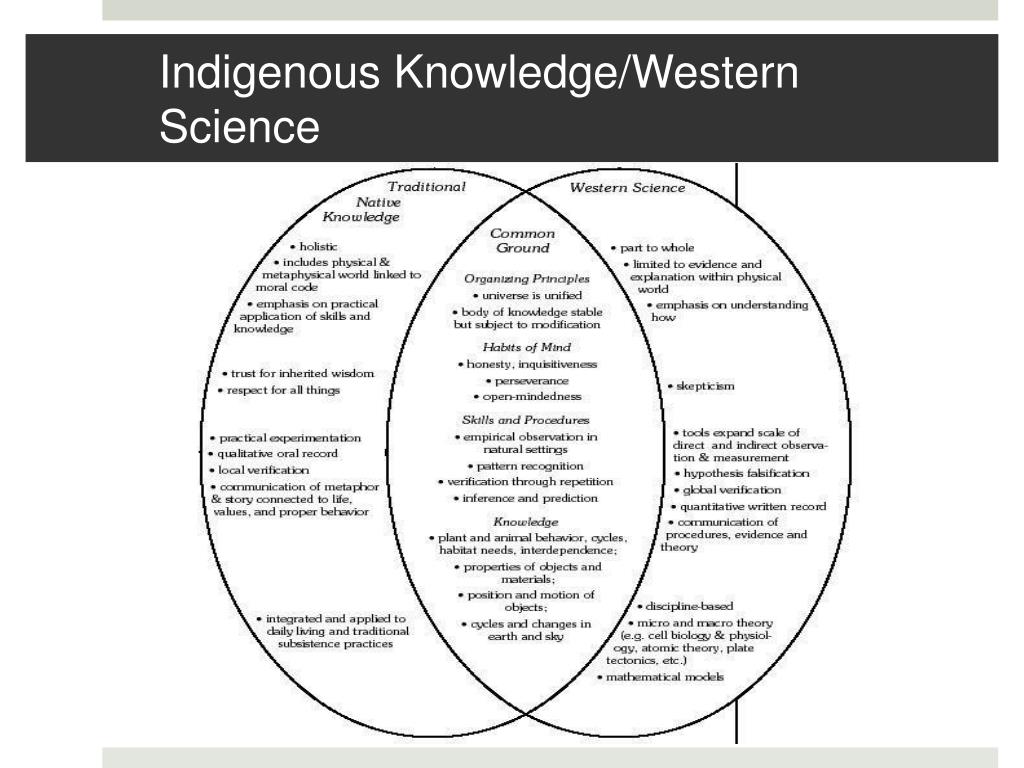
We get a better idea of what’s really being compared here when we further note that the Chinese and the Indians and the Persians and the Arabs and so many other highly civilised peoples who have an equal right to be known as the indigenous of their lands are also utterly ignored in the characterization of the IWK. Does anyone think that the vast complexity of ‘traditional’ Indian epistemology or knowledge production is well captured by the left lune of the diagram above? How homogeneous are we to think are the Chinese ‘traditions’ of Daoism, Buddhism, Confucianism (and that’s just the majors,) and how well described as / reduced to IWK? How, finally, are we to imagine that the intellectual epistemological traditions of all those civilisations are to be seen as basically the same as Maori, Mohican, or Hottentot?
Clearly, the ‘Indigenous’ in the term IWK is not referring to peoples picked out by their indigeneity, but rather according to the sophistication of their culture. But that of course, would be an unacceptable observation for two reasons: firstly, and most importantly, because it might ‘hurt their feelings,’ and secondly, because it would then become much more obvious why we might no longer accept IWK as providing appropriate epistemological standards.
Tags: