Occupy Phobos!
March 21, 2026 – 6:29 pmElon Musk is determined to create a viable human civilisation on Mars and is intent on going there directly as quickly as possible (notwithstanding his slight detour through the Moon.) I think this is a mistake. I believe that there are many advantages to the creation of a base on Phobos as a preliminary step to the human exploitation of Mars.
- The moon is more accessible than the planet (technologically speaking.)
- The ΔV required is about ¾ that for a landing on Mars.
(ΔV Earth Surface-Mars Surface = 9.3 (ES-LEO) + 4.3 (LEO-MTO) + 0.9 (MTO-MCO) + 1.4 (MCO-LMO) + 4.1 (LMO-MS) = 20.0 km/s
ΔV Earth Surface-Phobos Surface = 9.3 (ES-LEO) + 4.3 (LEO-MTO) + 0.9 (MTO-MCO) + 0.5 (MCO-PTO) + 0.5 (PTO-PS) = 15.5 km/s)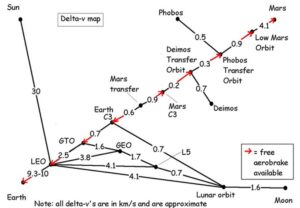 [1]
[1] - Phobos has no atmosphere or gravity well requiring complicated landing systems or risky departure procedures. All of the most dynamic and dangerous manoeuvres are at Earth departure and return – which are required in any case.
- The ΔV required is about ¾ that for a landing on Mars.
- A base could serve valuable functions in facilitating early Mars missions
- Phobos is believed to be a captured C-type asteroid containing vast quantities of carbon compounds, nitrogen, silicon, and some metals, and density calculations also indicate large quantities of water ice. These resources would allow a Phobos base to serve as a refuelling and replenishment station for missions to the Martian surface.
- Note that ΔV Phobos Surface-Mars Surface = 5.5km/s
- Robotic operations on the Martian surface (exploration, investigation, construction, maintenance & repair, etc.) could be controlled in real time from the base. This would obviate the need for such early surface missions to be manned at all.
- Rescue, emergency resupply, and other interventions for eventual manned Martian surface missions would be possible from Phobos which are not possible from Earth, greatly reducing the failure risks of such missions.
- Until a better understanding is achieved of the biological vulnerabilities or threats of Mars, a Phobos base and remote operations would allow a minimisation of associated risks.
- Phobos is believed to be a captured C-type asteroid containing vast quantities of carbon compounds, nitrogen, silicon, and some metals, and density calculations also indicate large quantities of water ice. These resources would allow a Phobos base to serve as a refuelling and replenishment station for missions to the Martian surface.
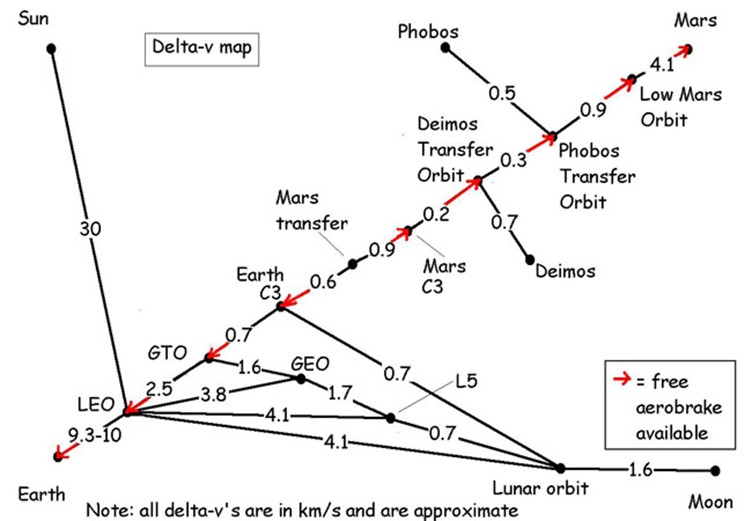
Looking beyond early Mars missions, it has also been proposed[2] that Phobos could serve as the anchor for elevators to and from the Martian system.
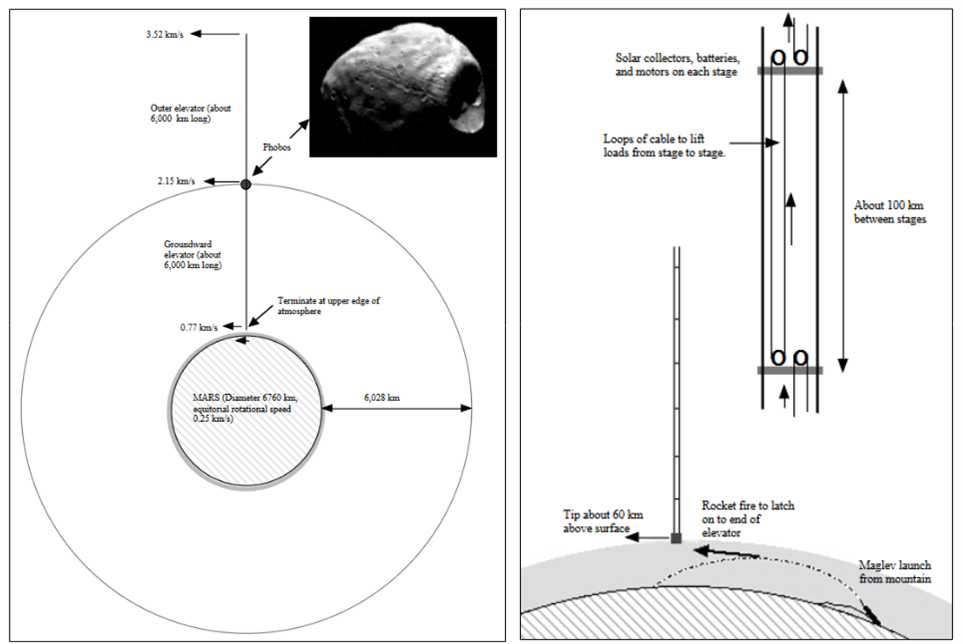
Or as the transfer point for an Earth-Mars Aldrin Cycler (See Davidson & Vorobieff (2019) Improving the SpaceX Mars Colonization Plan for a general description of such a cycler architecture.)
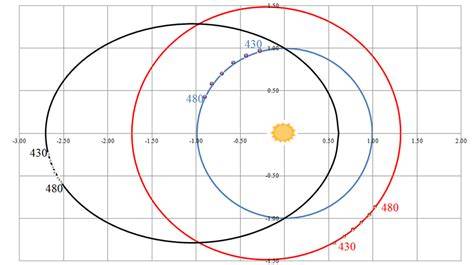
The gravity on Phobos is negligible, which is an advantage for the operations just mentioned but would have serious implications for human survivability in the long term. In order to have a permanent base there it will be necessary to compensate for that deficiency, probably with some form of artificial gravity. On the other hand, since we have no idea whether any g < 1g (9.8ms-2) is sustainable for humans, this may be the case on Mars and the Moon as well.
Several solutions have been proposed for the production of artificial gravity on low mass bodies by means of centripetal forces. The simplest way of doing this is just to have a circular track with a car running around it. More complex proposals involve boring tunnels to contain the tracks in order to shield the car or cars from radiation.[3] A system like this would be perfectly suitable for Phobos – especially if it was located in Stickney crater on the Mars-facing side of Phobos where even a surface car would be shielded from 90% of the incident Galactic Cosmic Radiation.
If it does turn out to be the case that any gravity significantly less than 1g is harmful to humans, then the colonisation of Mars itself is much less attractive, and the Phobos base (and other space habitats) might well remain the preferred permanent habitations. In fact, the danger to human health of prolonged low gravity is just one of several disadvantages of planetary surfaces with respect to human expansion in space. Other major problems often cited are the location at the bottom of a gravity well (making access to the superabundant resources available in space difficult and constraining travel to and from the settlement,) general paucity of energy sources, the constraints on available areas for settlement and the limits to expansion that planetary surfaces impose, the difficulties imposed by the dynamics of the planetary surface environment, and so on. Considerations such as these have convinced many that planetary surfaces are not the appropriate focus for human expansion, and that space settlements should be preferred. This has long been the view of Jeff Bezos, founder of the space access company Blue Origin, for example, who argued for the construction of O’Neill Cylinders in a 2019 presentation.[4]
O’Neill Cylinders[5] are large rotating habitats for which the rotation produces the appropriate artificial gravity and the enclosed space contains whatever environment the designers or occupants desire. The mature versions of these are envisaged to be kilometres wide and long, though the earliest versions would certainly be much smaller.[6] The initial proposal was that they should be built at the Earth-Moon L5 Lagrange point for orbital stability and should be constructed of materials sourced from the moon, since the ΔV Earth Surface-L5 = 13.4km/s while the ΔV Moon Surface-L5 = 2.3km/s. (If it was built closer to LEO, as I suspect would be the case, the comparative ΔVs would be 9.3 vs 5.7 km/s.)
It is often further proposed that such habitats could be constructed within asteroids that have been (or are being) mined for resources. The advantage of such a procedure would be at least twofold: in the first place, the asteroid itself would provide most of the construction material so that the expense of transportation could be eliminated; and in the second place, the remnant of the asteroid would provide radiation (and thermal) shielding that the constructed cylinder would not then have to include.
Phobos would be a good place to begin building such a habitat.
- A permanent habitat on Phobos has already been shown to be valuable, and the cylinder construction could be undertaken as a natural and incremental expansion of existing facilities.
- Construction at Phobos could be used as a testbed for processes required for the construction of such facilities around other asteroids that are not so conveniently located; especially given that Phobos itself is thought to be a C-type asteroid of exactly the kind that is likely to be chosen for the site of a habitat.
- The body of Phobos is thought to contain voids, which might be used to accelerate the excavation process.
If Bezos and Musk would collaborate on this Martian project, the realisation of both of their visions could be accelerated.
[1] Diagram from Mission Table – Atomic Rockets
[2] 2003-Space-Colonization-Using-Space-Elevators-From-Phobos.pdf
[3] Gravity Loops For Mars and Moon Colonies?
[4] Blue Origin 2019: For the Benefit of Earth
[5] GK O’Neill (1976) The High Frontier. His original paper for Physics Today (Sept 1974) is available at The Colonization of Space – Gerard K. O’Neill, Physics Today, 1974 – NSS
[6] The lower limit of habitat radius is set by requiring the artificial gravity to be produced by a rotation rate no greater than about 2rpm. That seems to be the fastest rotational rate at which humans are still comfortable. For g = 1g, that gives a radius of about 200m. The upper limit is set by the strength of available materials: even current materials can handle radii in kilometres.
Tags: