Against AI Art
May 24, 2026 – 3:10 amThere was recent kerfuffle online when a blogger posted an image of a real Monet and said that he had generated it using AI.
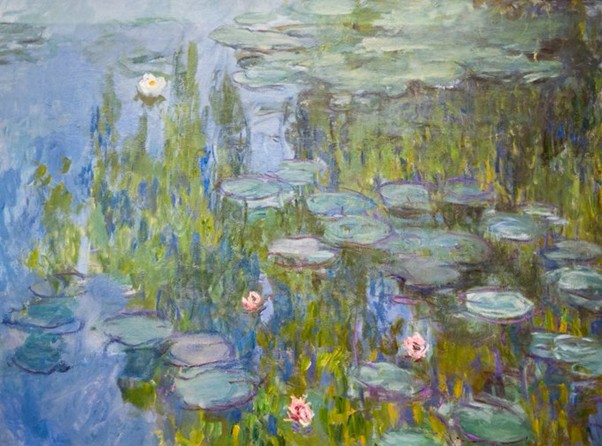
Could his readers tell him, he asked, why it was inferior to this other image that was of a real Monet?
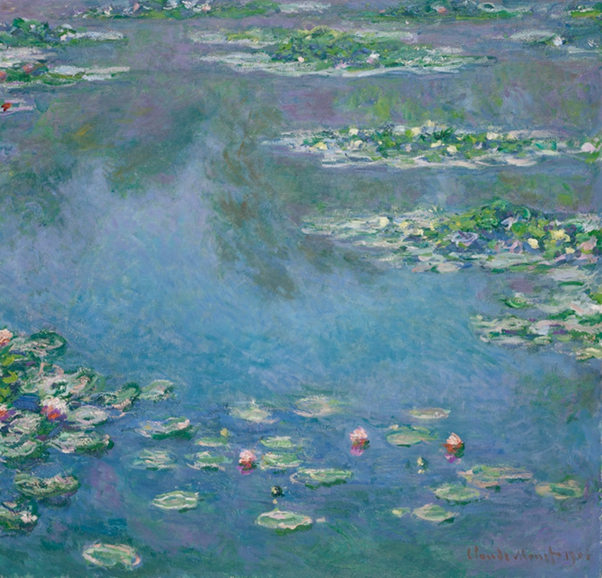
Of course, his replies were filled with people offering their artistic analyses demonstrating the technical failures of the first compared to the second – and those people should be properly chastened by their gulling – but amongst that dross were a couple of replies that seemed to get at the real difference. In particular, Jon Gomm observed that
People hate AI art *because it’s AI* So it doesn’t actually matter what the art is. The point of art is the making. Not the object, which is merely the conduit of connection to the person who made it
Another interesting observation – not precisely relevant to the point I’m going to make – was made by Gina Choy
Monet, along with the Impressionists, radically transformed how light, colour, atmosphere, and nature itself were perceived, shifting perception at a collective and cognitive level. What feels visually familiar to us now was once a profound rupture in the history of seeing. While AI generated imitation has been an important catalyst for thought and discussion, this particular work offers little that is new or perceptually transformative. AI’s capacity to replicate styles, aesthetics, and techniques has already been well established. For that reason, an AI image made in the style of Monet holds far less value than Monet’s original work, which fundamentally altered visual consciousness rather than simply reproducing an existing language.
The point they are straining for is that AI is not an artist, and that what it produces should not be thought about in the way that we think of what artists (quâ artists) produce. There was a similar discussion pursuant to a post on Althouse’s blog concerning an AI poem generator. The worth of such poems was dismissed for various reasons, and Anne Althouse commented @ 9:08 that “If I know a poem is written by a machine, I don’t want to read it. There’s no person behind it!”
I think that’s exactly correct, and the reason we think that is because much of the value that we give to an art work depends upon it being a work of ‘art,’ which is to say, something made deliberately and with intention – not to mention with skill – and a machine can have no intention (at least, no machine yet created.) Moreover, our appreciation of an artwork is in large part bound up in our search for the significance of the work, which is to say in some intention that can be read into it. Now, there are those who claim that the artwork, after it has left the artist’s hands, has an independent aesthetic existence and the intentions of the artist in creating it are not determinative or even relevant to the intentions that can be read into it. I think our hesitation in appreciating an AI work gives the lie to this hypothesis. We clearly believe that something that was made with no motivating intentions is not properly appreciated in the same intentional way that ‘real’ artworks may be. The artist is not dead. Even if we were to ignore his intentions, they would have to have been there for us to accept the work as an artwork and therefore it is reasonable to say that the artist’s intentions are essential to the interpretation of the work.
I wonder how this might be affected by our understanding of how the AI works. For most people, there is a naive refusal to attribute intentionality to a machine because of a number of faulty assumptions concerning the mind – people who make this refusal are basically dualists who think that there is something special about our chemically organic brains that allows sentience that non-organic brains cannot possess: and when pressed on this they’ll generally retreat into a lot of talk about originality, creativity, emotions (what about love?,) etc. which are simply declared to be non-mechanical .
I, on the other hand, embrace my mechanical nature, and accept the intentional capacity of constructed machines in theory, but deny that the machines that we have constructed to perform AI tasks have the right function or structure to have intentions in our own deep sense. The poems mentioned for example are produced by a device that has drawn statistical generalisations from large samples of input data – data that has of course been properly formatted so that certain generalities are available to the purely syntactic pattern-recognition process. There is no construction of an inner world or model of perceived reality, much less of the perceiving device, which are the very least that we’d expect of a sentient being. Much less is there any sort of semantic or pseudo-semantic relationship between the machine and the real world – some sort of interaction probably has to be present in order for the syntax to become semantic in even the most etiolated sense.
Tags: