Western Love
May 23, 2026 – 1:33 pmIn Plato’s Symposium, Aristophanes presents a theory of love fitting a comic poet. Ignoring the details included to explain/excuse homosexuality, the story is roughly that humans were originally spherical beings with no distinction of sexes, then the gods divided us, forming a male and a female out of each divided person, and ever since we have each sought to reunite with our estranged other half. The impulse to love in such a system is an impulse to completeness.
This idea that love is a striving for completion has had a significant afterlife, quite independent of its comic origin. In fact, in a seminar I recently attended the claim was made, with some support, that this idea was the ‘mainstream’ view. I had to disagree. I think that the mainstream idea of love (by which, I think, is really meant the mainstream of learned opinion) actually follows from the theory that Socrates, responding to Aristophanes and others in that same dialogue, said that he had learned from the philosopher Diotima. I also think that none of those philosophical ideas of love have had much effect on the way that people who are not actually philosophizing think about love.
According to Diotima (210a–212b,) since we desire only what we do not have, as mortals we must desire immortality. This we cannot achieve; indeed, even if we were to live forever, it would not be us living forever, for we, as we are now, are ever in a state of change. Therefore, seeking the closest that we can get, we desire to reproduce – or to have our names live in glory, but reproducing is the more common and achievable strategy – and thus we are drawn to those with whom we may get our progeny[1]. Moreover, of those who are our possible mates, we are drawn to those who are good (kale) or beautiful (kale.) (The Greeks had some difficulty distinguishing between the good and the beautiful.)
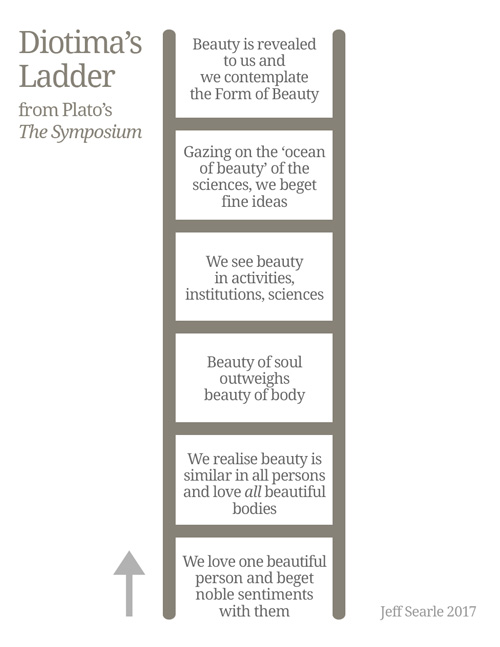
Yet this attraction is just the first step on what Ficino called the scala amoris, the ‘ladder of love.’ By proper reflection on things and by the getting of wisdom, we rise up by gradual steps from merely loving one particular person for their physical beauty to loving in contemplation the Form of Beauty-in-itself. It is that final step that is ultimately valuable and to be sought, and the other steps are valuable only in so far as they lead to the final step.
Of course, there are problems here. To begin with, to make every step other than the last merely instrumental degrades the love felt at all those steps and makes them worthless in themselves. This is hardly a positive view of the kinds of love that ordinary persons typically feel – it’s rather contemptuous, in fact. Moreover, if those steps are only valuable as steps, then is the lover required to put aside the loves that led to the step that he is currently on? Once he loves the beauty in all bodies, for example, is he required to stop especially loving the particular beautiful body he began with? It all seems very mercenary. Moreover, the character of the emotion involved in loving those different objects is never made quite clear. At the first step the emotion is motivational and inspires a movement towards possessing the object of desire; but as the object becomes more abstract, the condition of satisfaction moves toward mere contemplation. It is an open question whether emotions with such dissimilar conditions of satisfaction can really be called varieties of the same emotion.
In any case, the theory was rejected – or perhaps we should say entirely ignored – by the poets of Greece and Rome, whose opinions are doubtless much closer to the non-philosophical opinions then current.
Didactic poets like Lucretius or Oppian glorified love as an all-powerful and omnipresent force, but conceived of this force as a natural, not metaphysical principle, pervading yet not transcending the material universe. In lyrics , on the other hand, love was depicted as the strongest of human emotions, blissful and torturing, life-giving and deadly; but neither Theocritus nor Tibullus, neither Catullus nor Ovid would have thought of elevating the object of this emotion to a ‘supercelestial realm.’ [2]
On the other hand, the theory had a great influence on the Neoplatonists[3] (naturally enough,) the Islamic mystics, and the Christian Fathers. We can see its reflection, for example, in the important Augustinian doctrine of the ordo amoris. Augustine accepts the Platonic and Neoplatonic idea that love is a force in the soul that directs us towards the ultimate attractive thing, which, for him of course, is God (standing in for Plato’s Good-in-itself). He alone is the proper focus of our love, and things and people apart from God should be loved just to the degree that they are in conformity with the will of God. Thus, there is a natural ordering of love by its objects and the love that we feel naturally alters with its change of focus, just as with the Platonic case. For Augustine, however, the movement of love’s focus is not an ascent from a particular beauty to the Form of Good but a descent from God to the things of the world – which are, of course, unworthy of love for their own sake.
The Augustinian view of the ordo amoris (combined with the related idea of the Scale of Being) became a standard view amongst Christian theorists. We note here, however, that whereas the origin of the love impulse in the Platonic scala is fully explained by the natural desire for concupiscence and immortality at the initial step, the origin of the love impulse in the Augustinian ordo directed towards a distant abstract being requires a more involved and theoretically bound explanation. (It is ultimately in obedience to a command to ‘Love the Lord’ – and the plausibility of that as a motivation to love is certainly open to doubt.) It also seems to neglect the aspect of love that is most striking in human affairs: the fact that love/desire is extremely motivating. Indeed, the love between the sexes that tends towards reproduction and that is of so much concern to the poets (and that, in fact, is the very form of love that motivates our concern with the concept) is in constant danger of falling away from the praiseworthy state of caritas – rightly ordered love – and becoming blameworthy cupiditas/concupiscia – disorderly love.[4]
There are possible solutions to this problem, of course, and the most powerful and influential was that provided by Aquinas at the other end of the Mediaeval period. He incorporated the idea of the ordo amoris into a larger view of the nature of Natural Law and God’s intentions. (God had intentions when He made the world, and as we are rational in His image, we can discover them if He wills it.) Thus, he proposes that God, who, being good, desires our happiness, has given us natural inclinations towards fundamental goods that will lead to our happiness, and that among these is a natural inclination towards reproduction. That natural inclination we would experience as love/desire for the opposite sex, and by observation of the rationally derived precepts of action we can be assured that the pursuit of these inclinations will tend to that good end and will not be corrupted and thwart our happiness.
Love itself, according to Aquinas was
… a principle of volitional movement and rest, thus distinguishing it from desire or delight, which he considers its effects. When the object of love is not possessed, this causes the will’s locomotion towards the object (or towards union with the object) with the intent of obtaining the object (or being united with it). This he calls desire. The only reason for the will’s loving and therefore desiring some object is if the human intellect perceives it as “good.” Aquinas’s definition of “the good” is correlative with desire: “For since the good is what all seek, the notion of good is that which calms the desire. … good means that which simply pleases the appetite.”[5] When the object of love is possessed, the will (which Aquinas defines as an appetite) is at rest and reposes in the good, and this he calls joy or delight.[6]
Outside the monasteries, however, quite a different conception of love was being developed, mostly amongst the poets and often in direct rejection of the Church-approved doctrines that tended to make passionate love even within marriage sinful. The idea of ‘courtly love’[7] took its Classical inspiration not from the philosophers but from Ovid’s Ars Amatoria, which they treated as a serious text and not as the mocking satire intended by the poet. From the jests of that poet they drew the supposed rules of love-making and courtship with which we are all tolerably familiar, but the ideology of their love was very different from his.[8] Although they accepted, as he did, that love was essentially rooted in physical desire (even where consummation was impossible,) they insisted that love, properly conducted, could have an ennobling effect on the lover. Thus, Capellanus says (1.3):
… [I]t is the effect of love that a true lover cannot be degraded with any avarice. Love causes a rough and uncouth man to be distinguished for his handsomeness; it can endow a man even of the humblest birth with nobility of character; it blesses the proud with humility; and the man in love becomes accustomed to performing many services gracefully for everyone. O what a wonderful thing is love, which makes a man shine with so many virtues and teaches everyone, no matter who he is, so many good traits of character!
The idea of ‘courtly love’ in the form defended and celebrated in the late Middle Ages now appears ludicrous, but from it the modern view on love seems to have taken ideas of romantic attachment, devotion to a single object, unrequited love, heroic gestures of affection, the elevated status of women, and much else – including, especially, the idea that love itself is an improving thing rather than just a form of passionate madness.
Whether this forms the mainstream of our view of love today or not – and I think it probably contains a great part of the common culture’s mainstream – it is certainly more significant than either version of the ordered view of love proposed by the Platonists or the Augustinians.
[1] This story is rather spoiled by the need to explain homosexual (in fact, pederastic homosexual) desire as being that which results not in the birth of a child as a bridge to immortality but, equivalently, in the arising of a conception of virtue as another form of the good/beautiful.
[2] E. Panofsky (1939) Studies in Iconology, NY: Harper, p. 99
[3] See for example Plotinus Enneads I.6, III.5 (‘On Love’)
[4] De Civitate Dei XIV.16 (‘Lust’) illustrates the danger and Augustine’s attitude to even marital union
[5] ST I-II.27.1.ad.3.
[6] B R Cochran ‘Love and Charity in Aquinas’
[7] G Paris (1883). “Études sur les romans de la Table Ronde: Lancelot du Lac, II: Le conte de la charrette” Romania 12 (48): 459–534
[8] As this was in reaction to the ideology of the ‘intellectual’ class, explicit defences or descriptions are few. The work most often cited in this regard is Andreas Capellanus, De arte honeste amandi (The Art of Courtly Love)
Tags: