The Music of the Scop
February 27, 2026 – 12:56 pmAccording to the poetic corpus itself, poems such as Beowulf were typically performed in front of the lord in his feasting hall by a scop, roughly equivalent to the ON skald. There are those who doubt the reality outside literature of this class of persons, but the evidence of all other Germanic and Northern barbarian traditions makes that doubt unreasonable. Moreover, again on the evidence of the literature and cognate traditions, there is no doubt that the scop’s performance of the poem. was typically accompanied by what the Anglo-Saxons called a hearpe but which we think of as a round lyre rather than a ‘harp’ as the OE term would suggest. (This is the case even if Pope’s theory concerning the use of the hearpe to determine metre is rejected.) A number of examples of these instruments have been found, most notably in the Sutton Hoo ship burial, which is dated to the 6th or 7th C – about the accepted time of the composition of the poem. A reconstruction of the instrument is shown.
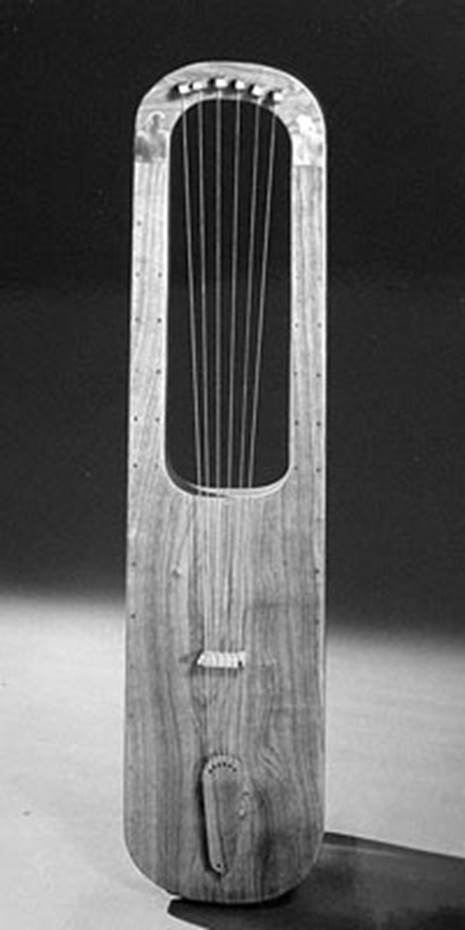
We note that the instrument has 6 strings, which strongly suggests a pentatonic scale (the 6th string being the ‘octave’ of the first.) Though there are many possibe pentatonic scales it is likely that the Anglo-Saxons used the series C E♭ F G B♭ because it is the scale used in early English folk song and it is reasonable to assume some continuity in the musical tradition.
Finally, the textual evidence indicates that the hearpe when used by a scop to accompany a recitation was not played just by the ‘block and strum’ method, nor yet by providing a simple drone, though these techniques were doubtless available for variety. Descriptions of the hearpe’s use indicate that at least on occasion music and voice were linked, though on other occasions the action of the hearpe was relatively independent of the scop’s voice, and that it could be played loudly and with a rapid flow of notes. [1]
Perhaps a good example of what this sounded like is to be found in Beowulf: The Epic in Performance – Benjamin Bagby, voice and medieval harp. This performance looks and sounds much more like how I imagine a scop’s performance than the poetry readings generally performed. Note, in particular, the use of the hearpe and the division into air and recitative (and the fact that the hearpe is not just strummed, but his fingers fly as the records show they did.)
[1] Beowulf: 1063-5, Widsith: 103-4, The Gifts of Men: 49-50, The Fortunes of Men: 77-84
Tags: