Why Do Angels Have Wings?
July 19, 2019 – 12:23 pm‘Angel’ translates the word mal’akh in Hebrew, which is a particular kind of messenger. The Hebrew word can refer to either spiritual beings or material, but our translations only use ‘angel’ for the spiritual kind. In the Bible they are never said to have wings but are described as being like people. In Mk 16, for example, the angel is said to be ‘a young man, dressed in a white robe.’ Wings are given to cherubim (in Ezekiel’s Merkabah vision, Ez 10:6-9) and to seraphim (Isa 6:2,), and though we tend to think of all the ranks of the Celestial Hierarchy as being populated by ‘angels,’ they are never described as malakhim.
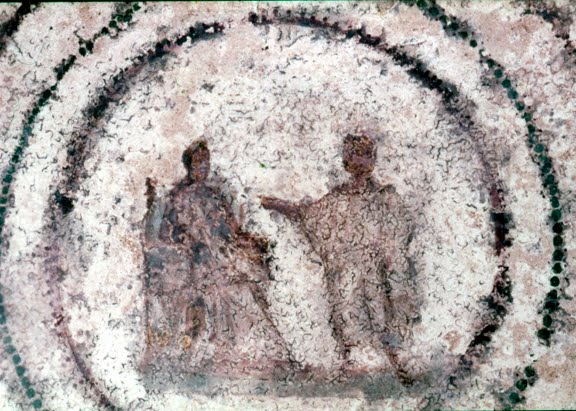
The first images of angels didn’t have wings. The earliest we know of is in a scene of the Annunciation in the Catacomb of Priscilla on the Via Salaria in Rome.
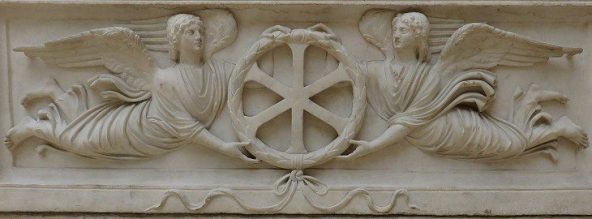
Images of angels in Christian art didn’t commonly feature wings until about the 5th century, when it became almost universal. The first such image is on the ‘Prince’s Sarcophagus’ found near Istanbul and dating to about the end of the 4th century.
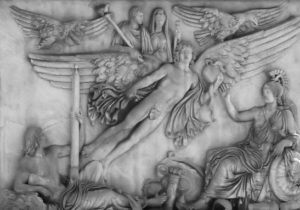
Why they got wings at all is a bit mysterious. There may have been some confusion with the other celestial beings or it may just be a matter of adopting some elements of the preceding pagan art in which several gods and goddesses were typically shown with wings (like ‘Winged Victory.’) If it is just that, then the specific model for the angels is probably the Roman genius, a spirit that is supposed to be the guardian of a particular person. They were often depicted with wings. Here’s one from the 2nd century in a column relief depicting the apotheosis of Antoninus Pius:
In many places in the Bible, it is implied that angels are assigned, like genii, as guardian spirits to particular persons (Catholic Encyclopaedia, s.v. ‘Angels’.) The angels on the ‘Prince’s Sarcophagus’ are also looking after the body of a royal person who is being translated to heaven, so perhaps that common theme also helped connect the two types of spirit early on.
The standard post facto justification for their depiction with wings is from John Chrysostom:
They manifest a nature’s sublimity. That is why Gabriel is represented with wings. Not that angels have wings, but that you may know that they leave the heights and the most elevated dwelling to approach human nature. Accordingly, the wings attributed to these powers have no other meaning than to indicate the sublimity of their nature.
This would be more convincing if I could find this passage anywhere in the collected works of that Saint, but a search of The Life and Works of St. John Chrysostom (Schaff, 1886) yields nothing. It is always rather suspicious when the same quote appears everywhere you look but never with a proper reference.
Tags: