Botticelli – The Birth of Venus
March 31, 2019 – 12:20 pmOne of several criticisms of the Actual Intentionalist theory of interpretation – even in its weakened or modified forms – is that it requires that each artwork have just one correct interpretation. According to Davies (ed. 2015, The Philosophy of Art, p. 118) for example, such a critic
rejects the idea that artworks have only one meaning, this being the one intended by the author. In Art, we expect great works to invite multiple, even contradictory, interpretations
Unfortunately, the reply offered to this is rather odd.
In reply, the moderate actual intentionalist can allow … that the work has meanings additional to those that are intended. And a more important point is that artists deliberately make their works to be complex, richly layered, and tantalizingly ambiguous or vague, precisely because they intend to produce art allowing for a variety of plausible interpretations. The multiple interpretability of artworks is consistent with the claims of moderate actual intentionalism, so the proposed objection misses its mark.
A more reasonable response is to once again point to the analogy between Art and common speech (an analogy that is appropriate for discussions of the communicative purposes of Art, but not necessarily for much else) and to note the entirely uncontroversial fact that any utterance may have several meanings that are all intended by the utterer. Those different meanings and messages conveyed are conveyed by different aspects of the utterance, and the same may undoubtedly be true of an Artwork. In support of this, let us consider a work where it is acknowledged that there are probably multiple interpretations: the Birth of Venus by Botticelli.
Thought to have been painted 1484-6, the history of the painting is disputed. Sometime before 1550 Vasari saw it and the Primavera in the Villa di Castello outside Florence, which had been bought in 1477 by Lorenzo di Pierfrancesco and his brother Giovanni di Pierfrancesco de’ Medici, cousins to Lorenzo ‘Il Magnifico.’ It has usually been assumed that the Primavera and Birth of Venus are companion pieces, and were commissioned soon after the Castello had been bought. (On the other hand, a catalogue of 1499 lists the former but not the latter as belonging to Lorenzo’s descendants, which has led to some doubt on the matter.) It is also a common assumption – because it makes sense of some of the iconography and would add to the sense of some of the interpretations – that the paintings were commissioned as wedding presents.
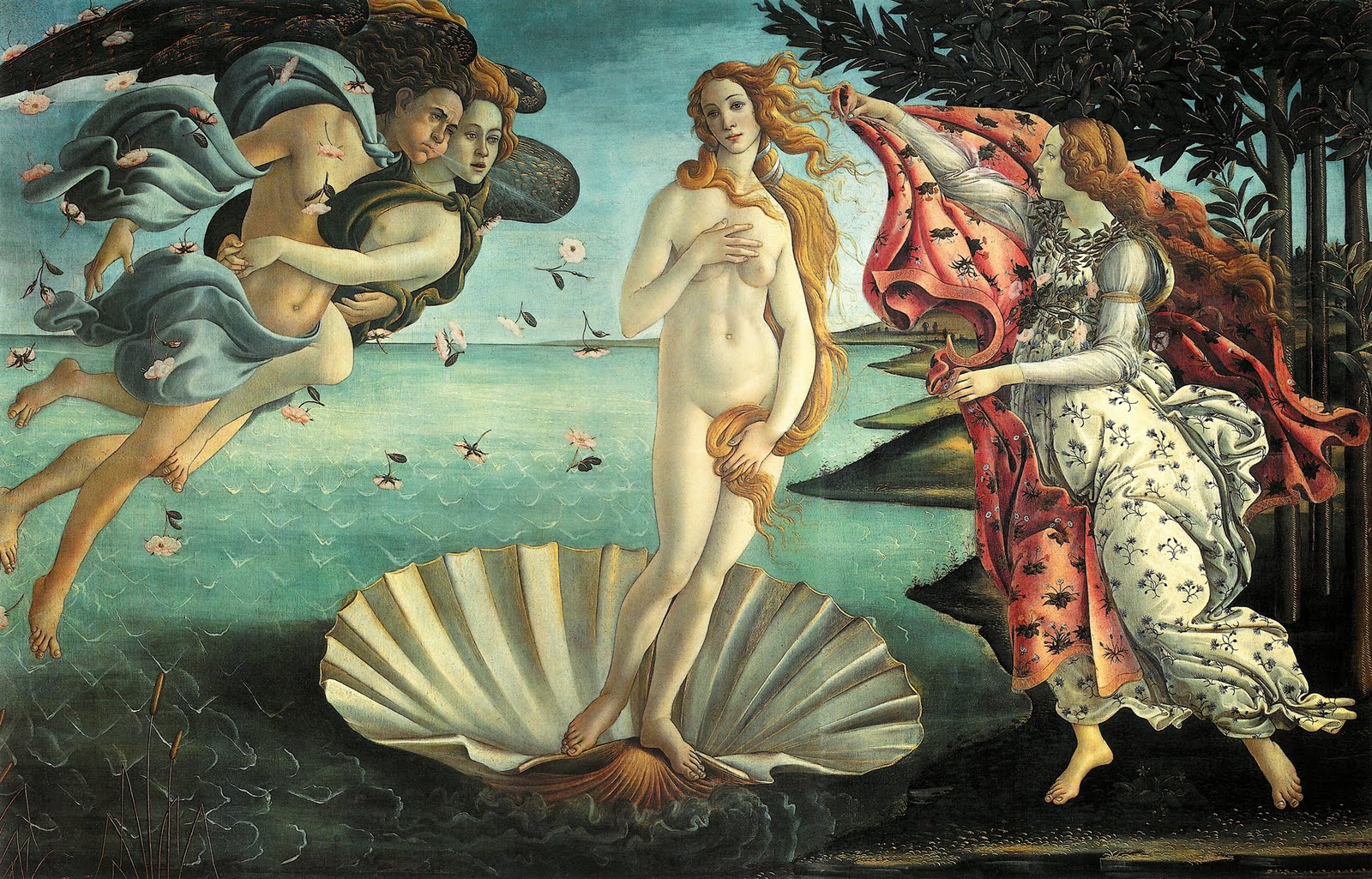
The subject of the painting, however, has never been in dispute: it is the arrival of Venus to shore on Cyprus after her birth full grown in the sea. (The painting’s original name is not known, but it was said to depict the birth of Venus by Vasari, who made a trivial error there. The current name which continues that error is known to have been applied to it in the XIXth C.) The episode is a common one in the minor classical arts, and Pliny reports (HN 35) that Apelles once painted it for Alexander, but the scene that this painting shows is inspired rather by late literary sources than by any of those early works. Two poems are commonly identified in this context: the first being Angelo Poliziano’s Stanze di messer Angelo Politiano cominciate per la giostra del magnifico Giuliano di Pietro de’ Medici, in which a representation in relief of the episode is described (verses 99-102;) and the second is a translation by Demetrios Chalkokondyles of the second hymn to Aphrodite from the Homeric Hymns.
The elements of the painting are more interesting: the image of Venus herself in particular. Her posture is closely modelled on the Medici Venus which is a Venus pudica. That is not according to the classical tradition, in which this mythological episode is illustrated with a Venus anadyomene. In style, it has long been noted that the image is more reminiscent of the gothic treatment of nudes with their rounded bellies, broad hips, lack of musculature, sloping shoulders, and generally exaggerated length. In the gothic imagination, however, nakedness was typically associated with shame or some sort of moral failure – harlots in Hell, Eve being expelled, fallen women generally. There is no such suggestion here. In fact, her head is just the same as the heads of his Madonnas – the expression is ‘wistful’ (Clark, K. (1956) The Nude Harmondsworth: Pelican, pp. 97 f.) Moreover, though she is shown classically contrapposto, Botticelli’s Venus fails to meet the classical standard of aplomb, for she could not possibly stand at that angle. We are presumably to read her as floating, like the two winds Zephyr and Aura at left, and also, possibly, like the Hora of Spring at right.
A number of interpretations have been proposed.
- A now standard interpretation of the painting (see Panofsky, E. (1965) Renaissance and Renascences in Western Art, London: Paladin pp. 198 f) begins from the observation that the Venus pudica type derives from Praxiteles’ famed Aphrodite of Knidos whose nude form came to be associated with the Venus coelestis representing pure, intellectual love. (This being contrasted with the Venus vulgaris deriving from Praxiteles’ clothed Aphrodite of Kos and representing love of a more worldly and natural kind.) The painting is therefore supposed to reference and recommend this more elevated aspect of the goddess. This interpretation would be especially plausible if the painting had been intended as wedding gift: for it could then be seen as an appropriate moral reminder for the young couple.
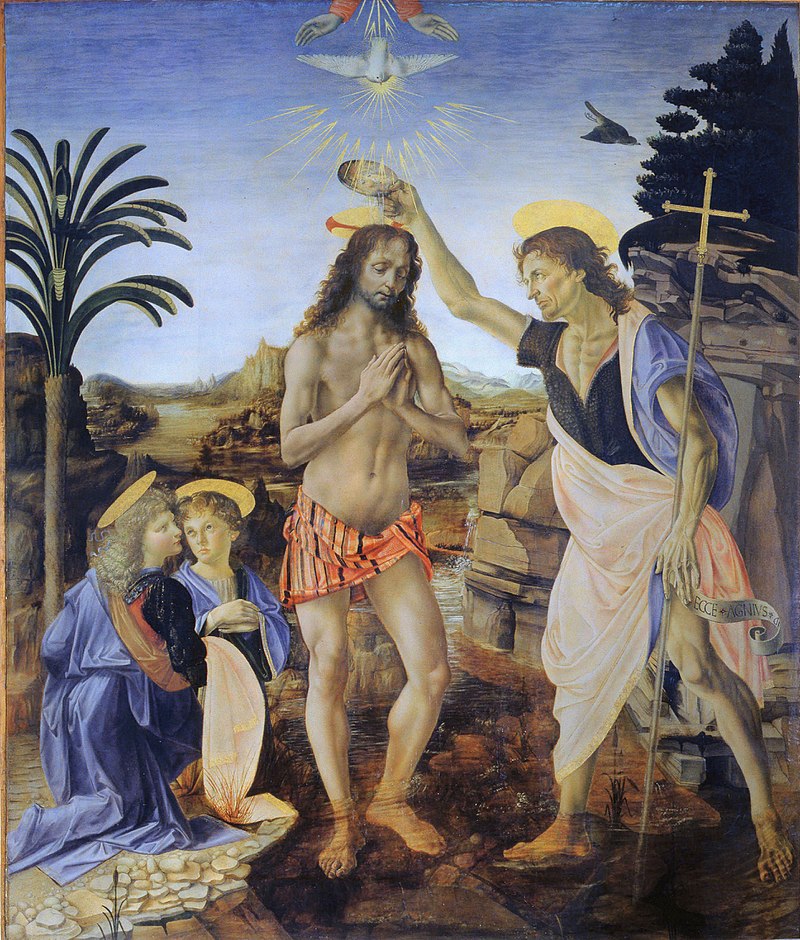
- It is possible to enlarge upon this interpretation if it is also accepted (as it usually is) that Botticelli or his patron was familiar with the Neo-platonism that was then popular amongst the Florentine humanists. In that system, Venus coelistis is said to bring forth divine love (Amor divinus) “ad divinam cogitandam pulchritudinem,” i.e. so that we may come to understand divine Beauty (Ficino in Commentary on the Symposium II, 7.) The painting thus celebrates that event and the possibility of this knowledge. Some (e.g. Gombrich, E. (1945) “Botticelli’s Mythologies” Journal of the Warburg and Courtauld Institute, 8:7-60, p. 55) have seen further support for this interpretation in the way that the attitude of the Hora who bestows the mantle upon Venus echoes John’s attitude in scenes of the baptism of Christ (compare, for example, Verrocchio’s Battesimo di Cristo.) The implication is that the arrival of Venus in the world in this form is an event that brings the possibility of divine love and the knowledge of Beauty, in much the same way that the entrance of Christ into his mission brings the possibility of divine love and the knowledge of God.
- It may further be noted (as by Wind, E. (1967) Pagan Mysteries in the Renaissance, Harmondsworth:Peregrine, pp. 131 ff.) that from the left it is a wind of passion that issues from the two entwined and amorous spirits (and especially da’ Zefiri lascivi as Poliziano describes him in Giostra 99) to move Venus. And on the right it is chaste Hora who approaches to wrap her in a decent cloak. The Venus pudica itself is an image of not exactly chaste but elevated love, but here she manages to unify the two forms to one wholesome whole. Again, this is a recommendation appropriate for a wedding present.
- As a wedding present however, it may have a more than simply admonitory intention. It has been argued that the peculiar flatness of the painting and the space-filling pattern of flowers give it an appearance that would well suit it to the environment of a private chamber, where tapestries and heavy patterns were common. Supposing it then to be intended to be enjoyed privately, we can identify a number of erotic elements that are proper only in that context. The principal element of course is the image of the naked Venus herself; and here it is surely significant that it is amongst the first full length nudes after the classical period. The faces of the two spirits at the left plausibly belong to a couple in coitus. The shell that Venus stands on has since classical times been taken as a symbol of the goddess of love and as representing the female sexual organs. And the loop of hair directly above her pudendum and the fold of fabric into which her hair blows are also clearly depicting the female sex. (In no other place in Botticelli’s works do we see such loops or folds.) In so far as we think that this is intended to have an ‘interpretation,’ it may that sexual desire is not alien to the pure goddess, and this claim presumably implies a recommendation to indulge it in the marriage. However, that is probably not the principal intended function for those elements.
- Some have also tried to argue that the painting was intended as a piece of flattery to Lorenzo ‘Il Magnifico’ de’ Medici, head of the Medici family. It is claimed that the model for the Venus is Simonetta Catanneo Vespucci, who was a noted beauty of the time and reputed to be the mistress of both Lorenzo and his brother Giuliano. Lorenzo’s allowing the use of Simonetta’s likeness (though she had by then been dead for about 10 years) is compared to Alexander offering his mistress Campaspe to Apelles as a model for the original Aphrodite anadyomene (Pliny, HN 35.) Lorenzo is thus to be compared to Alexander. Unfortunately, there is no evidence that Simonetta was taken as the model, nor that she was the mistress of Lorenzo. Indeed, it was Giuliano who took her as the object of his courtly love gestures (which are celebrated in Poliziano’s Giostra) but there is no evidence for her being his mistress either. Consequently, we can dismiss this as a possible interpretation.
All of those interpretations are consistent with each other, and the evidence actually offered for them (or against them) is exactly the evidence that the Actual Intentionalist would admit. Where there is proposed to be conflict between these interpretations – as between the 2nd and 3rd listed above – it is reasonable to think that those who are proposing the conflict would say that one of those is correct and the other is incorrect; just as it is possible to interpret a statement in two ways according to the rules of the language and the conventions of the conversation, but for only one of those interpretations to be the intended (correct) one. Does anyone actually claim that the intention of an artist is to assert two contradictory claims?
Tags: