Titian – Sacred and Profane Love
March 23, 2019 – 8:38 pmThe appreciation of art is usually taken to involve an aesthetic judgement, and this judgement is most often said to be essentially non-cognitive. According to the Hume/Kant model of artistic appreciation, however, an aesthetic judgement of that kind is very often dependent upon a previous cognitive act of ‘understanding’ the artwork. Hume, for example, pointed out ((1751) Enquiry Concerning the Principles of Morals, §1) that
[I]n order to pave the way for [an aesthetic judgement,] and give a proper discernment of its object, it is often necessary, we find, that much reasoning should precede, that nice distinctions be made, just conclusions drawn, distant comparisons formed, complicated relations examined, and general facts fixed and ascertained. Some species of beauty, especially the natural kinds, on their first appearance, command our affection and approbation; and where they fail of this effect, it is impossible for any reasoning to redress their influence, or adapt them better to our taste and sentiment. But in many orders of beauty, particularly those of the finer arts, it is requisite to employ much reasoning, in order to feel the proper sentiment;
An act of understanding is thus supposed to be required in order to be able to present all the relevant features (whatever they might be) of the artwork to the faculty (whatever it might be) responsible for the aesthetic judgement. But whether or not we think that there is some special faculty or special judgement or special aesthetic quality, it is almost universally believed that a proper appreciation of an artwork can only be gained once the artwork is properly understood. For this reason the critical engagement with artworks has tended (very strongly) to be directed at increasing our understanding of them.
Consider, for example, the painting by Titian now known as Sacred and Profane Love
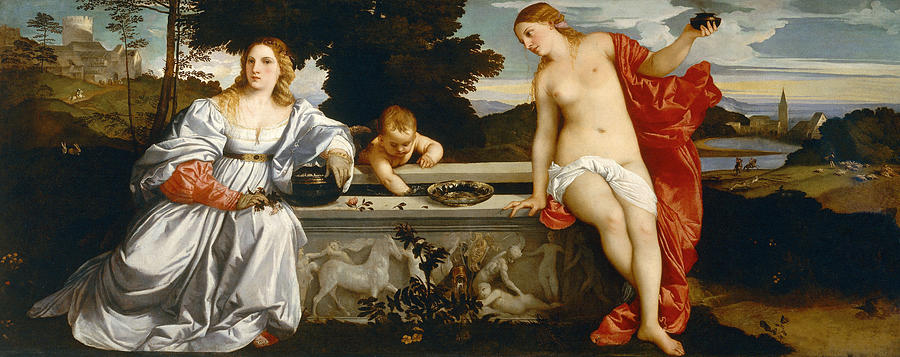
Certainly, this is a beautiful thing and it can be appreciated at that level alone in admiring the colours, the organization of forms, the images of two pretty girls, and so on; but no one really thinks that leaving the appreciation at that level would be doing justice to the art work, and therefore much scholarly effort has gone into understanding why the artist has disposed the details of the painting in the way that he has. Such enquiries, though they may not all reach the same conclusions, seem to be in general agreement about the sorts of things that would count as contributing to the understanding of the artwork.
Many begin by noticing, for example, that the painting is divided neatly into two with the details on one side being in some sort of correspondence with details on the other, and from that reasonably supposing that the painting has a ‘dialectical’ structure, so that the one half is a commentary upon the other. This was not an unusual way of proceeding at the time. Beyond that it has been proposed (by E. Panofsky in (1962) ‘The Neoplatonic Movement in Florence and North Italy’ pp. 150-4 in Studies in Iconology, New York: Harper & Row, pp. 129-169) that the two figures are two images of Venus – one, the Venere Vulgare at left standing for the generative, fertile, earthly form of love; and the other, the Venere Celeste standing for the pure, intelligible, intellectual and universal form of love. The identification does not come out of nowhere: there are arguments from the nature of Titian’s earlier works, his prior and later use of imagery, the iconography and thematic concerns then current, and references to the contemporary philosophical movements and literature. In any case, it does make some sense of the background details, as on the left there are rabbits (a pretty obvious symbol of fertility) and the turret of a town (where worldly interests are pursued;) while on the right we see the campanile of a church, sheep, and a hunt in progress. In this interpretation, inspired by the Neoplatonism of Marsilio Ficino – as perhaps transmitted to Titian in discussions with his friend and leading humanist Pietro Bembo – the two figures in harmony indicate that an emergent harmony between Earthly and Heavenly Love is possible, that the idealised form of each is compatible with the other. This, it is felt, is an appropriate signification for a painting that was intended as a wedding present to celebrate the marriage of Nicolò Aurelio (whose coat-of-arms is seen on the frieze beside the spigot) and Laura Bagarotto. (The woman on the left is dressed as a bride with myrtle flowers which are symbols of Venus and also signify married fidelity.)
According to that interpretation, then, we should understand the painting as a meditation on the proper form of married love, and an exhortation to its realisation. So, if we were correct above to say that an understanding of the artwork is essential to its proper appreciation, and if the methods of producing the appropriate understanding are such as produced the interpretation at which we have arrived, then it is this sort of understanding that we seem to believe is essential to a just appreciation of Titian’s painting.
But what sort of understanding does this kind of interpretation give us? Well, pretty clearly, it takes the artwork to be the deliberate creation of an artist who had some intention in mind in creating it; and it is assumed that a proper interpretation will depend upon identifying the intentions of the artist. For that reason, we note that the painting is of a genre with which the artist was familiar, that he would therefore be aware of the purposes of that genre and how it was meant to be interpreted. We propose the sort of interpretation that we could imagine the artist feeling was appropriate in the circumstances of the painting’s commission as a wedding present. We present evidence that the artist might well have had the intellectual resources to intend that interpretation by looking at the intellectual milieu in which he existed, and even at the popular ideas of his time. We look at his other works to see whether the use of iconography required for that interpretation is consistent with his other uses of similar elements. And so on.
All of this points toward a theory of interpretation that is called Actual Intentionalism
Tags: