Text Hoard: Nag Hammadi Library
September 24, 2026 – 10:26 amNature of the Hoard
- 12 codices
- Contain 52 tractates (51 bound and one unbound)
- The unbound tractate, formerly ‘Codex XIII,’ was found inside the front cover of Codex VI
- Comprise at least parts of 1139 pages of text
- Contain 52 tractates (51 bound and one unbound)
- Written in Coptic.
- Dated to the 4th C AD.
- Principally gnostic – both Christian and some non-Christian – though with other material included: e.g. three texts from the Corpus Hermeticum and an extract from Plato’s
- Generally assumed to be the concealed property of the nearby Pachomian monastery. They may have been removed from the monastery collection after Athanasius in his 39th Festal Letter in 367 AD published a list of texts he deemed canonical and condemned the use of texts he deemed non-canonical.
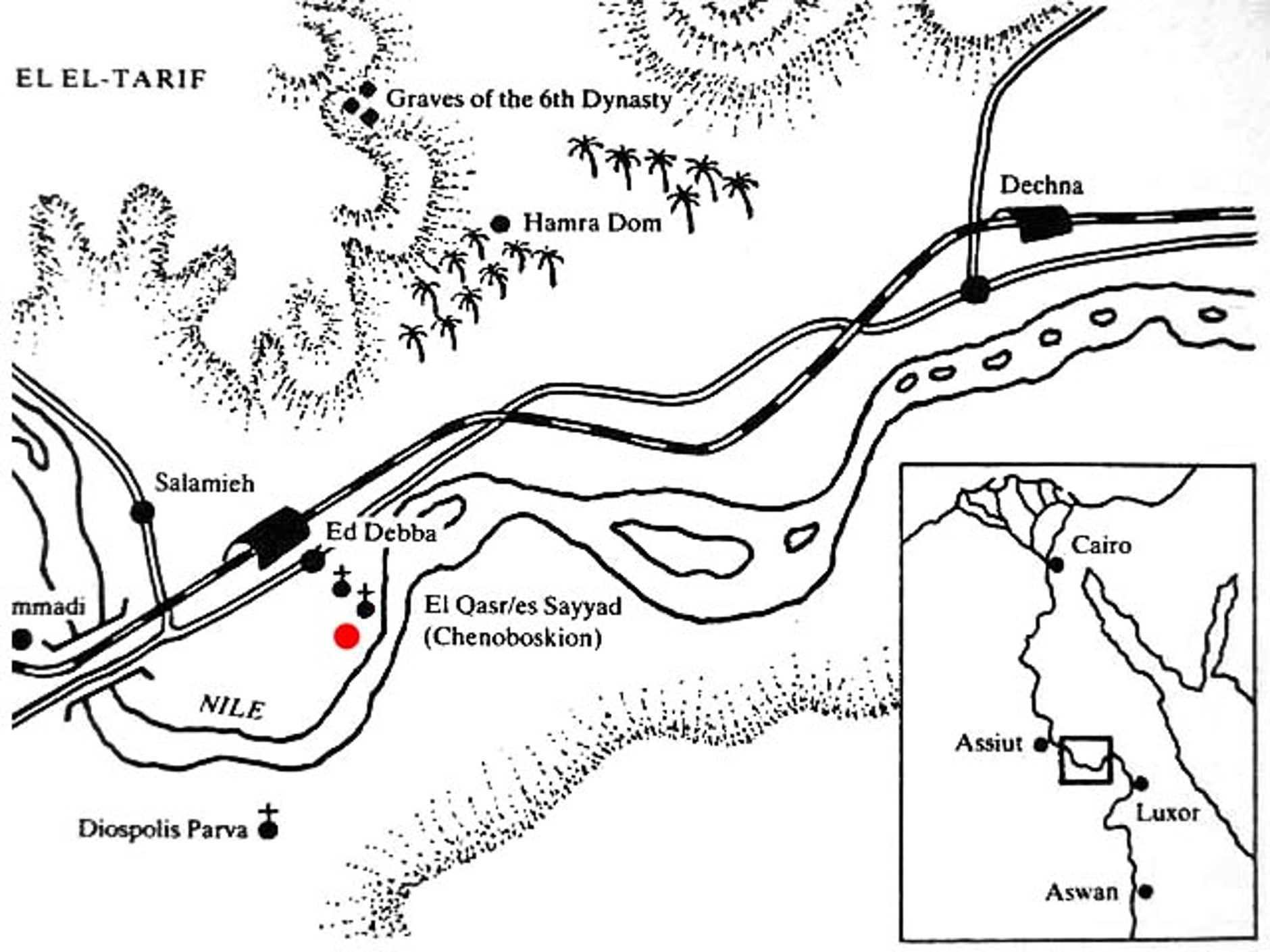
Location
Discovery
The existence of the codices became known in 1946. Between 1947 and 1950 French historian Jean Doresse investigated their origins, establishing that in 1945 a buried jar containing the codices had been unearthed by a farmer, reportedly from a graveyard near some 6th Dynasty tombs. In the 70s the farmer, one Muhammad ‘Ali al-Samman, was found and interviewed by James Robinson who described to him the circumstances of the discovery, which was at the base of the Jabal el Tarif cliffs near the village of Hamra Dom, within sight of the Pachomian monastery of Pbau/Pbow (modern Faw Qibli) 5 km from the Pachomian monastery of Chenoboskion/Seneset (modern al-Qasr wa as-Sayyad,) and 11 km from Nag Hammadi. The story he told is not much to be trusted, but his mother did mention that she used some of the texts as kindling and Robinson believes that that explains the poor condition of Codex XII.
Acquisition
- Most of the texts were initially collected from 1946 onwards by Phokion J. Tano(s), a Cypriot antiques dealer in Cairo.
In 1948 they were taken by the Department of Antiquities and in 1956 they were given to the Coptic Museum. - In 1947/8 Codex I was sold to Albert Eid, a Belgian antiques dealer in Cairo.
It was then bought by the Gustav Jung Institute in Zurich in 1952 as a gift for Gustav Jung and named the ‘Jung Codex.’
In 1975, after the text had been published, it was given to the Coptic Museum.
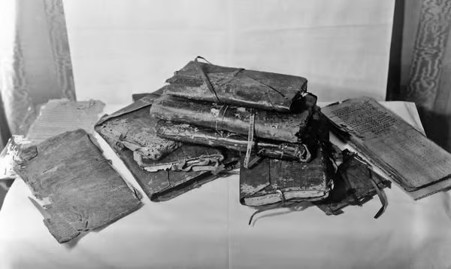
Photo: Courtesy of Institute for Antiquity and Christianity, Claremont, CA
Publication
The editio princeps of the Jung Codex (NHC I) appeared in stages from 1956 to 1975, prepared by scholars for the Jung Institute using material from both Zurich and Cairo, after which NHC I was returned to Egypt.
The Gospel of Thomas (NHC II, 2) was published in a photographic edition in 1956 and an English translation with Coptic text was issued in 1959 as The Gospel of Thomas by A Guillaumont, H-C Puech, G Quispel, WC Till, Y ‘Abd al-Masih (eds.)
The Facsimile Edition of the Nag Hammadi Codices in 12 volumes was published largely between 1972 and 1977 (with the volumes Cartonnage appearing in 1979 and Introduction in 1984) by the International Committee for the Nag Hammadi Codices, established in 1970 by UNESCO and the Egyptian Ministry of Culture, under the direction of JM Robinson of Claremont Graduate University.
Images of the original codices may be seen via the Claremont Colleges Digital Library’s Nag Hammadi Archive.
An English translation by members of the Coptic Gnostic Library Project of the Institute for Antiquity and Christianity of Claremont CA (James M. Robinson, Director and General Editor,) appeared as The Nag Hammadi Library in English in 1977.
Contents
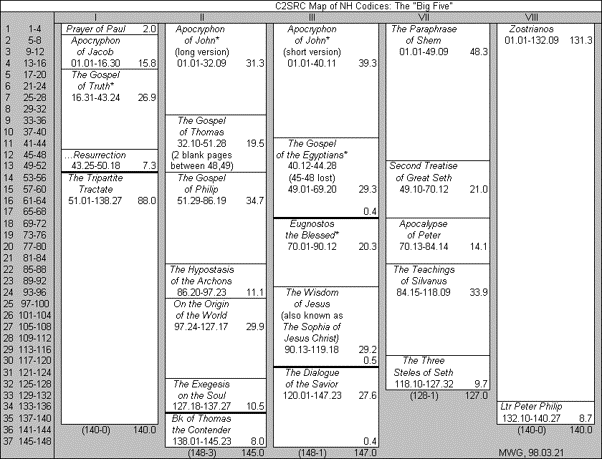
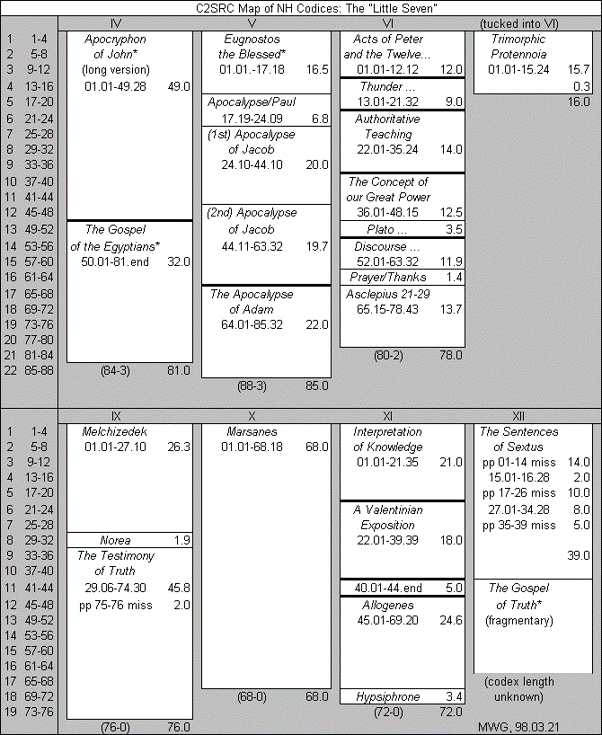
- Tractate References
| Order | NHC | Number | Title | Pages | Abbreviation |
| 01 | I | 1 | Prayer of the Apostle Paul | (2) | Pr. Paul |
| 02 | 2 | Apocryphon of James (Secret Book of James) |
1–16 | Ap. Jas. | |
| 03 | 3 | Gospel of Truth | 16–43 | Gos. Truth | |
| 04 | 4 | Treatise on the Resurrection | 43–50 | Treat Res. | |
| 05 | 5 | Tripartite Tractate | 51–140 | Tri. Trac. | |
| 06 | II | 1 | Apocryphon of John | 1–32 | Ap. John |
| 07 | 2 | Gospel of Thomas | 32–51 | Gos. Thom. | |
| 08 | 3 | Gospel of Philip | 51–86 | Gos. Phil. | |
| 09 | 4 | Hypostasis of the Archons | 86–97 | Hyp. Arch. | |
| 10 | 5 | On the Origin of the World | 97–127 | Orig. World | |
| 11 | 6 | Exegesis on the Soul | 127–137 | Exeg. Soul | |
| 12 | 7 | Book of Thomas the Contender | 138–145 | Thom. Cont. | |
| 13 | III | 1 | Apocryphon of John | 1–40 | Ap. John |
| 14 | 2 | Holy Book of the Great Invisible Spirit (Gospel of the Egyptians) |
40–69 | Gos. Eg. | |
| 15 | 3 | Eugnostos the Blessed | 70–90 | Eugnostos | |
| 16 | 4 | Sophia of Jesus Christ | 90–119 | Soph. Jes. Chr. | |
| 17 | 5 | Dialogue of the Saviour | 120–149 | Dial. Sav. | |
| 18 | IV | 1 | Apocryphon of John | 1–49 | Ap. John |
| 19 | 2 | Holy Book of the Great Invisible Spirit (Gospel of the Egyptians) |
50–81 | Gos. Eg. | |
| 20 | V | 1 | Eugnostos the Blessed | 1–17 | Eugnostos |
| 21 | 2 | Apocalypse of Paul | 17–24 | Apoc. Paul. | |
| 22 | 3 | First Apocalypse of James | 24–44 | 1 Ap. Jas. | |
| 23 | 4 | Second Apocalypse of James | 44–63 | 2 Ap. Jas. | |
| 24 | 5 | Apocalypse of Adam | 63–85 | Apoc. Adam | |
| 25 | VI | 1 | Acts of Peter and the Twelve Apostles | 1–12 | Acts Pet. 12 Apost. |
| 26 | 2 | Thunder, Perfect Mind | 13–21 | Thund. | |
| 27 | 3 | Authoritative Teaching (Authoritative Discourse) |
23–35 | Auth. Teach. | |
| 28 | 4 | Concept of Our Great Power | 36–48 | Great Pow. | |
| 29 | 5 | Fragments: 588a-589b of Plato’s Republic. | 48–51 | Plato Rep. | |
| 30 | 6 | Discourse on the Eighth and Ninth | 52–63 | Dis. 8–9 | |
| 31 | 7 | Prayer of Thanksgiving | 63–65 | Pr. Thanks. | |
| 32 | 8 | Asclepius | 65–78 | Asklepius | |
| 33 | VII | 1 | Paraphrase of Shem | 1–49 | Paraph. Shem |
| 34 | 2 | Second Treatise of the Great Seth | 49–70 | Treat. Seth | |
| 35 | 3 | Gnostic Apocalypse of Peter | 70–84 | Apoc. Petr. | |
| 36 | 4 | Teachings of Silvanus | 84–118 | Teach. Silv | |
| 37 | 5 | Three Steles of Seth | 118–127 | Steles Seth | |
| 38 | VIII | 1 | Zostrianos | 1–132 | Zost. |
| 39 | 2 | Letter of Peter to Philip | 132–140 | Ep. Pet. Phil. | |
| 40 | IX | 1 | Melchizedek | 1–27 | Melch. |
| 41 | 2 | Thought of Norea | 27–29 | Norea | |
| 42 | 3 | Testimony of Truth | 29–74 | Testim. Truth. | |
| 43 | X | 1 | Marsanes | 1–68 | Marsanes |
| 44 | XI | 1 | Interpretation of Knowledge | 1–21 | Interp. Know. |
| 45 | 2 | Valentinian Exposition | 22–40 | Val. Exp. | |
| 46 | 3 | Allogenes | 40–44 | Allogenes | |
| 47 | 4 | Hypsiphrone | 45–69 | Hypsiph. | |
| 48 | XII | 1 | Sentences of Sextus | 15–16, 27–34 | Sext |
| 49 | 2 | Gospel of Truth | Gos. Truth | ||
| 50 | 3 | fragments | Frm. | ||
| 51 | XIII | 1 | Trimorphic Protennoia | 35–50 | Trim. Prot. |
| 52 | 2 | On the Origin of the World | Orig. World | ||
| fragments |
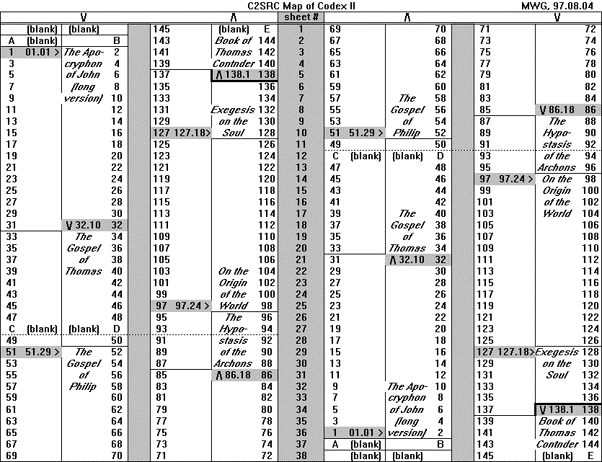
- C2SRC Maps