Justifying the Gnostic Cosmos
July 12, 2026 – 5:30 amThe massively complicated cosmogony, cosmology, and metaphysics of Gnosticism often strikes students as merely fantastical. I propose, however, that a very large part of it can be explained as an attempt to integrate a small set of not-obviously-coherent principles and presuppositions. Amongst those are the following, listed here in no particular order:
- Christ appeared on Earth and is the path to our salvation
- God has to be purely good
- The material world is flawed and hard to explain as the creation of a purely good God
- The trinitarian doctrine indicates a tripartite nature of the ultimate God
- A feminine principle is required in the nature of God
- The Middle and Late Platonists have demonstrated that
- The world has a hierarchical structure in which lower levels of reality are emanations of higher levels
- The world is the creation of an emanation (known in that role as the Demiurge.)
- All emanations ultimately originate from the Good.
- The goal of man is to know the Good
On these assumptions, the general form of an argument for the claims made by the gnostic theorists can be imagined.
- The world is a sad and inferior place, and we cannot explain why the perfect and good God would make it so poorly. Perhaps He didn’t make the world at all, but it was made by someone else, someone flawed.
- But if that one made the world, He would have to be a divine being too. So, there is at least one divine being below the real God (between Him and us,) and if the real God is the real source of all Being, then He would have to be the ultimate cause of that one too.
- That’s OK, because we already know that God has given rise to other divine beings in the form of the Holy Trinity, in which both the Holy Spirit and Christ ‘proceed’ from the Holy Father. The idea that those who proceed from the Father are equal to the Father is incomprehensible, so we think that there is going to be a hierarchy here, even if the precise nature of the hierarchy is going to be a bit mysterious.
- But anyway, none of those are going to be the World Creator, because Christ is sent to save us from this world, and the Holy Spirit only works with the Holy Father and the Holy Son. So there has to be yet another level of Being between the Trinity and us.
- Incidentally, how odd is it that the Trinity consists of two persons, both male, and a non-person? Wouldn’t it make more sense for a Holy Family to have a Holy Mother, or at least some sort of female principle? Particularly if we want to talk about the Trinity as a generative principle. It’s not as if we don’t have plenty of examples of divine family groups and divine females. Let’s suppose that the third, or rather, second person of the Trinity is the female principle, the Holy Mother, and call her Barbelo.
- Getting back on topic, this is starting to look like a cosmic hierarchy, and we already have a model of the structure of the world in terms of a hierarchy of Being in the Platonist teachings that are the best philosophical explanations that we have for the way the world works. In that view, the lower levels are emanations of the higher levels and the highest level of all is the Good, which looks a lot like God. In that view too, the material world is a wretched thing that we need to get away from somehow. And they confirm our deductions in saying that the world is not the product of the perfect One but of an inferior Demiurge.
- Let’s suppose then that the divine realm consists of a collection of emanations from God. The Trinity might be a special case in which they aren’t quite separated somehow, but the others can be fully autonomous divine beings. The Platonic emanations are the Forms of various things all subordinate to the Good (somehow,) so the emanations from God – call them Aeons – can be analogous hypostatizations of divine attributes, like wisdom, eternality, immeasurability, and so on. This divine realm is the ‘Entirety’ of the world (the Pleroma)
- One of these Aeons has to be responsible for the flawed world that we see. Which one of the hypostatized divine attributes might act in such a way as could explain this flawed creation? It is proposed that Sophia ‘Wisdom’ is the one who is responsible. She, following her nature, sought to understand the Pleroma, but she was unable to fully comprehend it because it is only for the One to fully grasp it. But in her failure, the faulty thoughts that she had gave rise to a world, this material world, as a distorted version of the Pleroma – for creation by the divine is really just thinking a thing to be.
- But if this were the case, then Sophia would be the real creator of this world, and She would be the God responsible. She would be the God who claimed that She was jealous and that there was no God but Herself. This can’t be right, because there’s no reason for Sophia to be a wicked, arrogant liar in that way, She is still, after all, a divine attribute. There must be a further step to be taken.
- It is further proposed, then, that Sophia, in her failure, emanates not the world directly, but a being who, although divine, is, as a consequence of her faulty comprehension of the Pleroma, flawed, ignorant, and arrogant. He is called Ialdabaoth, and He then creates the world that we inhabit because He is a very hypostatization of a misunderstanding of the Pleroma and has both creative desire and fatal incompetence.
- The world that He emanates is the standard world of concentric zones corresponding to the planets, the Earth, and perhaps some underworld areas, all ruled over by dedicated spirits Archons) and containing all sorts of living beings.
- Now, we humans are also created by this Ialdaboth so we partake of this incompetent performance, and we are trapped here in this disastrous attempt at a world. What are we to do? How are we to be saved? We have two clues to the answer to this problem. In the first place we know that Christ came to save us. In the second place, we have the example of the Platonists (who have investigated the hierarchical nature of the universe) to tell us that the way to escape from the illusions and evils of this world is to come to know the truths of the higher worlds of purer Forms and more authentic Being.
- Those two clues tell us that Christ has come down from the Pleroma to guide us to truths about the higher realms that will allow us to escape this sorry world.
- But how can we escape this world when we are completely and utterly part of it, created along with the rest of it by Ialdabaoth in his great error? Clearly, there must be some part of us that is able to separate from this material world; a divine part. Again, we find support in the Platonic philosophers who tell us that the soul of man is indeed of a higher nature and only temporarily estranged from the world of Forms to which it must return.
- A natural supposition is that, somehow, Sophia is at the root of this possibility: it cannot be Ialdabaoth, and the other Aeons are not involved. Perhaps she gave off divine sparks of herself in her retreat, and they have found housing in material bodies in this world.
And so, we find ourselves with something like these structures:
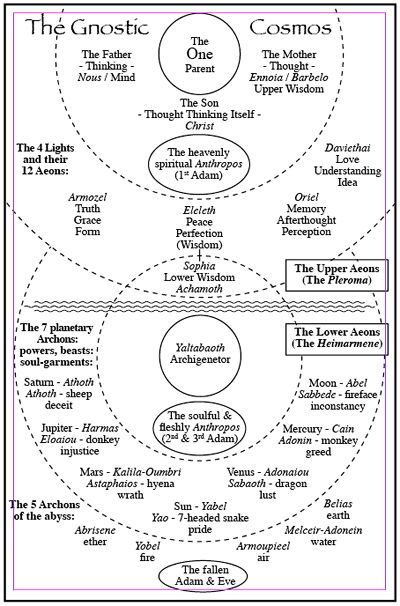
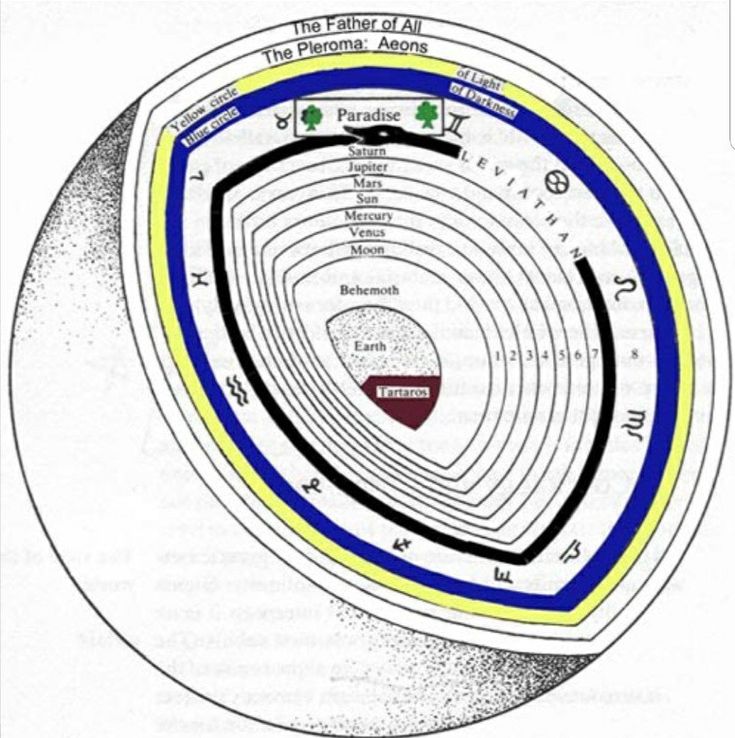
Note, of course, that this is just one possible chain of reasoning leading to one possible (Sethian) Gnostic-style cosmos. For various reasons, it might well have gone otherwise: where the solution to a problem is achieved through a hypothesized inference to the best explanation other choices could have been made leading to other solutions; where other problems occurred to the theorist solutions to those might have led in different directions; and where different presuppositions were present those might also have justified different outcomes. The point is, that the entire, seemingly absurd elaboration can be rationally motivated. Gnosticism is a serious position.
Tags:
1 Trackback(s)