Vowel Movements
October 31, 2014 – 9:40 pm
Proto-Indo-European Origins
It is proposed that Proto-Indo-European had a single original vowel timbre: e (though I’ve also seen original e and o claimed – by G. Bourcier, for example, in History of the English Language, (Stanley Thornes:Cheltenham, UK:1981, pp. 30ff.)
The three proposed basic vowel timbres of the reconstructed system are then supposed to have been produced by the action of the three proposed laryngeals of PIE (see this post) upon that original vowel; thus:
γ+e / e+γ → e / ê
χ+e / e+χ: → a / â
h+e / e+h: → o / ô
[Note that the three proposed laryngeals are of unknown pronunciation and these characters are merely placeholders. That being the case, how is it argued that the pronunciation of these sounds had the claimed differential effects? A mystery.
Note also that the circumflex is in place of the macron to indicate vowel lengthening]
In addition, the vowels i and u were produced by the glides j and w in their role as vowels;
and there is also supposed to have been a syllabic laryngeal pronounced as ə.
Given these developments, as far as I’ve been able to make out, the standard reconstruction of the vowel system of Proto-Indo-European is as follows:
| front | near-front | central | near-back | back | |
| close | i/î | û/u | |||
| near-close | |||||
| close-mid | |||||
| mid | ə | ||||
| open-mid | e/ê | ô/o | |||
| near-open | |||||
| open | a/â |
[Note that the sound of ‘a’ is (in IPA) [ɑ]. Which is another mystery, since LJ Brinton & LK Arnovick in The English Language: A Linguistic History (Oxford:OUP:2006) pp. 111, 139 indicate that it is central, but ɑ is used for the back at that height.]
[The note of uncertainty above is because there are alternative reconstructions whose merits I am not qualified to assess, and the various presentations even of the standard version are not exactly user-friendly, so that I can’t be sure that I’m interpreting them correctly. (Still, this will be accurate enough for my purposes.)]
To continue: the (now) three vowels combined with the two glides (w, and j) to produce a system of diphthongs:
| j | w | |
| e | ei | ew |
| o | oi | ow |
| a | ai | au |
which have also their lengthened counterparts.
Proto-Indo-European to Primitive Germanic
The changes to the vowels are as follows:
| PIE | i | e | ū | a, o, ə | ō, ā | ī, ei | ē | ? | eu | u* | a* |
| PG | i | e | ū | a | ō | ī | æ | ē | iu | o, u | ā |
* In some contexts.
Which may also be displayed as:
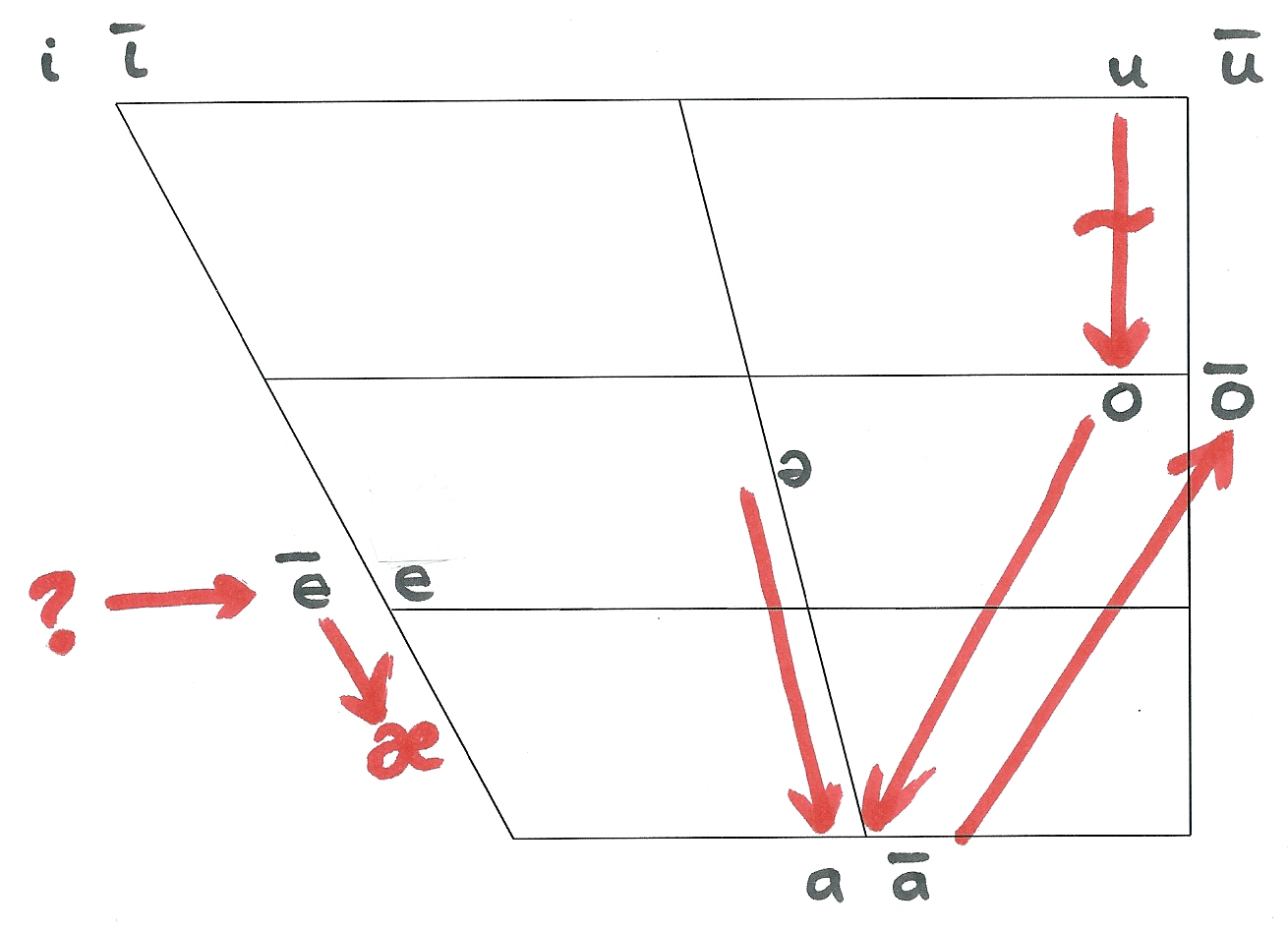
|
Which results in the following vowel system:
| front | near-front | central | near-back | back | |
| close | i/ī | u/ū | |||
| near-close | |||||
| close-mid | |||||
| mid | |||||
| open-mid | e/ē | o/ō | |||
| near-open | æ | ||||
| open | a/ā |
with the following diphthongs (and their long versions:
| au | ai | iu |
Primitive Germanic to Old English
There are two major processes; both named by Jacob Grimm.
- Umlaut
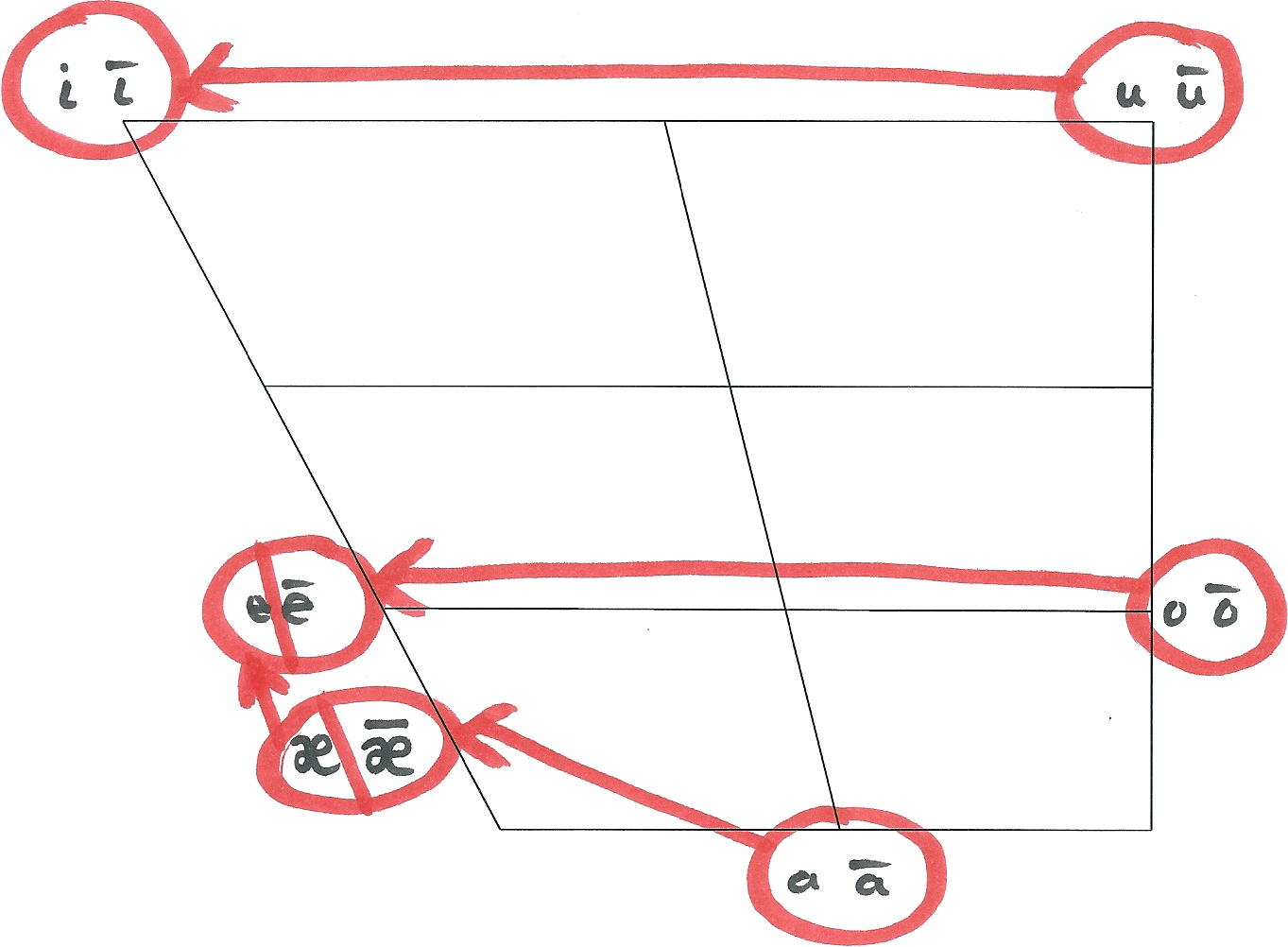
[Note that the ‘i’ above should actually be the rounded ‘y’ sound.]
- Breaking
Operates on the short and long sounds thus:
PG OE (IPA) Example (short) Example (long) æ ea (æə) *hærd → heard ‘hard’ *næh → nēah ‘near’ e eo (ɛə/ēə) *fehu → feoh ‘cattle’ *lēht → lēoht ‘light’ i io (iə) *tihhian → tiohhian ‘to consider’ *betwīh → betwīoh ‘betwixt’ The changes only occur when the vowels precede a liquid+other consonant or h+another consonant, and not always even then..
And these changes together with several other modifications apparently result in the OE vowel system describable as follows:
| front | near-front | central | near-back | back | |
| close | ī, ý | ū | |||
| near-close | i, y | u | |||
| close-mid | ē | ō | |||
| mid | |||||
| open-mid | e | o | |||
| near-open | æ, æ’ | ||||
| open | a, ā |
[Note that the table entries are the OE letters not the IPA symbols. Length is shown by a macron or a following single quote (if I can’t find the appropriate unicode) and roundedness is indicated by underlining.]
Together with the diphthong system shown here:
| PG | ɑi | ɑu | iu | ||
| OE | ɑ’ | æ’ə | ēə | æə | ɛə |
Old English to Middle English
We observe the following pure vowel movements:
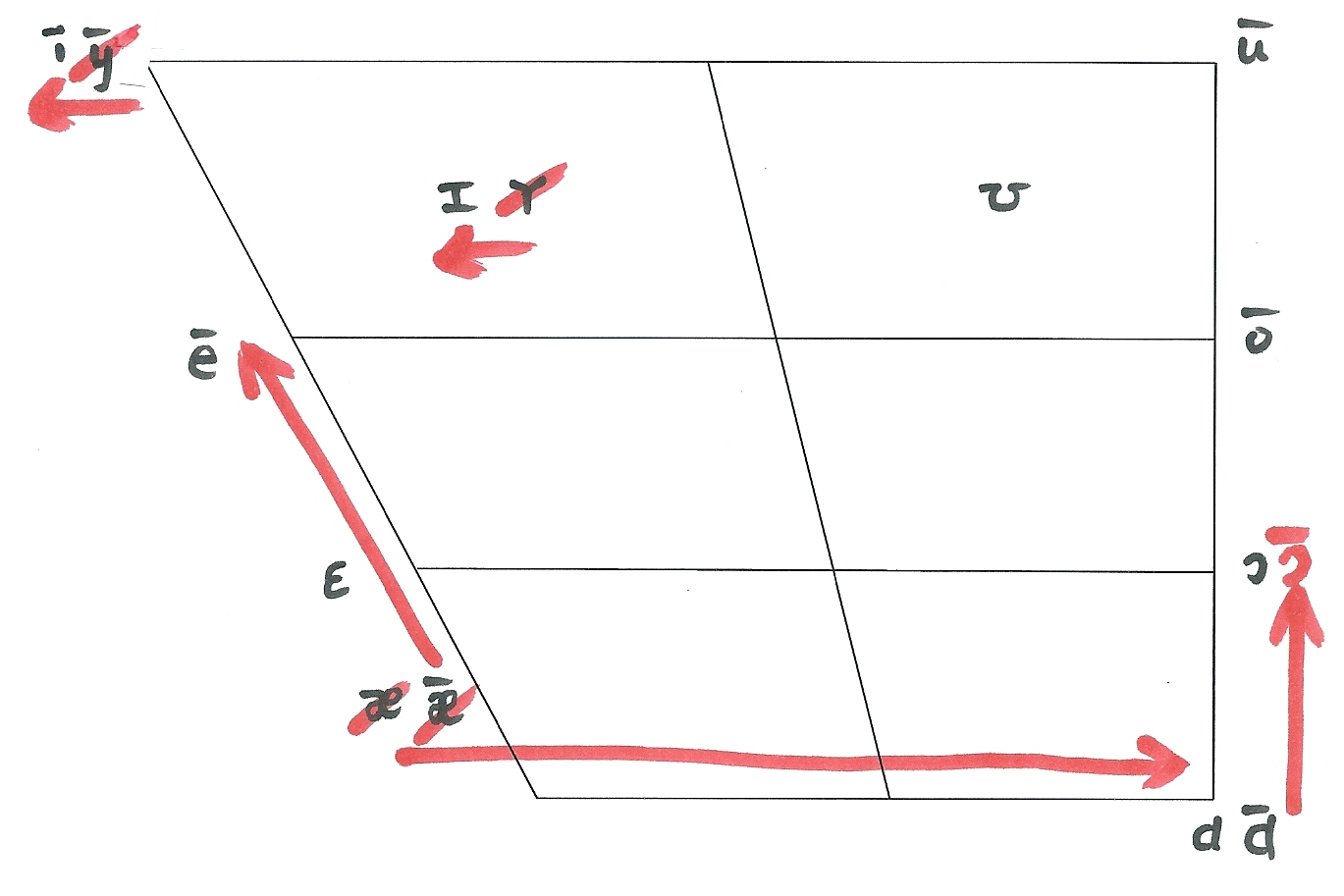
|
The OE diphthongs monophthongized:
| OE | æ’ə | ēə | æə | ɛə |
| ME | ɛ’ | ē | ɑ | ɛ |
(Which, note, added a long ɛ to the ME vowel repertoire)
And new diphthongs appeared
| IPA symbol | æɪ | aʊ | ɛʊ | ɪʊ | ɔʊ | ɔɪ | ʊɪ |
| ME spelling | ai, ay,ei,ey | au, aw | eu, ew | eu, ew | ow, ou | oi, oy | oi, oy |
Explanations have been offered for the appearance of these new diphthongs. I take these from Brinton & Arnovic, op. cit. p. 256.
- Borrowing of [ɔɪ] and [ʊɪ] from French.
- Vocalization of [w] to [ʊ] after [ɑ], [ō], [ē], and [ī] to produce [aʊ], [ɔʊ], [ɛʊ], and [ɪʊ]
- Vocalization of [j] to [ɪ] after ME front vowels to produce [æɪ]
- Vocalization of [ɣ] to [ʊ] after ME back vowels to produce [aʊ] and [ɔʊ]
- Development of glide [ɪ] before [χ] after ME front vowels to produce [æɪ]
- Development of glide [ʊ] before [χ] after ME back vowels to produce [aʊ] and [ɔʊ]